Tuesday, December 7, 2010

Cinemanila 2010: Hope for a Red Eagle sequel

The 12th annual Cinemanila International Film Festival wrapped up on Sunday, with Wisit Sasanatieng's The Red Eagle among the line-up.

Insee Dang himself, Ananda Everingham, was in attendance, and did a Q&A after the screening. According to Twitter, he said:

"If Wisit makes nice with Five Star, then the sequel will film in 2011." He also shared that Sahamongkol is interested in sequel.

So maybe there will be The Red Eagle: War of the Deadly Psychobots. I guess I still have a slim hope.

Ananda also took time out to talk to the press, talking about Filipino films and the possibility of his planned collaboration with Adolf Alex Jr. on a Spratlys Islands drama, Kalayaan.

Cinemanila opened this year with the Taiwanese comedy Pinoy Sunday and closed with John Sayles' Philippine-American war movie Amigo – two foreign films featuring Filipino actors and telling Filipino stories.

Suffering budget problems, the festival ran just five days this year, and come together at the last minute, according to Film Business Asia.

At the opening ceremony, the festival's founding director, Amable "Tikoy" Aguiluz, stated that "Cinemanila is like Philippine cinema, always in crisis mode, always in trouble, but somehow, someway, always pulling through".

Screening fees are blamed for being the biggest drain on the budget. Read the Film Business Asia article for more on that.

(Photo via Hammered Thor)

Luang Prabang Film Festival 2010: Festival notes


I was invited to attend the opening weekend of the Luang Prabang Film Festival, which is screening 23 Southeast Asian films until Saturday.

The fest got me a deal on a Lao Airlines flight (one of the sponsors) and put me up at a My Lao Home guesthouse (another sponsor). So many thanks to the director, Gabriel Kuperman, for inviting me and putting on what hopefully will be an annual event.

I wrote up a story about it for The Nation, and it's in the paper today. Here's a snip:

The fest, the first-ever in Laos’ Unesco World Heritage city, flickered to life over the weekend, showing films from neighbouring nations in the hopes of getting Laotian people interested in making movies.

In fact, they already are. The opener on Saturday night was an exuberant compilation of 15 one-minute films made by children in Luang Prabang. They played to an audience of 1,000 that filled the 800 seats in the City Market Square and spilled out around the edges. Passersby would pause on their way to the walking-street night market.

The Oneminute Junior programme, put together by Unicef and various other cultural organisations, was under the theme of “Daily Life in Dreams”. The short subjects ranged from a public-service message about wearing motorcycle helmets to mini-profiles of artisans.

One of the most entertaining was Be Careful!, an animation of an aeroplane, similar to the tiny twin-propeller aircraft that buzzed past the open-air festival venue on take-offs and landings at the city’s international airport. The crayon drawings of the plane flying through a thunderstorm in the mountains were moved by hand in front of the camera while the noise of the aeroplane and storm were imitated by vocal sound-effects that had the audience in stitches.

Made just last month in a Luang Prabang workshop, it was the first time many of the children had ever held a video camera, says Kuperman, who’s been in Laos since 2008.

Other shorts gave voice to the children’s dreams, of becoming a teacher or owning a computer shop. Maybe now, some of the children will dream to be filmmakers.

I think the short films were my favorite of the festival, and would recommend the package to other festival programmers. It's not every day you see a film from Laos.

I'd seen most of the other films already.

The opening feature was the Irish documentary Today is Better Than Two Tomorrows, which was filmed in Laos by director Anna Rodgers. Beautifully shot and interspersed with philosophical quotations, it's an intimate portrait of two boys who seem destined to live the same hand-to-mouth existence as subsistence farmers as their parents. An uncle convinces the families to send the boys to Luang Prabang. One enters the monkhood, where he'll spend 10 years in meditation and getting an education. The other attends a school. I was grateful for the scenes that showed the temples and monastic life around Luang Prabang. Because I was on a working weekend, and concerned with covering the festival, I didn't take much time out for touristy things like visiting the temples.

On the van ride from the airport, I ran into Stirling Silliphant, who I became acquainted with years ago when he was living in Bangkok and playing in a co-worker's rock band, the Eastbound Downers. Stirling, son of the famous screenwriter, was there representing the Vietnam-based Indochina Film Arts Foundation, one of the festival's "gold sponsors".

I also met Blaine Johnson, who was providing technical support for Open Air Cinema, an American company that specializes in inflatable movie screens for outdoor screenings. While the once-popular outdoor cinema screenings are becoming thing of the past in Thailand, Blaine says they are all the rage in the U.S., where park districts put on shows. For the Luang Prabang fest, Jay had a conventional fixed screen, 20 feet by 11.5 feet, which was a bit small. But that was within the small budget of the festival. A large Sony projector provided by Lao Star TV beamed the images from DVD files ripped onto a laptop.

Lao pop singer Alexandra Bounxouei was the mistress of ceremonies on opening night, providing bilingual translation of the speeches by Kuperman and the various Lao government dignitaries.

There were only a few noticeable technical difficulties. Moisture in the projector lens made a red splotch on the screen that sometimes made it look like someone's head was bleeding.

And sadly, one of the films playing this weekend that I hadn't seen, Kelvin Tong's Singaporean ghost thriller The Maid, had a problem with its file, which had apparently been ripped from VCD and send on a DVD. It was pixellated and running poorly and then gave up the ghost entirely about halfway through. I had a great time watching it with the Lao kids in the crowd, who screamed and covered their eyes to keep from being scared.

Later in the evening, for movies like Adrift from Vietnam or Karaoke from Malaysia, the audience tended to drift away, but like any festival, there's a hard-core of die-hard viewers who'll watch them all.

The Lao movies like Sabaidee Luang Prabang starring Ananda Everingham tended to attract the biggest audiences, showing there's a hunger for local movies.

Tuesday, November 30, 2010

Sahamongkol gets to monkeying around with Kapi

The tradition of coconut growers and their trained monkey coconut pickers is harvested for family friendly comedy in Kapi Ling Jor Mai Lork Jao (กะปิ ลิงจ๋อไม่หลอกจ้าว ), yet another tentpole Thai studio release set for this King's Birthday holiday weekend.

The first movie to come out of the 2007 round of the Thailand Script Project, Sahamongkol Film International picked this up, and added comedy vets Thep Po-ngam, Mum Jokmok, Kom Chuanchuen and "Tukky" Sudarat Butrprom to the cast – as if a cheeky macaque and a little boy aren't laughs enough already.

The kid Tong (Richard Ghaini) lives with his ailing uncle (Thep Pho-ngam) and mischievous pet monkey on an idyllic coconut plantation by the sea. They put up a fight against a rich developer who wants to build wind turbines.

Nitivat Cholvanichsir directs.

Kapi was picked out of the 2007 Thailand Script Project alongside E-Nang Ei (White Buffalo), about Isaan women who marry foreign men, which has been backed by the Culture Ministry’s Strong Thailand fund, and a third winning script, also in development, called Pee Kanoon, referring to the woman who hang around the outdoors at night, under jackfruit trees.

Kapi opens alongside two other Thai films this holiday weekend, the GTH sci-fi/horror comedy Cool Gel Attacks and the bare-chested historical action epic Yamada: Samurai of Ayothaya.

There's a trailer for Kapi and you can watch it here.

Apichatpong-a-rama: Uncle Boonmee coming to DVD, but see it in the cinema


Apichatpong Weerasethakul's Uncle Boonmee Who Can Recall His Past Lives has gotten its first English-friendly DVD release in South Korea. It's out of stock now, but check back later. The UK release is set for March 28, 2011. There's a page on Amazon.com too, for the U.S. DVD due out sometime next year.

But don't wait for it to come out on DVD. Uncle Boonmee is one of those films that should be experienced in the cinema, in the dark, immersive environment, on the big screen.

As Apichatpong himself would say, "film is magic".

If you don't believe me, read what critic Peter Nellhaus has to say. He caught Boonmee at the Starz Denver Film Fest:

I had made a point of seeing Uncle Boonmee theatrically while I had the opportunity. I would recommend the same to others. There are too many shots in the film that need to be seen on the big screen, the bigger, the better, to be understood.

One of the first shots is of a water buffalo, barely visible in the distance. A later shot in this first sequence of the loose water buffalo is of the animal barely visible, walking through the foliage. Throughout the film, Apichatpong uses extreme long shots so that the characters are in a sense, lost within nature. The themes of man, nature and animism are continuations explored in Tropical Malady, although it is more explicit in this film.

I love that scene.

Trouble is, despite the countless film-festival appearances and limited theatrical runs around the world, Uncle Boonmee remains relatively difficult for the average movie-goer to find. In a world where Harry Potter and the Deathly Hallows remains supreme, Uncle Boonmee is but a glimmer in the eyes of the multiplex crowds.

The Guardian Film Blog had a look at Boonmee's box-office performance in its U.K. release, in which it debuted in 14 cinemas earning £27,500. "It's not an exciting number. On the other hand, given the challenging nature of the film, it's not bad at all."

That tiny number of screens had the BBC's Mark Kermode wondering whether anybody besides critics would be able to see Uncle Boonmee, or would they just wait for the DVD?

There are lots of reviews, meaning it's been showing somewhere, and hopefully some people have gone to the actual cinema to see it:


Unsurprisingly, Uncle Boonmee Who Can Recall His Past Lives is already being tipped as one of the best films of the year, coming in at No. 2 behind The Social Network on the Sight & Sound list.

Interviews? Want interviews with Joei?

Well, there's one in The Guardian, in which he says the answer to everything is: "You don't have to understand everything."

There's also talks with Little White Lies, The Financial Times, and with Metro, in which he breaks the news to us gently:

So, we are going to die right, you and I? One day we are all going to turn to dust. But we will not disappear.

"We just integrate and transform into other things. In classical reincarnation you are reborn into another animal but I believe it’s more like an energy, what Buddhists call a transmigration of souls. The idea we connect with everything: with the sunlight, the Earth, the animals – we are all recycled. That’s what I’m interested in."

There's also a nice picture of Joei at Out.

Recent film festival appearances have included opening the Tokyo FILMex, where Apichatpong served on the fest's first-ever competition jury. It also played at the St. Louis International Film Festival, and is in the Tallinn Black Nights Film Festival, alongside Anocha Suwichakornpong's Mundane History.

It was in competition at the International Film Festival of India. In fact, the print's being in Goa delayed the screening of Boonmee at the Jakarta International Film Festival, where it's now set for one screening on December 3.

Uncle Boonmee is in Honolulu in the Southeast Asia on Screen series, alongside Who Killed Chea Vichea?, Dear Galileo, Sawasdee Bangkok, Agrarian Utopia, Woman on Fire Looks for Water, Rainbow Troops, In the House of Straw, 15 Malaysia, Talentime, The Forbidden Door and Same Same But Different.

It's in Montreal.

And it's opening in Spain, hence the gorgeous poster of the Catfish Princess at the top of this post. Cineasia has an interview.

(Thanks Logboy!)

Monday, November 29, 2010

From 6 to 6, Aditya Assarat's short film for the King

The Film Festival in Commemoration of the Celebration on the Auspicious Occasion of His Majesty the King's 83rd Birthday Anniversary begins today at SF World Cinema at CentralWorld in Bangkok.

Commissioned by the Office of Contemporary Art and Culture,
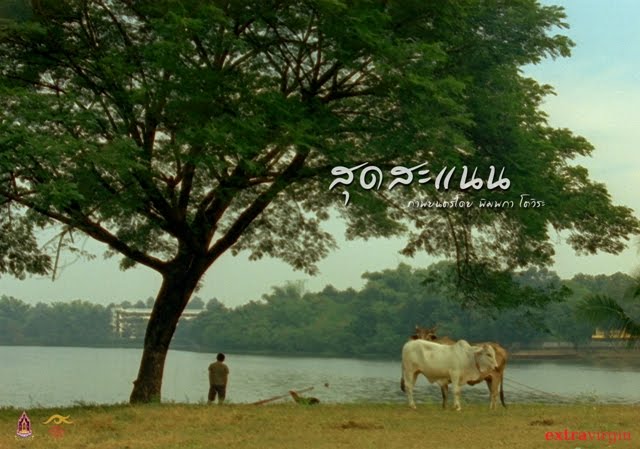
Ministry of Culture, the shorts are Six to Six (เพลงชาติไทย, Pleng Chat Thai) by Aditya Assarat, Terribly Happy (สุดสะแนน, Sudsanan) by Pimpaka Towira, Superstitious (เกษตร ...ตะกอน) by Nonzee Nimibutr and The Greatest Love (รักที่ยิ่งใหญ่) by Sirisak Koshpasharin and Pranpaporn Srisumanant.

Here's more about Aditya's Six to Six:

One afternoon, Kaen, Noi, and Pa Nit, employees of an old apartment building, are cleaning the master’s room on the top floor. They eat lunch, chat about this and that, and enjoy the cool breeze from the canal. At six o’clock they wait for the national anthem to mark the passing of another peaceful day in the kingdom.

Director’s Statement

I’m just a normal person. I’ve never met the King, never even seen him, except on TV. I suspect most Thai people are like me. So I wanted to make a film from the perspective of the small people living in this kingdom. As a man we may not know His Majesty, but as a symbol, his presence is felt all around us, like the warm sunlight or the cool breeze of an afternoon, a constant amid the conflicts currently afflicting our nation.


Three of the shorts are from Silpathorn Award laureates – Nonzee, Pimpaka and Aditya. The award is a prestigious contemporary arts honor, given by the OCAC.

There's also a trailer for Pimpaka's Terribly Happy.

The Greatest Love, a melodrama extolling the virtues of His Majesty's "sufficiency economy" theories, is screened in 3D as well as 2D. The 3D version screens by itself at 10.30 daily until Friday. The 2D version is screened with the other three shorts.

There are also two feature films, So the short films aren't screening in all sessions. There's also The Ultimate Dream (ปิดทองหลังพระ ตอน ความฝันอันสูงสุด), about military heroes, starring Maj-Colonel Wanchana Sawatdee (Naresuan) and Sornram Theppituk, and 9 Mahasan-Ong-Rachan-Palang-Pan-Din (๙ มหัศจรรย์ องค์ราชัน พลังแผ่นดิน), which is a compilation of segments about nine miracles.

The screenings are at SFW CentralWorld. Free tickets are at a table in the lobby. You can also check this spreadsheet for the schedule.

The Red Eagle, Camellia at Cinemanila

The 12th annual Cinemanila International Film Festival is running just five days this year, from December 1 to 5, but there's a killer of around 100 movies that includes Wisit Sasarantieng's The Red Eagle and Iron Pussy: A Kimchi Affair, which is part of the Camellia Pan-Asian trilogy of Busan-set romances.

The Red Eagle is part of the World Cinema program that also includes Ekachai Uekrongtham's Singporean romantic comedy The Wedding Game, as well as such films as Scott Pilgrim vs. the World, Reign of Assassins and A Prophet.

Camellia, also featuring segments by Joon-Hwan Jang and Isao Yukisada, is part of the Mabuay, Mr. Kim!: Focus on Korean Cinema, in tribute to the Pusan International Film Festival's retiring director, Kim Dong-ho. The program also includes such films as Thirst by Park Chan-wook, Bong Joon-ho's Mother and Im Sang-soo's The Housemaid

There's a SEA Cinema line-up that comprises Ang Damgo ni Eleuteria by Remton Siega Zuasola and Halaw Sheron Dayoc from the Philippines, Red Dragonflies by Liao Jiekai from Singapore, Sunday Morning in Victoria Park by Lola Amaria from Indonesia and The Tiger Factory by Woo Ming Jin Year Without A Summer by Tan Chui Mui from Malaysia.

In observance of 20 years of the Network for the Promotion of Asian Cinema, NETPAC Award-winning films to be screened are Animal Town by Kyu-hwan Jeon (South Korea), Au Revoir, Taipei by Arvin Chen (Taiwan), Divine Intervention by Elia Suleiman (Palestine), Floating Lives by Nguyen Panh Quang Binh (Vietnam) and Kaleldo by Brillante Mendoza and Pila Balde by Jeffrey Jeturian (Philippines).

The fest opens with the Taiwanese comedy about Filipino migrant workers Pinoy Sunday by Wing Ding Ho and closes with Amigo, veteran U.S. indie director John Sayles' look at the Philippine-American war of 1800-1902.

Thursday, November 25, 2010

Insects in the Backyard still bad for morality

Censors crossed out the words "public order" on the official form stating their decision on Wednesday to uphold the ban on Tanwarin Sukkhapisit's sexually and emotionally charged debut feature Insects in the Backyard.

"Do not allow projection," says the form, which you can see at Matichon Online.

Now the authorities rule that the film's content is merely "contrary to morality” but apparently isn't harmful to public order.

They softened their stance somewhat since their initial decision two weeks ago. But the movie is still banned.

"I feel upset my film is still banned," the director is quoted as saying on The Nation website.

While remaining adamant that none of the film's strong depictions of sexual acts be cut, Tanwarin hoped to gain favor with the censors by adding a disclaimer, stating that film is a work of fiction, is not meant to resemble any actual events and that common sense should be used while watching it.

Never mind that Tanwarin herself had stated the film is unsuitable for viewers under the age of 20, making Insects in the Backyard appropriate for Thailand's restrictive 20- motion-picture rating.

The gay transvestite filmmaker, who also stars in the film, hasn't given up hope of being able to screen the family social drama, and has taken the next step of appealing to the Culture Ministry's National Film Board and obtaining the endorsement of the Thai Film Director Association, which is headed by Songyos Sugmakanan, the youthful director of the GTH films Dorm, Hormones and Fan Chan. A new ruling on this third appeal is expected in about a month.

Tanwarin is hoping to release Insects in the Backyard for a limited commercial run in one Bangkok cinema as part of Bioscope magazine’s Indy Spirit Project, which earlier this year supported the successful limited-run screenings of Apichatpong Weerasethakul's Palme d'Or winner Uncle Boonmee Who Can Recall His Past Lives at SF cinemas.

Insects in the Backyard premiered in the Dragons and Tigers Competition at the Vancouver International Film Festival and at last month’s World Film Festival of Bangkok.

Meanwhile, there is lots of support for Tanwarin, a veteran director and star of many acclaimed short films and a respected figure in the industry and indie circles.

There's a petition as well as a "We're Insects in the Backyard" avatar, suitable for use on your Facebook or Twitter profile.

Commentator Pravit Rojanaphruk wrote a column in The Nation that was also picked up by Prachatai, blasting the Thai government's "nanny state" mentality.

Never mind that the film might carry a message, or can be interpreted according to the viewer’s discretion. To the board, each and every Thai "not just those below 20" is so immature and vulnerable that they will be seriously corrupted if they watched this film.

Censorship, be it political or otherwise, lies in the hands of a few people who claim to know what’s best for the rest of us.

Four short films for HM the King's 83rd birthday


Three Silpathorn Award laureates are among the directors of four short films will screen at Bangkok's SF World Cinema at CentralWorld next week in a Film Festival in Commemoration of the Celebration on the Auspicious Occasion of His Majesty the King's 83rd Birthday Anniversary.

The films are:
  • Terribly Happy (สุดสะแนน, Sudsanan), directed by Pimpaka Towira
  • Superstitious (เกษตร ...ตะกอน), directed by Nonzee Nimibutr
  • Six to Six, (เพลงชาติไทย, Pleng Chat Thai) by Aditya Assarat
  • The Greatest Love, (รักที่ยิ่งใหญ่) by Sirisak Koshpasharin and Pranpaporn Srisumanant

Nonzee, Pimpaka and Aditya were given the Silpathorn Award in 2008, 2009 and this year, respectively. The prestigious contemporary-arts honor is conferred by Thailand's Office of Contemporary Art and Culture of the Ministry of Culture. Those government agencies are among the organizers of the film-festival project.

In Pimpaka's Terribly Happy, a young soldier stationed in southern Thailand takes his leave to return to his hometown in Udon Thani in the Northeast and finds that his girlfriend has a Westerner for a lover. He's angry as first, but learns forgiveness.

An e-mail from Pimpaka's production company Extra Virgin explains further:

Loosely translated as "terribly happy", Sudsanan is an Isaan expression meaning the state where all the sorrows and miseries end, leaving only the feeling of blissful happiness. Similarly, the main idea behinds this film is that human sufferings can be healed by learning how to give.

In a situation of severe conflict, we always think that there has to be a winner and loser. But the reality is that there is never a real winner. Any battle, big or small, always has a cause in greed, ego and self-centeredness.

The filmmaker is inspired by the speech of His Majesty the King on Compassion, which is one of the Ten Royal Virtues. The filmmaker hopes that this film will help bringing about the importance of compassion and generosity in our society on all levels, no matter what social status or language.


Aditya's Six to Six was completed very quickly, and in fact was only shot earlier this month! The Pop Pictures blog explains how they did it:

If anyone is interested in making a fast film, here is some advice:

1. Few Characters: save time on casting and rehearsals. Not many people know this, but the thing that takes the most time on set is when an actor can’t do the scene. For this film, we worked with three actors, all of whom we’ve worked with in the past.

2. Few Locations: save time on location scouting and traveling during shooting. In the middle of Bangkok, having to move locations from one place to another within one shooting day, is a killer. Shoot in one place, it gets rid of the problem.

3. No Music: nobody really thinks about this when they’re writing a script. But having to hire a composer not only costs money but takes time because they generally can’t start until the editing is complete. No music, no composer.

The Greatest Love,
a melodrama extolling the virtues of His Majesty's "sufficiency economy" theories, is screened in 3D as well as 2D. The 3D version screens by itself at 10.30 daily until Friday. The 2D version is screened with the other three shorts.

There are also two feature films, So the short films aren't screening in all sessions. There's also The Ultimate Dream (ปิดทองหลังพระ ตอน ความฝันอันสูงสุด), about military and police heroes, starring Maj-Colonel Wanchana Sawatdee (Naresuan) and Sornram Teppitak, and 9 Mahasan-Ong-Rachan-Palang-Pan-Din (๙ มหัศจรรย์ องค์ราชัน พลังแผ่นดิน), which is a compilation of segments about nine "miracle" concepts.

The screenings are at SFW CentralWorld. Free tickets are at a table in the lobby. You can also check this spreadsheet for the schedule.

Wednesday, November 24, 2010

Jakarta International Film Festival lives, has Uncle Boonmee, S-Express shorts

The 12th Jakarta International Film Festival begins this week, but almost wasn't held this year because organizers couldn't find the money. They put out a public appeal for donations and got a major boost in sponsorship from Nokia, which agreed to "present" the festival.

The program provides an idea of what this year's Bangkok International Film Festival might have been like, had it actually been held and not fallen by the wayside due to Thailand's political problems and violence this year.

Jiffest's selection includes many marquee titles, opening with Waiting for Superman, the education documentary by An Inconvenient Truth director Davis Guggenheim. The closer is Biutiful, Alejandro González Iñárritu's drama starring Javier Bardem.

The heart of the festival though, is a big helping of local films making their premieres, documentaries and the Indonesian Feature Film competition. Film Business Asia has a rundown on those.

There's also a strong slate of Southeast Asian programming, which includes Apichatpong Weerasethakul's Cannes winner, Uncle Boonmee Who Can Recall His Past Lives. It's playing in the View from the SEA selection.

And there are the S-Express shorts packages from Indonesia, Malayasia, the Philippines, Singapore, Thailand and "Chinese" filmmakers.

You can download the schedule PDF at the festival website. Jiffest runs from November 25 to December 5.

Update: Uncle Boonmee's November 26 screening at Jiffest was canceled because the print was still at the International Film Festival of India in Goa. Jiffest now aims to show Boonmee on December 3 to what's sure to be a packed audience.

Tuesday, November 23, 2010

Mundane History wins NETPAC Award at Taipei Golden Horse fest


Anocha Suwichakornpong's social drama Mundane History (เจ้านกกระจอก, Jao Nok Krajok) won the NETPAC Award at the recent Taipei Golden Horse Film Festival.

The jury from the Network for the Promotion of Asian Cinema said it gave the award "for the director’s vision in crafting such a beautifully layered and delicate film that movingly captures the co-relation of all things and the essence of what cannot be explained."

Mundane History played in the Golden Horse fest's "When You Are a Stranger" line-up in the The Battle for Life section.

The fest closed last Thursday with Apichatpong Weerasethakul's Uncle Boonmee Who Can Recall His Past Lives. A retrospective tribute to Apichatpong was also held, screening all of his features.

The full list of Golden Horse winners is at the festival website.

The Taipei win for Mundane History adds to awards already received in Mumbai, Wroclaw, Transylvania and Rotterdam.

The film is now playing out of competition at the Festival of 3 Continents in Nantes, France. It was the Nantes fest's Produire au Sud workshop at the World Film Festival of Bangkok back in 2006 that helped give Mundane History its start.

(Via Screen Daily)