Friday, March 18, 2005

Storm of Thai horror

Three horror films are out or are upcoming in Thai cinemas:

  • The Necromancer - an occult thriller about feuding wizards.
  • Rahtree Returns - a sequel to the comedy horror, Buppha Rahtree.
  • The Eye 10 - Another in the Eye series by the Pang Bros, looking at 10 different ways people can see ghosts.

The Necromancer is out now. I wasn't too intrigued by the previews, so I haven't seen it. The Bangkok Post's Kong Rithdee has seen it, however, and he writes that it is "nothing more than blood-soaked bedlam, a schlock horro tableau that picthes two warlocks against each other in a senseless battle cheered on by other warlocks." Chatchai Plenpanich stars as an escaped convict with a tatoo that renders him invulernable to knives, bullets, missles, etc. Puttichai Amatyakul is a cop who hopes to remove the tattoo. Here's more about Necromancer at The Nation.

Next up is Rahtree Returns, Yuthlert Sippapak's sequel his Buppha Rahtree or Rahtree: Flower of the Night. Apartment 609 is still haunted by the ghost of a spurned young woman (Chermarn "Ploy" Boonyasak). And this causes problems for a bumbling gang of bank robbers whose loot has somehow found its way to that room. Yuthert, who did Sai Lor Fah (Pattaya Maniac) and Killer Tattoo is up to his usual tricks of putting a cast of comedians, including Somchai Saktikul (who apparently as agreed to star in every single Thai comedy film made in 2004 and 2005), Supakon Srisawat, Phan Rojanarungsri and Bunpoj Weerarat, through their paces, combining elements from the action, horror and crime genres with slapstick. Thai hearthrob Kris Srepoomseth returns as the college boy Ake. For seducing Ratree, he had both his legs amputated. He’s in for more disfigurement in this episode. Pitchanart "May" Sakhakorn (Butterfly in Grey, Sai Lor Fah) also stars.

The Eye 10, directed by Danny and Oxide Pang, is a pan-Asian venture, set in Hong Kong and Thailand. The emphasis is more on comedy than scary shivers and centers on four Hong Kong teenagers on a visit to Thailand. While staying at a friend’s house, they learn the basics of ghost watching through a book called "The 10 Encounters". Then one of them disappears and the others start seeing spooks everywhere. Stars Isabella Leong, Chen Polin, Ray MacDonald, Bongkote Kongmalai and Chen Po Lin.

(Cross-published at Rotten Tomatoes)

The Holy Man is the holiest

One of the biggest homegrown hits at the Thai box office this year is The Holy Man, which last week celebrated earnings of 80 million baht (about US$2 million) and has kept rolling, with the Bangkok Post now reporting earnings of 100 million baht. The film has done better in the provinces and suburbs, rather than central Bangkok.

Kong Rithdee has more on the funny phenomenon:

Directed by comedian Note Chernyim, The Holy Man is a low-brow, folksy flick ... starring TV funnyman Teng Terd-teung as an ex-thug turned eccentric monk with a stock of hilarious one-liners. [T]he film presents both cultural and marketing case studies that our social structure, as reflected in the movie-going habit, has become ever more complicated. And as major Thai film studios step up their campaigns of exporting local movies and going global, the jackpot scored by The Holy Man shows the glaring reality that Thai viewers may still crave the simple fun that does nothing more than tickle.

The film, which is basically a series of gags about the misadventures of Monk Teng, also prove that the Thai movie market, notoriously unpredictable, still has a place for cornball titles whose rustic appeal seems to have been inherited from the sentiments of the era of village-dwelling and outdoor cinema.

"As long as Thai people still like to eat nam phrik [shrimp paste], we believe they will continue to like this kind of low-brow comedy," says Tawatchai Panbhakdi, general manager of Phranakorn Film, which financed and distributed The Holy Man. "Some of us may develop a taste for spaghetti, but at the end of the day it's the shrimp paste we always come back to."

As it happens, taste is a great divider -- and money is a great leveler. At the rate the film's raking in revenue, The Holy Man is likely to move past the 110 million baht made by last year's box-office champion, the smart, international-flavoured ghost flick, Shutter.

Holy Man is the latest from Phranakorn Film, a small studio that started up three years ago. It had a big hit with its first film, Pee Hua Khad, or Headless Hero, barnyard slapstick about a buffalo-riding ghost looking for his severed head. It was the biggest box-office earner in 2002. Last year, Headless Hero spawned a sequel even as the first film continues to gain a cult following on the international DVD circuit. Other titles from the studio are Duk Dum Dui (about Thai comedians in Africa), Khon Pee Mah, and Pee Chong Air. Owned by Thanapol Thanarungroj, the studio is an extension of the Thana Cineplex, a theatre chain that mainly operates in Thailand's northern provinces.

Some of the company's films were flops, others generated a decent return, and it didn't bother anyone at the company that no film festivals abroad extended an invitation to these homespun pictures.

"This is a time when we cannot predict which Thai movie will make money," says Kraiwut Julaponsathorn, noted film critic and editor of the much-read Bioscope magazine. "In the case of The Holy Man, I think it's the influence of Teng, the lead actor, that successfully draws people in. And this further confirms the fact that comedians are the real stars of Thai cinema today."

Chalida Eubumrungjit, film scholar at the Thai Film Foundation, says that the film presents a strong case that Thai cinema needs middle-of-the-road movies like this one in order to iron the audience's confidence. "What we must make clear is that The Holy Man is of acceptable quality, though it doesn't come from a major studio," she says.

"The film doesn't resort to the usual hit-and-run approach -- tricking the audience to fill up the theatre in the first weekend by using heavy promotion -- and even though it didn't set any high ambitions, it does its job fairly okay. It's difficult, however, to pinpoint why this particular film has made such a lot of money while other titles in a similar vein -- low-brow, simple entertainment -- didn't perform as well. Perhaps it's the timing, but then, well, there might be many things else too."

(Cross-published at Rotten Tomatoes)

Tadanobu Asano typecast in Invisible Waves

Tadanobu Asano wants to portray a regular guy but says he just keeps getting cast as a killer, the Associated Press reported.

"I never picked the roles that have to do with killing,'' the AP quoted him as saying, citing a South China Morning Post story. "I have no idea why they picked me. Maybe I do look like those types.''

Asano played a suicidal Japanese gangster on the run in Last Life in the Universe by Thai director Pen-Ek Ratanaruang.

Asano was in Hong Kong filming Invisible Waves, the upcoming film by Pen-Ek, which he co-wrote with Last Life writer Prabda Yoon. As with Last Life, Pen-ek is collaborating with cinematographer Christopher Doyle.

According to the Bangkok Post, Asano plays a chef who flees Macau to Phuket on a cruise ship after killing his mafia boss's wife. On board he's stalked by a hitman (Eric Tsang from Infernal Affairs) and hooks up with a Korean-Thai woman (Gang Hye Yang from Old Boy).

Invisible Waves is co-financed by Dutch, Thai, Korean, Hong Kong and Italian investors and has already been pre-sold to many countries including the US, France and Russia as well as the Scandinavian nations. In Thailand, the film's distribution rights will go to Five Star Entertainment. Locations also include Macau and Bangkok. The film is expected to premiere in early 2006.

In the AP article, the 31-year-old Asano was quoted as saying he just wants to play "ordinary people who have peaceful and uncomplicated lives.''

He is perhaps better known for his role in Ichii the Killer as a sadistic killer with a pain and disfigurement fetish. More recently, he portrayed an assassin for hire in Takeshi Kitano's historical martial arts comedy-drama Zatoichi.

He also stars in the 2003 romantic drama, Cafe Lumiere. The homage to Ozu is playing soon at Bangkok's Lido cinema. Not sure if he kills anyone in that movie, though from the previews he does appear slightly unhinged.

(Cross-published at Rotten Tomatoes)

Wednesday, March 9, 2005

Play It Again, Siam

The Village Voice's Dennis Lim follows up on the 2005 Bangkok International Film Festival:
As hospitable and confounding as the city itself, the Bangkok Film Festival is, like so much else in Thailand, inseparable from tourism. Run by the country's tourism authority and programmed by a Los Angeles-based firm, this ever morphing event—which unspooled in a scaled-back, post-tsunami edition in January—seeks out a middle ground between domestic showcase and glamour importer. Hence the need to balance a retro of late local pioneer Vichit Kounavudhi with a career achievement award for Joel Schumacher ("known to some as 'the God of filmmaking'," the catalog proclaimed, without attribution).

Even to a casual observer, the festival seemed to operate at a suspicious remove from Bangkok's film community. Kong Rithdee, a critic at the English-language Bangkok Post, kicked off his coverage with a scathing editorial that called the festival "oblivious to its context," taking issue with the absence of Thai subtitles and the exclusion of Apichatpong Weerasethakul's Tropical Malady, the first Thai film to compete—and win—at Cannes.

Still, Thai cinema was more generously represented than in previous editions, and those hoping to sample the local wares had the option of shuttling between the multiplexes in the Siam Square mall nexus or heading to the DVD stores in those very malls, where most of the same titles could be snapped up for as little as $3 apiece. From the flashy eroticism of The Sin to the relentless tear-jerking of The Letter to the slick scare tactics of The Shutter, the big picture that emerged was one of an industry looking to measure global ascendancy not by festival prizes but by international deal making. As Thanit Jitnukul, director of Bang Rajan, put it at a panel of local filmmakers: "Our movies must talk to non-Thai audiences."

Ironically, the homegrown auteurs best known to non-Thai audiences were barely in evidence—one exception being Tears of the Black Tiger director Wisit Sasanatieng, whose Citizen Dog is a crazy-chroma love story about happenstance, karma, and the urban-rural dichotomy; Bangkok-based critic and Voice contributor Chuck Stephens has a pivotal role as a tie-dyed hippie.

As for Apichatpong, who was off to the jungles to shoot a new short the week of the festival, he did turn up as the star of the most revealing movie here: the making-of doc Malady Diary, in which he oversees meetings in a Cahiers du Cinéma T-shirt, directs his actors to "act as if you're in a movie," participates in a pre-shoot prayer ceremony (presumably not to that God of filmmaking), and triumphs over mysterious financing woes. All in a year's work for a world-class artist who remains an outsider at home.

(Cross-published at Rotten Tomatoes)

Born to Fight, Overture, Baytong at Deauville

The Overture and Born to Fight are in competition at the French Asian Film Festival in Deauville.

The festival is featuring around 40 films during its four-day run.

The Overture, a historical musical melodrama, is in the general competition while Born to Fight, a gritty, nationalistic actioner from Ong-Bak stunt coordinator Panna Rittakai is competing in a special Action Asia category.

Also from Thailand will be Nonzee Nimibutr's sometimes humorous tale of Buddhist-Muslim conflict, Baytong, showing in a non-competing "Panorama" screening.

The horror trilogy, Three Extremes, featuring works by Takeshi Miike, Park Chan Wook and Fruit Chan, will also be screened.

Other films in competition include the drama Charon directed by Gen Takahashi, Lakeside Murder Case by Shinji Aoyama and a low-budget controversial horror Marebito by Takashi Shimizu (Ju-On, The Grudge).

From China there's Electric Shadows, "a heart-warming tale" by first-time female director Xiao Jiang and The World by Jia Zahngke, the Taiwanese romantic comedy Holiday Dreaming from Fun-chun Hsu and This Charming Girl, shot entirely by hand-held camera by Korean newcomer Lee Yoon-ki.

From India comes the "visually poetic" Chased by Dreams by Bengali director Buddhadeb Dasgupta.

The festival will also pay homage to Takeshi Miike, screening his films including Audition and Dead or Alive.

Takeshi Kitano also will be present with his grim historical drama, Blood and Bones.

Violence -- and laughs -- will be dispensed in screenings of Stephen Chow's Kung Fu Hustle.

Tribute will also be paid to the Indonesian actress and producer Christine Hakim.


(Cross-published at Rotten Tomatoes)

Volunteer censors?

Membership of the Film Censorship Board will be open to volunteers and the public under a proposed amendment to the Thai Film Act, according to the Bangkok Post.

The draft law was being scrutinised by the Council of the State and was expected to be approved by parliament this year. The amendment provides for setting up a screening committee to select the 19-member Film Censorship Board, which until now has been appointed by the police chief. Many of the board's members have normally been senior police officers, especially the top positions.

The new committee would be able to recruit ''suitable outsiders'' such as scholars and volunteers to the board.

Film censorship, overseen for many decades by police, was transferred to the Culture Ministry last year. The ministry has been waiting for decisions by about 200 police working at the Film Censorship Department whether they want to transfer to the new agency.

''We hope they will join us as I have heard many of them developed a passion for the job,'' Culture Ministry permanent secretary Thipawadee Meksawan told the Post.

Instead of chopping out or putting Vaseline on sexually explicit scenes, the new censorship criteria would focus on rating films, VCDs and DVDs shown or sold in the country to ensure the content was viewed by an appropriate audience.

( Cross-published at Rotten Tomatoes)

Monday, March 7, 2005

Review: Ruang Talok 69 (6ixtynin9)


  • Directed by Pen-Ek Ratanaruang
  • Starring Lalita Panyopas
  • Released in 1999, Region 1 DVD released January 11, 2005 by Palm Pictures
  • Rating: 5/5

The title refers to the main character's apartment number. She lives in apartment six, but the number is missing a nail and often flips over making it look like she's in number nine.

Set in Bangkok, with the fallout from the Asian economic crash still coming, the main character, Tum, has just lost her job, determined by drawing straws with numbers on them. Ironically, number 9 was her number. In Chinese culture, 9 is a very strong, auspicious and lucky number.

But not for Tum. And like the number on her apartment door, her life is about to go topsy turvy.

She walks home, box of office supplies in hand. She is met by a neighbor, who reminds her she is lucky to have a job. She doesn't want to get into it. "Yeah, I'm lucky," she says simply.

Waiting for the elevator, a guy tells her she's going to have to wait for a few days. The elevator is out of order. He offers to carry her box. And he knows where she lives. She's weirded out by this, but eventually allows him to carry her box.

Finally alone, Tum contemplates what to do. Fantasy sequences show her drinking household chemicals, red fluid dripping down her cheeks as she downs a bottle of toilet cleaner. Or, maybe she could blow her head off with a gunshot. Splat goes the blood against the wall.

Then there's a knock at the door. She answers it but only finds a Mama instant noodles box. She opens it. It's filled with cash, about 1 million baht.

Later, a couple of guys come to collect the box. They end up dead. From there, the movie goes on an enjoyable enough crime-thriller ride with bits of comedy to lighten things up. Thai boxing, Mafia, bumbling cops, sentimental melodrama all find their way in.

Though neither the title nor the main character have anything to do with sex, people all around Tum are obsessed with it, particularly a nosey neighbor and her friends, who talk about cutting off a guy's penis, chopping it up and making it into a spicy minced-meat dish. Also, there's Tum's friend, Jin, who is obsessed with her long-haired boyfriend.

The actress Lalita is quite striking. She is at turns androgynous or feminine, sexy or scrawny, meek or a determined survivor.

Made in 1999, this was Pen-Ek Ratanaruang's second film. In style and themes, it is more similar to his meditative Last Life in the Universe than the racous musical Monrak Transistor.

(Cross-published at Rotten Tomatoes)

Thursday, March 3, 2005

Tom Yum Goong trailer


The trailer for the Ong-Bak followup, Tom Yum Goong, is now posted at Ultimate DVD.

Meanwhile, the Ong-Bak onslaught continues in the US. Tony Jaa was recently in Philadelphia, demonstrating his martial-arts prowess. He and director Prachya Pinkaew were interviewed. Here's an excerpt:

Triangle: Do you want to eventually cross over into American films or do you want continue making Thai films with a universal appeal?

PP: We want to keep the essence of Thai when making films. We want to make films in Thailand, but have foreign investors so we can have a bigger production.

TJ: I feel the same way. I want viewers to be able to watch movies that are of quality.

Triangle: Could you tell us a little about your upcoming collaboration Tom Yum Goong?

PP: Well it's our second film with the same crew. We're almost done filming and it might be out by the end of this year. Of course you'll see Muay Thai again, but in a different light.

It speaks in terms of culture and how eloquence plays an important part in Thai culture and way of life. A lot of times foreigners see eloquence and think of Thailand and we wanted to portray that. You'll see how these things get related with other cultures as this film will be based in Australia.

You'll see a variety of different martial arts as Muay Thai will be executed with different opponents. You'll have to wait and see how different it will be.

Another Thai film is on Ultimate DVD. They have the trailer for Beautiful Boxer.

(Cross-published on Rotten Tomatoes)

Bang Rajan: The DVD

Bang Rajan is now out on DVD in the UK. It's reviewed at Monsters and Critics.

The two-disc set is heavy with extras and these are mainly on the second disc. Apart from the above mentioned audio commentary there is almost two hours of interviews come from the director (Tanit Jitnukul), producer (Adirek Wattaleela) and three of the main principles (Winai Kraibutr, Jaran Ngamdee and Bongkot Kongmalai). Most of these are in Thai with English subtitles. They are refreshing and tell of how this movie has touched them and their celebrity status back home, their humble and gracious nature is wonderful to see and it's a shame Hollywood generally does not follow this novel all too human example. A short making of which plays like an extended trailer, two trailers, a short and weird documentary on the legend itself (reincarnated water buffalo I hear you say) and the strangest of all is 'Bang Rajan Re-scored'. This short little feature is not as you may expect but it is actually Premiere Asia scoring the music for the glorious DVD menus and the UK promotional Trailer and not anything to do with the movie itself. Twelve more trailers for more of Hong Kong Legends and Premiere Asia compete this disc.

On the downside the movie footage used throughout the extras is very much the same so you do get a little tired of seeing the same clips over and over again. Perhaps if not viewing all in the one go this will seem less bothersome. The other down-note is that during the interview session with Director Tanit he mentions time and time again about how the movie had to be trimmed down to get it in under the two hour mark, it's such a shame that none of that deleted footage makes its way here. These are small quibbles on a mighty show.

(Cross-published at Rotten Tomatoes)

Tropical Malady in London: 'Never show the monster'

Tropical Malady is opening the UK, and there is a retrospective of all of Apichatpong Weerasethakul's films playing in London. He talked to the Guardian.

"It's about suffocation by happiness," explains the soft-spoken 34-year-old director. "The first part is utopian, like a memory that comes in fragments, part fabricated. Blissfully Yours is also about entering a state where you're so happy that you suffer, because later you have the burden of these happy memories that you can't get back."

Memory as a debilitating infection is the tropical malady of the title. Weerasethakul translates the film's Thai title, Sud Pralad, as "strange animal" - a jungle monster with transformative powers. The film was inspired by the adventure tales of Thai author Noi Intanon ("they're Indiana Jones kinds of stories - a hunter goes into the jungle trying to find a white buffalo or hidden treasure") and by Jacques Tourneur, director of I Walked With a Zombie and the original Cat People.

"I wanted a real old-fashioned mood of a horror film. But Tourneur never used a real monster; he would just use a shadow and a sound, and I wanted more monster. In the end, we agreed that Tourneur was right - never show the monster!"

(Cross-published at Rotten Tomatoes)

Friday, February 18, 2005

Overture over Miami

Audiences at the recent Miami Film Festival had a hard time deciding what they liked most, so The Overture took a three-way tie with audience pick for best dramatic feature prize shared with The Edukators (Germany) and Red Dust (South Africa), according to the Fort Lauderdale Sun-Sentinel.

(Cross-published at Rotten Tomatoes)

Thursday, February 17, 2005

Bangkok Critics pick Overture

The Bangkok Critics Assembly played it safe and awarded The Overture five awards, adding to the accolades already heaped upon it by the Thailand National Film Awards.

Directed by Itthisunthorn Wichailak, the prizes included Best Picture and Best Director. "I was fortunate to have such perfect cast members. Without them, the film would not have won these awards," Itthisunthorn was quoted as saying in The Nation.

Other nominees, according to the Bangkok Post, were the horror box-office topper, Shutter, the historical drama Siam Renaissance, the surreal romantic comedy Citizen Dog and the sharp-edged social critique Ai-Fak (The Judgement).

The Overture marked a successful return to the Thai film industry for Itthisunthorn, who last directed a film in 1993, Look Bah Thiao Laa Sud (The Latest Momentum of Madness), which won four awards from the Bangkok Critics Assembly including Best Film and Best Director.

The Overture also won for Best Supporting Actor, Best Score and Best Editing, almost half of the 11 awards presented by the assembly, which was established in 1990.

"I wish to dedicate this award to Khun Duangkamol Limcharoen [the respected late film producer] who should be credited for making this project possible," Nonzee Nimibutr, a veteran filmmaker who produced The Overture, was quoted as saying in The Nation.

The Best Supporting Actor award went to Pongpat Wachirabunchong, who portrayed an overbearing military officer in The Overture.

Best Actor and Best Actress awards repeated the National Film Awards - Pitisak Yaowananon won for Ai-Fak and Ann Thongprasom won for The Letter.

The Best Supporting Actress award went to Jarunee Boonlek for her portrayal of a Karen maid in the slapstick spy spoof, Jaew (M.A.I.D).

The best screenplay award went to Ai-Fak screenwriter Somkiat Wituranich, whose script is an adaptation of the Seawrite Award-winning novel Kam Pipaksaka by Chart Kobjitti.

Three other nominees wrote original screenplays: Yuthlert Sippapak for Sai Lor Fah, Wisit Sasanatieng for Citizen Dog, and Itthisunthorn Wichailuck for The Overture. Kongdej Jaturanrasamee's script for The Letter was an an adaptation of a Korean film.

According to the Post, an issue has been raised among observers about whether it's time to break down the screenplay division into original and adapted screenplay awards, to recognise the demands of the two approaches

Two technical awards, best art direction and best cinematography, went to the expensive Siam Renaissance, a revisionist historical tale about Western colonisation during the reign of King Rama V.

The Assembly also honored veteran comedian Prachuab Ruekngamdee, presenting him with a Lifetime Achievement Award. According to the Post, Prachuab is a perennial supporting actor who has appeared in nearly 100 films since the 1960s.

To the surprise of many, the Post's Kong Rithdee points out, Apichatpong Tropical Malady, an arthouse favourite that has won recognition from film festivals abroad, was not nominated in any of the categories.

The popcorn favorite, Shutter, helmed by two young directors Pakpoom Wongpoom and Banjong Pisanthanakul, missed out in all six categories in which it was nominated, but received a special mention by HBO as the biggest Thai box-office earner of 2004.

(Cross-published at Rotten Tomatoes)

Wednesday, February 16, 2005

Pen Ek's Invisible Waves

No Thai films at this year's Berlin Film Festival. However, there was some activity at a sidebar film market, reports IndieWire. Palm Pictures will release Pen-ek Ratanaruang's Invisible Waves, which is due out sometime later this year.

Produced by Fortissimo Films, along with CineAsia and Five Star, this is the followup to Last Life in the Universe. It's another collaboration with writer Prabda Yoon, will again feature the lenswork of Christopher Doyle and will have Japan's Tadanobu Asano (Last Life, Zatochi, Ichi the Killer) in the cast, with Korea's Gang Hye Jung (Old Boy) starring opposite, according to Twitch.

Not much else on what the film is about, though Pen-Ek goes on at length about the state of the Thai film industry and why he's going for a more pan-Asian flavor in this interview by Aditya Assarat:.

AA: What do you think of the present Thai film industry?

PR: Well, a lot of films are going to go bust. It's the same in every industry, film or real estate or what not.

AA: So we're in a film bubble economy?

PR: Yes. It's like real estate. The craze is pushing everything out of proportion. People are calling this the golden age of Thai film and its bullshit. A few years ago people would call me up to give me money to make films and I would ask them, "well what do you do?" and they would be like the owner of a sausage factory. And why would they want to make films? They see the big films that make money but they don't hear of the other hundred that lose money. So first I tell them well you're calling the wrong guy. Go do some research first. But I never take their money because they don't have any idea what they're getting in to. That's not business - it's just gambling. They're throwing money at one racehorse and wait to see if it hits. And I think that's very destructive for the industry as a whole.

AA: Most of our films lose money. How do we fix the system? How do we improve our industry?

PR: Easy. But like everything else in Thailand, nobody will be able to do it. If you look at our industry, every position, from directors to actors all the way down to grips and coffee boys and everybody, we only have the personnel to make 10 films a year [in 2003 Thailand produced approximately 50 feature films]. If we take these people and make just 10 films a year, they'll be of a certain quality, and maybe three or four will be outstanding. But the standard will improve, commercially and artistically. Maybe if we're really greedy, we can squeeze 20 films out of these people. And I'm not only talking about the production people - I'm talking about the marketing, sales, all those people who must understand the business of movies. I think if we can stick to 10 quality films a year that should be our goal. But like anything, the success of the film industry doesn't rely only on the producers but also the audience. We first have to build up faith in our work. We have to build faith in the audience, that they can pay money for our products and not come out of the theater disappointed. The other problem is that we don't yet know who we are. Thai films cannot figure out their own identity yet.

AA: So what path should we take?

PR: I'm not sure either. But I always say films like Mekhong Full Moon Party or Fan Chan or Monrak, these films should not be labeled as outstanding films. If we really had a healthy industry, these three films would be considered standard films. Good films but not these wonderful achievements that people make them out to be. But currently these films are singled out for praise. Why? Not because the filmmakers are any better but because they put more care and thought and discipline to the job at hand. These are the kinds of commercial films that should be our base. The Thai industry doesn't need people like me or Joe, it needs people to make quality commercial films.

AA: Yes, I think that there will always be Thai art-house films. I don't think Pen-ek or Apichatpong will disappear because they represent a distinct voice. The danger lies in our commercial side because those films are competing directly with Hollywood movies.

PR: I have a secret hope that Thai films will go back to a time when we made 10 quality films a year. Hub-Ho-Hin is a company that's making quality commercial films. Yuthlert [Sippapak (February, Buppha Rahtree)] is making quality commercial films. It's my hope that the Thai industry will have a few more of these people who know what they're doing, care about what they're doing. In the old days, in the 70s, we had a good period where people like Than Mui [Prince Chatrichalerm Yukol], Cherd Songsri, Piak Poster, Manop Udomdej, were all making interesting auteur films - similar to the 70s in America. And then it disappeared. I hope that we can get back to that kind of environment again with movies like Mekhong, Fan Chan, Monrak as our standard films.

AA: And lastly, getting back to your new film, Invisible Waves, I'm wondering how you're going to continue to explore delicate emotions within the confines of the film noir genre.

PR: Yeah, I'm wondering that too.

Invisible Waves has been tapped for "presentation" along with 27 other working titles at the upcoming Hong Kong-Asia Film Financing Forum to be held March 22-24 at the Hong Kong Convention & Exhibition Centre, according to Kung Fu Cult Cinema.

Other films vying for funding at HAF include The Coffin, by Beautiful Boxer's Ekachai Uekrongtham (produced by Pantham Thongsang) and The Tin Mine (Meung Rae), by Jira Maligool (Mekhong Full Moon Party). There's been some discussion about Jira's film on the Spotlight on Thai Cinema.

(Cross-published at Rotten Tomatoes)

Asian films at Rotterdam

The Village Voice's Dennis Lim follows up on the International Film Festival Rotterdam, which featured a slough of Southeast Asian films this year.

Keenly anticipated among trend-chasers, the Southeast Asian focus was more than a little spotty, though there's no denying the uptick in independent-minded activity in the area, on the fringes of film industries that not long ago were dormant to nonexistent. Quintessentially Rotterdamian specimens included Thai youth-culture chronicler Thunska Pansittivorakul (Happy Berry) and Filipino mondo terrorizer Khavn, whose "brown comedy" The Family That Eats Soil seemed to be a fast-forward favorite at the festival's video library. Much slicker, Filipino American two-man crew Neill Dela Llana and Ian Gamazon's brilliantly resourceful Cavite (made for little more than the cost of two plane tickets to Manila) uses a wireless, real-time ransom countdown to orchestrate a stricken tour through the slums just outside Manila.

With Thailand's Pen-ek Ratanaruang and Apichatpong Weerasethakul having graduated to art-house stars (and a next wave yet to fill the void), the regional buzz has migrated somewhat to Malaysia, home to a small, close-knit group of emerging filmmakers. James Lee (The Beautiful Washing Machine) and Ho Yu-hang (Sanctuary) practice a wry, oblique minimalism derived from Malaysian-born Taiwanese master Tsai Ming-liang. Their cohort Amir Muhammad is a wholly distinctive voice in Southeast Asian movies. Essayist, activist, and sociologist all in one, he deploys whimsical humor and sharp analysis to hack away at the contradictions and willed amnesia endemic to Malaysian culture and politics (as in his '04 Sundance entry The Big Durian). At Rotterdam, he premiered two records of trips abroad: the experimental tone poem Tokyo Magic Hour and The Year of Living Vicariously, a digressive meditation on rebellion and nationalism in the guise of a making-of doc, shot on the Jakarta set of a period biopic, against the backdrop of Indonesia's first direct presidential elections.

The Bangkok Post's Kong Rithdee recently returned and found plenty to learn from (temporary link). He points out that the focus on Southeast Asian films paints a picture that isn't exactly clear.

Rotterdam's selections, adventurous and open-minded, juxtaposed the various sensibilities of this multi-ethnic region and suggested one vibrant, happening cinema scene. For us Thais, it reminds us how little we know or care about the cinematic traditions of our neighbouring cultures _ and one can't help wondering if Bangkok, looked up to by other [Southeast Asian] nations as a leading force in the region's cinematic revival, shouldn't take up a more central role in gathering Asean filmmakers and save us all the trouble of flying to Europe to see Filipino indie flicks or Indonesian shorts.

"Our 'SEA Eyes' section was motivated by two different things, one positive and one negative,'' said Gertjan Zuilhof, a festival programmer who toured this corner of Asia last year looking for movies.

"The positive impulse came from several films by directors who're still not well-known enough [though they deserve to be], and the negative motivation is related to [the fact that] even though Rotterdam has a name to defend in the field of screening important Asian cinema, it happens that part of Asia, the tropical part, has always remained underrepresented.''

Perhaps not Thailand though. At least one Thai movie has travelled to this Dutch cinefest every year since 1999; and in the recent episode a record eight Siamese titles joined the panoply.

Leading the pack were two hot-iron pictures from last year: the brooding man-tiger meditation Tropical Malady by Apichatpong Weerasethakul, and the patriotic xylophone flick The Overture, by Itthisunthorn Wichailuck (Apichatpong's The Adventure of Iron Pussy was also picked). Meanwhile Ekachai Uekrongtham's gender-shifting Beautiful Boxer once again proved itself an irresistible crowd-pleaser, ranked 12th in the audience poll that rated 190 feature films.

But Rotterdam's reputation comes largely from its ardent support of independent movies, and two Thai indie fares of 2004 that hardly any Thais have seen secured their slots in the fest's busy schedules: Birth of the Seanema, by Sasithorn Ariyawicha, and the funky Happy Berry by Thunska Pornsittivorakul, both emblematic of made-on-the-fringe Thai movies done with petty money and progressive thinking. And beside feature films, eight short movies by young Thai directors were also selected into the festival's sidebar section.

Short films indeed constituted the majority of the SEA Eyes programme, and that reflects the common situation in all Asean countries where there's no solid structure to encourage the making of 90-minute artistic films. The mainstream film industry of, say, Malaysia or the Philippines is made up largely of sticky melodramas and homespun comedies with low standards of production. And the burgeoning, more "sophisticated" film culture of the region is brewed up henceforth by a slate of upcoming New Wave directors who scrape money up from wherever they can get their hands on it. Sure enough, they make movies that are less popular yet much more ambitious.

Following the lead of the Thai talents, the Malaysian indie filmmakers have squeezed themselves into the possible Next-Big-Thing checklist of global critics.

(Permalink)

Monday, February 14, 2005

Sun sets on Tony Jaa


Tony Jaa is continuing his tour of the US to promote Ong-Bak and was recently in the Washington-Baltimore area. He spoke to the Baltimore Sun.

One film into his career, and Thai actor Tony Jaa is being compared to Bruce Lee, Jackie Chan and Jet Li. That's heady company for an actor looking to specialize in martial-arts films, but Jaa isn't quite ready to embrace the hype.

"In terms of replacing Bruce Lee, Jackie Chan or Jet Li, I would never consider that," Jaa says through an interpreter. "They are my mentors, and my masters."

But if Jaa isn't ready to proclaim himself the new martial arts superstar, plenty of other people are. Fan Web sites have been abuzz about his film, Ong-Bak: The Thai Warrior, since it was released in Asia and Europe two years ago; at the 2003 Toronto Film Festival, audience members were so adrenalized by the movie, according to The New York Times, that they didn't want to leave the theater.

Last week, Time magazine jumped on the bandwagon, with film critic Richard Corliss proclaiming that the martial-arts genre "needs another hero, and Jaa is the fellow to fill the void."

In person, Jaa appears not menacing, but rather thoughtful and consistently self-effacing. ("To be humble and to have humility is part of being a Thai person," he says.) Dressed casually in a well-worn black leather jacket, white shirt and blue jeans, he steers the conversation away from himself and toward the discipline he loves.

Jaa sees himself not as a movie star (though he's wanted to be one since he was a kid), or even as an acknowledged expert in the martial art of Muay Thai, a combination of kung-fu and street brawling. Rather, he sees himself as an emissary for both the Thai film industry and his chosen discipline.

If Ong-Bak - in which his mission is to bring back a stolen Buddha the inhabitants of his remote village believe protects them - helps him spread the word, then he will have chosen his profession well.

"I wanted to make movies first, mainly to show people the beauty of martial arts," says Jaa, 28. "I wanted to be able to show Muay Thai as an art, not just a sport. ... To have it be successful in Thailand was my goal. To have it be successful in Asia and Europe, and now here, makes me very proud."

Born in the rural province of Surin in northeastern Thailand, Jaa (given name Phanom Yeerum) is the third of four children. His parents were subsistence farmers, raising enough food for themselves and their family. The movies offered him a chance for escape.

"I've loved the martial arts since I was a kid," he says, "and I would love to go watch martial arts movies. ... I would travel 10 kilometers just to watch a film."

At age 10, he began learning the basics of Muay Thai from his father. Over the years, he learned from various masters and attended schools around the country, perfecting his skills and heightening his resolve to spread the word.

Ong-Bak proves the worth of all those labors; Jaa's character, Ting, is a martial-arts master unlike any the screen has seen before. Though, in true martial arts tradition, he is reluctant to use his fighting skills on others, when attacked, he turns into a dervish of pent-up fury that comes pouring out in every blow, whether they come courtesy of his feet, arms, hands, legs, even elbows. One of Ting's favorite moves involves flying at one of his attackers, using his elbows and forearms to land a haymaker that would do Hulk Hogan proud.

His preparation for Ong-Bak, Jaa says matter-of-factly, took nearly eight years, during which he studied, practiced, competed and put on exhibitions.

"It was something that I had dreamt of," he says, "to get Thai people to come back to their roots and learn about Muay Thai more, to learn about it as a sport. I think I succeeded."

And yet, Jaa clearly enjoys being a movie star. He's obviously studied those who came before him; he does dead-on impersonations of their facial expressions and hand gestures when talking about his influences.

"From Bruce Lee, I get his steeliness," Jaa says. "From Jackie Chan, I get his moves, his agility. From Jet Li, I get his swiftness and grace. I combine these things with my Muay Thai skills and put them to work."

Although its makers promise no camera tricks or special effects were used to make it, some of the moves Ong-Bak preserves on film are hard to believe, as when Jaa's character runs through an alley and escapes some would-be captors by running atop their heads and shoulders. Or when, pants literally ablaze, he attacks another would-be captor.

"I was worried," he admits of the fire scene, "but it went well. I was more concentrated and focused on aiming at the target where I was supposed to hit my knee. What happened was, we were waiting for the camera to speed up, and my eyelashes got burnt. It kind of smelled."

(Cross-published at Rotten Tomatoes)

Saturday, February 12, 2005

Overture sweeps Subhannahongsa Awards


It might not win an Oscar, but The Overture is most definitely the most-loved film within Thailand.

At the local industry's Subhannahongsa Film Awards, the historical musical drama won seven trophies.

Directed by Ithisoonthorn Vichailuck, The Overture won for best picture, best director, best screenplay, best sound effects, best script and best cinematography. According to the Bangkok Post, it was nominated in all 14 categories.

Covering a period from the early 1900s to the 1940s, the film presented a view of Thai culture that the government seized upon as it was struggling to present a Thai identity to the world in the same year that a Thai film with gay theme, Tropical Malady, won a jury prize at Cannes. The Overture was also a hit with audiences, ranking third at the box office among the locally produced films. It also sparked a revival of traditional Thai classical music.

Other awards:

  • Best actor - Pidisak Yaovanaan, in Ai Fak (The Judgement). It was his debut film role and what one hell of job he did.
  • Best actress - Ann Thongprasom in The Letter, a tear-jerking remake of a Korean weeper.
  • Best supporting actor - Adul Dulyarat, a veteran of Thai stage and screen, for his role as the older Sorn in The Overture.
  • Best supporting actress - Singer Apaporn Nakhon Sawan in The Bodyguard. The No 2 Thai box office draw last year, the crime comedy was a star vehicle for Petchtai Wongkumla (aka Mum Jokmok), the comic relief in Ong-Bak.
  • Best visual effects - Rightly went to Wisit Sasanatieng's Citizen Dog (Mah Nakorn), easily the most visually stunning film of the year. Period. Credit though went to The Post Bangkok, a post-production house.

Adul Dulyarat said he was glad to win best supporting actor as it was the first acting award he had received in his long career, the Bangkok Post reported in a February 12 Society column recap of the awards. The 73-year-old actor previously won two best director awards for two TV dramas.

The Federation of National Film Associations of Thailand handed out the Lifetime Achievement Award to veteran director Cherd Songsri for his 40-year contribution to the industry. Among his films, considered classics in Thailand are Phlae Kao, Kwan Rak, Tawiphop and Kang Lan Phap. Chalie Intravichit, a veteran composer, read the citation for Cherd. The composer described a scene from the novel that inspired him to write the song Phlae Kao, which became a big hit, and added, "but someone was more capable than me -- he transformed a great novel into an impressive movie."

Cherd thanked colleagues for making his films possible.

Diagnosed with cancer, Cherd has written Kui Kab Kwam Tai, in which he reflects on his battle with the disease. The book has quickly become a best-seller.

Newcomer Pitisak Yaowananon beamed when he won best actor for his role of tragic hero in Ai-Fak.

"I was very surprised and excited to be nominated. It was something beyond my expectations -- like a dream," said the young actor. He added that he would put the golden bird statue under his pillow to make sure he wasn't simply dreaming.

Anne Thongprasom, who starred in the year's best love story, The Letter, picked up best actress award.

"At first I felt like the movie screen was not my place -- I normally appeared on the television screen. But since I have received such positive feedback from movie-goers and the media, the award makes me feel more confident and gives me encouragement to be in cinema."

The actress urged Thai people to support Thai movies. "I want all Thai people to support Thai movies. The Thai movie industry is getting better and there are many good movies out there to watch instead of international films."

More winners:
  • Best Original Score - Pongprom Sanitwong na Ayudhya for the historical serial killer thriller, Zee-Oui.
  • Best Original Song - "Mai Mee Chai Mai" by Chatchai Pongprapapan (The Letter).
  • Best Art Direction - Saksiri Chantharangi, The Siam Renaissance.
  • Best Costume Design - Theerapan Changcharoen, Toskorn Trakulpadejkrai, The Siam Renaissance.
  • Best Make Up - Adij Yiamchawee, SARS Wars.

(Cross-published at Rotten Tomatoes)

Thursday, February 10, 2005

Review: Bangkok Loco


  • Directed by Phornchai Hongrathanaphorn
  • Starring Krissida Terrance, Nountaka Warawanitchanoun, Niphon Chaisirikul
  • Released in Thailand cinemas in 2004, DVD release in February 2005 (English subtitles, Region 3)
  • Rating: 3/5

Hoping to be for Thai rock drumming what Crossroads was for bubblegum blues guitar or Purple Rain was for bubblegum funk, Bangkok Loco involves a face-off between the God Drumming School and the Demon Drumming School.

But first, the chief contestant for the God drummers (Krissida Terrance) must elude the police because he's wanted for murder.

The comedy starts off promising, showing a shift back to the early 1980s from the present day with a montage of television sets and the content on the screen.

When it reaches the '80s, the first character on the screen is Narongrit Tosa-nga, better known as Khun In from The Overture, practicing his ranad-ek. But he can't concentrate, because his next-door neighbor in the incredibly funky apartment building is rock drummer Bae, who's flailing about, drumming on his set with jazzy abandon. Suddenly, blood and gore are everywhere and he's drumming with knifes, not drumsticks.

He comes out of his musical reverie and sees the horror - the horror - of what he's done, and takes off running around the incredibly fab and funky neighborhood while the opening credits are shown in various forms - on license plates, on signs, on the name tags of Siamese twin pad Thai vendors, etc. Loads of great visuals and energy. Oh, and there's an opening text role, a la Star Wars, spouting off some philosophical nonsense.

Bae is running to tell his lifelong friend, a cute girl named Don (Nountaka Warawanitchanoun), the story of how he found himself chopping a body into hamburger. Don, also a drummer, is in a rock band, and her bandmates don't believe Bae and want to call the police.

Bae takes off running again. And then the police show up, about a dozen boys in brown led by the Inspector Black Ears (surely a nod to Prince Chatrichalerm's Gunman, which had a police inspector nicknamed the Black Hand). All the cops somehow appear out of a little mini car. Black Ears (Niphon Chaisirikul), who has black ears, also has a sycophantic guy resting on his shoulder. Also, there's a small dog named Dumbass, who is told to track the criminals. The dog salutes and is off, running through the fab, funky neighborhood only to end up right next door to the crime scene. Hah. Later, for no apparent reason, they show the dog having intercourse with a Pekinese, with the penetration pixelated out.

Meanwhile, Bae and Don explain to the bandmates, Meow and Ohh (Nophadal Tavitumnusin and Pakapat Bunsomtom) that they studied at God Drumming School together as children. Flashback to a temple scene with an old drumming monk teaching the children on a set cobbled together from traditional drums. It's in black and white except for the children's yellow-black striped Bruce Lee Game of Death jumpsuits, which also reference Kill Bill.

The first God-Demon drumming duel is shown, with the Demon school represented by a guy who claims to be Ringo Starr. This is where the film started to lose me. Ringo as the Demon drummer? Not ready, steady Ringo. How about John Bonham or Keith Moon? Oh well, those guys I guess aren't as iconic as Ringo in his Beatles haircut and threads.

Somewhere in here, there's the first and best of three songs, a cool funk, drum-laden track, performed in a drained swimming pool.

Star Krissida Terrance, also known as Noi, is also the leader of an indie band called Pru. But this is the first time I've heard his singing voice. He was in Iron Pussy, but his real voice was not used. I must say, I don't like his singing. I find it too nasally and airy. The other two songs, one of which has lyrics that consist of La la la la la la la la la la, you get the idea, are pure saccarine. Stomach churning but cute.

The movie gets worse and worse, though it retains a really wonderful, vivid style throughout. Produced by RS Film, an arm of record company RS Promotions, it's best to look at this as one long music video. Or, best not look at all.

The story becomes incomprehensible as Bae and Don continue to elude the authorities and move closer and closer to their date with the Demon Drummer. The jokes get worse and worse. Inspector Black Ears is an annoyance, repeatedly trying to kick down doors that open to the outside. There is a very silly sex and drumming scene with Bae and Don. Also, while on the run, Bae meets up with a Thaksin Shinawatra lookalike and in a very Forrest Gump kind of way influences Thaksin to start the Thai Rak Thai party and become a mobile phone mogul.


(Cross-published at Rotten Tomatoes)

Indiewire in Bangkok, Rotterdam

Indiewire is covering the film festivals. Wendy Mitchell was in Bangkok:

The best local production I saw was The Shutter, a scary thriller that spooked me senseless and had quite a few audience members shrieking out loud. It followed typical genre conventions but had enough smart twists to make it seem fresh. The story follows a young photographer who starts seeing strange images in his photos after he and his girlfriend are in an accident. The film's real-life inspirations from mysterious spirits showing up in amateur photos made it even scarier. No wonder it was the top-grossing film in Thailand last year. I was shocked to learn that such an accomplished debut was the work of two guys in their early 20s, Pakpoom Wongpoom and Bunjong Pisunthanagoon. Expect more great things from these two as they now pursue solo projects. And I'd also think a Western remake of this one is inevitable (rights still seem to be up for grabs).

Another Thai film I enjoyed immensely was Citizen Dog, from Tears of the Black Tiger director Wisit Sasanatieng. It was a quirky and fantastical light comedy about a country boy, Pod, who moves to Bangkok and falls in love with the maid in his office. It didn't have much depth, but its playful spirit made for a very entertaining ride.

In the Asean competition of films from Thailand, Vietnam, Myanmar, Laos, Cambodia, Indonesia, Malaysia, Singapore and the Philippines. James Lee's The Beautiful Washing Machine from Malaysia, took top honors. I also heard good things about Minh Nguyen-Vo's Buffalo Boy and Thai drama The Letter by Phaoon Chandrasiri. I was less impressed with moralistic Thai film The Judgment and Homecoming, Gil Portes' melodramatic Philippine drama about a young woman whose village is threatened when she develops Sars.

There were a number of SARS films here -- the most fun was zombie flick Sars War. In the Thai Panorama section, I can't believe I sat through all of Art of the Devil, a cheesy thriller that wouldn't be out of place on Showtime at 3 a.m. One doc I saw, Yesterday Today Tomorrow, a Thai-Japanese coproduction, was a refreshingly lighthanded doc about people living with Aids in rural Thailand. It captured their everyday lives -- not the big moments we usually see on camera -- as they dealt with the disease.

Meanwhile, Stephen Garrett reports from Rotterdam.

A sidebar on South East Asian cinema was especially frustrating, with a slew of Malaysian movies that felt like warmed-over dramatic themes and formal montage strategies of social alienation from Tsai Ming-Liang and Hou Hsiao Hsien. Most promising of the lot was James Lee's The Beautiful Washing Machine, a marriage of wry humor with austere direction in its tale of a young man with a clothes washer that strangely takes human form in the shape of an attractive, silent woman fixated on cleaning.

The more interesting South East Asian films were genre-oriented, such as the omnibus Visits: Hungry Ghost Anthology. Lee is represented in this film as well, along with fellow directors Low Ngai Yen, Ng Tian Hann and Ho Yu-Hang, who each contribute to a quartet of horror stories that are admirably philosophical in their approach, minimizing schlock-shock moments and easy scares in favor of deeper ideas about social unease and haunting themes about human relationships.

Another genre-bending selection was The Adventure of Iron Pussy, a tongue-in-cheek satire of Thai melodramas and musicals starring an ass-kicking transvestite and co-directed by Michael Shaowanasai and Apichatong Weerasethakul (whose Tropical Malady couldn't be more different in style and substance).

And also surprisingly satisfying is the seedy thriller Cavite from American-Filipino directors Neill Dela Llana and Ian Gamazon. The film, which follows in almost real-time the story of a young man blackmailed by an anonymous cell-phone caller into committing an act of terrorism, initially plays like a bad Joel Schumacher film set in Manila. But its insights into the Philippines' rampant poverty and desperation, as well as the twist of having a moderate Muslim forced by an Extremist Muslim into violent behavior, makes the movie and its climax a powerful commentary on the complexities of modern-day religious fundamentalism and socioeconomic despair.


(Cross-published at Rotten Tomatoes)

Wednesday, February 9, 2005

Fipresci recaps Bangkok film fest

Fipresci, the International Federation of Film Critics, has posted its recap of the 2005 Bangkok International Film Festival, spotlighting new directors, Citizen Dog, The Beautiful Washing Machine and The Letter. Most surprising is their take on The Letter, which is acknowledged for being the weepy melodrama that it is, but it is defended as being a very well made weepy melodrama.

( Cross-published at Rotten Tomatoes)

Cambodia film festival

Quick, book a ticket to Phnom Penh. Pookai Books reports that the 2nd Annual Cinema Cambodia Festival is going on this weekend at Pannasastra University in Phnom Penh.

Focusing on documentaries, among the highlights will be a screening of Fragile Hopes. Narrated by Susan Sarandon, the piece looks at survivors of the Khmer Rouge regime and their relationships with their children. It features the music of rapper Prach Ly.

The opening film is called Bookwars, by Jason Rosette, which takes a look at the lives of a group of used book sellers in New York City. Rosette will be on hand for a discussion.

There also will be a package of short films by Cambodian filmmakers.

Other films focus on Cambodia's culture:
  • Memm by Chuon Sarin explores the origins of the memm, an ancient Khmer musical instrument depicted on the walls of the Bayon Temple.
  • Cambodia's Dump Children by Katy Bullen is the story of the children living at Phnom Penh’s Municipal Waste Dump and one Cambodian man’s inspiring effort to help them.
  • The Moaning of Madam Kesany by Sann Thy focuses on a traditional Khmer singing style called “smote”. This type of singing is often sung at Cambodian religious festivals, including funerals.
  • Beauty of Cambodian Arts by Chuon Sarin examines the renaissance in Cambodian art forms and efforts at preservation.
  • Women and Education in Cambodian Society by Chhim Sundaly looks at the difficulties faced by young Cambodian women in trying to obtain an education.
  • The Khmer Rouge Rice Fields: The Story of Rape Survivor Tang Kim by Rachana Phat explores the story of Tang Kim and her decades-long struggle to come to terms with what happened to her during the Khmer Rouge regime.
There will also by a play called Like You, featuring the Life of Hope Improvisational Drama Group, about the difficulties and discrimination faced by disabled people in Cambodia.

(Cross-published at Rotten Tomatoes)

Bang Rajan on DVD in UK

Kung Fu Cinema reports that the ultra-violent historical battle epic Bang Rajan is getting the royal treatment in a UK DVD release.

Directed by Thanit Jitnukul, the 2000 film is based on the true story of a small band of villagers who stood up to the armed might of the invading Burmese forces in 1765.

The two-disc Special Collector's Edition will be released by Premier Asia on February 28. Special features include dual language format (English dubbed and Thai language with re-mastered English subtitles); commentary by Asia film experts Bey Logan and Mike Leeder; "Walking Through History" featurette with Thanit Jitnukul; "Warrior Elite" – an interview with leading-man Winai Kraibutr: "The Power of One" – an interview with leading-man Jaran Ngamdee; "Daughter of Courage" – an exclusive interview with leading-lady, Bongkot Khongmalai; "Legend Re-born" – the making of Bang Rajan; "Impossible Dream" – a project retrospective with producer, Adirek "Uncle" Wattaleela and "Echoes of Battle" – a retrospective documentary, produced by Film Bangkok for the film's release.

(Cross-published at Rotten Tomatoes)

Thursday, February 3, 2005

Ong-Bak onslaught


Ong-Bak: Muay Thai Warrior opens across the US on Friday. Eclipse Magazine has a contest of some sort, giving away free passes in the Washington, DC, area. Also, more reviews are rolling in from various sources, including Counting Down and Film Jerk.

Meanwhile, Tony Jaa was seen at closing ceremonies for the recent Bangkok International Film Festival. He's okay. But the opening of the Ong-Bak followup, Tom Yum Goong, has still been put off, possibly until August.

And, according to the Ong-Bak official website, Tony and his team will be making appearances around the US in February and March to promote the film.

The website also has a testimony from the Wu-Tang Clan's RZA.

Additionally, trailers can be downloaded from Ultimate DVD.

(Cross-published at Rotten Tomatoes)

Saturday, January 29, 2005

Oscars snub Asia

I've always thought the Academy Awards were pretty meaningless as far as recognizing a year's truly great cinema. I won't go into all the shortcomings here.

I'm most disappointed in this year's nominees for best foreign film.
  • As It Is in Heaven (Sweden)
  • The Chorus (Les Choristes) (France)
  • Downfall (Germany)
  • The Sea Inside (Spain)
  • Yesterday (South Africa)
What's missing from that list? How about a film from Asia? Why is it so heavily weighted toward European films?

No Hero nor House of the Flying Daggers. No Old Boy nor Spring Summer Fall Blah Blah Blah. No Nobody Knows nor Ghost in the Shell: Innocence (in fact, the animation selections this are horrid, except for The Incredibles) And no Tropical Malady.

The way the nominees are chosen is the big part of the problem. An article in the New York Sun highlights some of these. Each country picks a film and sends it to the Academy. So not only are there problems within the Academy, each country is susceptible to hang-ups, favoritism and graft when it comes to the "byzantine" system of submitting films for consideration. The Sun mentions Thailand:

Which films countries choose to submit tells a lot about how they want to be perceived by the rest of world. Thailand snubbed Tropical Malady - which won the Prix du Jury at Cannes - presumably because the film's gay content violated the government's recent order to cut down on the portrayals of homosexuals. Instead, they sent The Overture, a conventional story of Thailand's last great classical musician, Luang Pradith Phairao.

What if Tropical Malady had been sent instead of the overly commercial Overture? Well, judging from this year's choices, which eschew Asian cinema altogether, it probably wouldn't have been selected, though it would have been a better choice. It's difficult to really discern the entire list of films that are submitted each year, except for fragmented, anectdotal evidence. It's a process that needs more light shed on it.

The Sun offers the entire list of films submitted for Oscar's consideration, noting the The Overture will be shown in North American sometime in the summer of this year.

  • Afghanistan - Earth and Ashes
  • Argentina - A Lost Embrace
  • Austria Antares
  • Belgium - The Alzheimer Case
  • Bosnia and Herzegovina - Days and Hours
  • Brazil - Olga
  • Bulgaria - Mila From Mars
  • Canada - Far Side of the Moon
  • Chile - Machuca
  • China - House of Flying Daggers
  • Croatia - Long Dark Night
  • Czech Republic - Up and Down
  • Denmark - The Five Obstructions
  • Ecuador - Cronicas
  • Egypt - I Love Cinema
  • Estonia - Revolution of Pigs
  • Finland - Producing Adults
  • France - The Chorus
  • Germany - Downfall
  • Greece - A Touch of Spice
  • Hungary - Kontroll
  • Iceland - Cold Light
  • India - Shwaas
  • Iran - Turtles Can Fly
  • Israel - Campfire
  • Italy - The House Keys
  • Japan - Nobody Knows
  • Korea - Tae Guk Gi (Brotherhood of War)
  • Macedonia - The Great Water
  • Malaysia - A Legendary Love (The Princess of Mount Ledang)
  • Mexico - Innocent Voices
  • The Netherlands - Simon
  • Norway - Hawaii Oslo
  • Palestine - The Olive Harvest
  • Philippines - Crying Ladies
  • Poland - The Welts
  • Portugal - The Miracle According to Salome
  • Romania - Orient-Express
  • Russia - Night Watch
  • Serbia and Montenegro Goose Feather
  • Slovenia - Beneath Her Window
  • South Africa - Yesterday
  • Spain - The Sea Inside
  • Sweden - As It Is In Heaven
  • Switzerland - Mein Name Ist Bach
  • Taiwan - 20:30:40
  • Thailand - The Overture
  • Uruguay - Whisky
  • Venezuela - Punto y Raya

(Cross-published at Rotten Tomatoes)

Friday, January 28, 2005

Something in Rotterdam

The International Film Festival Rotterdam has started and runs until February 6. As usual it boasts a number of Thai films. In fact, this year it has a huge category devoted to Southeast Asian cinema called SEA Eyes that features films from just about every Southeast Asian nation.

The Thai feature films being shown are:
  • The Adventure of Iron Pussy - The gender-bending musical spoof of James Bond films and bad Thai dramas.
  • Beautiful Boxer - A more commercial gender-bender, this is a biopic about kickboxer Nong Toom who underwent a sex change.
  • Birth of the Seanama- A silent experimental film by Sasithorn Ariyawicha.
  • Happy Berry - Documentary about a clothing boutique by Thunska Pansittivorakul.
  • The Overture- Mainstream historical epic about a Royal court musician.
  • Tropical Malady - Apichatpong Weerasethakul's Cannes-winning indie triumph.
There is also a package of short films compiled for a showing called Thai Dusk, Thai Dawn.

Among the shorts is Unseen Bangkok, from Happy Berry director Thunska. It's about a cameraman trying to have a serious conversation with a man who has an erection. Thunska runs a network of independent directors and has a website, www.thaiindie.com.

Other films include Malaysia's, The Beautiful Washing Machine, which won the Asean Award at the Bangkok International Film Festival. Another noteworthy film is Perth, from Singapore, which was also in competition at BKKIFF and was one I wish I had seen. An independent film, it focuses on the seamy side of emmigration for Singapore's rarely heralded underclass.

The Bangkok Post's Kong Rithdee joined a seminar on What is Thai Cinema?, featuring filmmakers Apichatpong Weerasethakul, Ekkachai Uekrongtham (Beautiful Boxer), Sasithorn Ariyawicha (Birth of the Seanema) and film critic Chuck Stephens (Peter/Andre from Citizen Dog).

(Cross-published at Rotten Tomatoes)

Tuesday, January 25, 2005

BKKIFF 2005: Hit Man File is the closing film

The action thriller Hit Man File, or Sum Mue Puen, was the closing film at the Bangkok International Film Festival.

It is directed by Sunanjit Bangsapan, who was responsible for the abysmal women's prison drama, Butterfly in Grey.

The movie depicts the life of a hit man, a former soldier, who lives on contracts to kill people. This basic plot outline mirrors Chatrichalerm Yukol's Gunman, and I have to wonder if this isn't just an out-in-out remake, dolled up with new, pretty stars.

An article in the Borneo Bulletin gives everything away. However, it points out the futility of the hitman business and says the film is trying to "demonstrate that killings are not necessary, as they will never end especially when a death is being revenged." Probably, I'll wager, this film was not necessary, either.

The Borneo Bulletin report said the stars of the film were present at the closing ceremony, and they demonstrated their ability in martial arts for the crowd.

The cast is huge and has impressive credentials.
  • Chatchai Plengpanich, a veteran actor who starred in Chatrichalerm's Song of Chao Phraya and appeared in Salween and Suriyothai.
  • Saranyoo Wongkrachang, an actress, was in the 1995 Cherd Songsri film, House of the Peacock.
  • Suntisuk Promsiri, who played the father in Jan Dara.
  • Bongkote "Tak" Kongmalai, who was in Ai Fak and is in the upcoming Tom Yum Goong.
  • Pitisak Yaowananont, who portrayed the titular character Ai Fak.
  • Nirut Sirichanya, who was in Siam Renaissance and is the father of actress model Porchita "Benz" na Songkla (Jeaw).
  • Sompop Benjatikul, from Macabre Case of Prom Pirum.
  • Thanit Jitnukul, the director of Bangrajan, makes an appearance.
Released under the Sahamongkol Film International marque, it's produced by Somsak Techaratanaprasert, written by Sananjit Bangsapan, photographed by Teerawat Rujintham, edited by Sunit Asvinikul with production design by Withaya Chaimongkol, sound by Ramintra Sound Recording Studios and score by Chatchai Pongprapaphan.

Hit Man File was put in the BKKIFF schedule to replace Tom Yum Goong, which organizers hoped would be ready in time for the festival. I noticed the schedule change when I was at Siam Theatre to see Wai Onlawon. The movie's title had been hastily pasted onto the board.

I had noted earlier that Ong-Bak star Tony Jaa had been injured in shooting and the release had been pushed back to April. I am still unaware of the extent of his injuries. But I should have also noted that Tony Jaa was present in Hong Kong recently for a tsunami relief benefit.

(Cross-published at Rotten Tomatoes)
Monday, January 24, 2005

BKKIFF 2005 awards: Beautiful Washing Machine wins top Asean Film


A low-budget, independent Malaysian film, The Beautiful Washing Machine, was named the Best Asean Film at the 2005 Bangkok International Film Festival.

Directed by James Lee and produced by Lorna Tee, the film cost 50,000 Malaysian ringgits (about US$13,000) to make.

Here's more from the New Straits Times:
The Beautiful Washing Machine is Lee's fourth feature after Snipers, Ah Beng Returns and Room To Let. The festival marks his 18th participation at an international film festival.

Lee was not [in Bangkok] to receive the award as he was busy wrapping up two short films he was producing.

He was heading for Rotterdam International Film Festival, where his movie is among the entries.

"The film was shot on the Panasonic DVX-100, which was generously loaned to us. And we couldn't have made it without the support of F&N Sarsi [a popular brand of sasaparilla-flavored soda] and Alexis Bistro," a beaming Tee said.

Teo Gay Hian's handiwork as the director of photography, she said, gave the film a visual quality comparable to Lee's previous productions.

"The director, producer and actors didn't get paid, you know."

The movie tells the funny story of Teoh's second-hand washing machine, from which emerges a woman, who washes when she wants and stops when she feels like it.

When Teoh discovers the secret soul of the temperamental slave, he exploits her for all his other household chores.

"When our filmmakers go to festivals, they don't only represent their films but also the country. It's important for the authorities to recognise this," said Tee.

She also hoped to prove that independent films didn't necessarily spell empty cinema halls.

"There is a discerning public, at least in the urban areas, that appreciate the cutting-edge works of independent filmmakers.

"I really hope to see a Malaysian film festival that showcases a good balance of mainstream and independent works," she said.

Beautiful Washing Machine beat out 14 other entries from Southeast Asia, including the lavish Malaysian historical epic, the Princess of Mount Ledang. According to NST, that film cost 16 million ringgit. It was reportedly the most expensive film ever made in Malaysia.
In a later interview with the New Straits Times, Lee said his triumph in Bangkok has opened a new chapter in his career.

“I’m confident and have more faith in my work now,” said Lee, who has completed two short films, A Moment of Love and Bernafas Dalam Lumpur, which is his first attempt in Malay and stars Namron, Mislina Mustaffa, Azman Hassan dan Mohammad Hariry.

More Golden Kinnaree Awards:
  • Best Picture - The Sea Inside, directed by Alejandro Amenabar.
  • Best Director award (tie) - Christophe Barratier, Les Choristes and Park Chan-wook, Old Boy.
  • Best Actor - Javier Bardem, The Sea Inside.
  • Best Actress (tie) - Annette Bening, Being Julia and Anna Geislerova, Zelary.
  • Best Documentary - Born Into Brothels.
    • Special Mentions:
      • Touch The Sound - for giving inspiration through sound and artistic treatment.
      • Final Solution - for the courage of reflecting realities
  • New Voices Award [for new directors] - Bharatbala, Hari Om.
  • Lifetime Achievement Award - Vichit Kounavudhi.
Being Julia co-star Jeremy Irons accepted the trophy on Bening's behalf.

Recognition was also given to Wong Kar-Wai for his contribution to the Asian film industry. His 2046 and In the Mood for Love were both shot in Bangkok and had post-production work done at Kantana in Bangkok.

Director Joel Schumacher was honoured with the Career Achievement Award for his work over the last two decades. In his acceptance speech, Schumacher said: "I think it shows great courage and compassion of the Thai people to have given us a festival after the tragedy they've suffered", in reference to the devastation left by the December 26 tsunami.

Schumacher's latest film, the adaptation of Andrew Lloyd Webber's The Phantom of the Opera, had its Asian premiere at the festival. Four of Schumachers films, The Lost Boys, Falling Down, A Time to Kill and Phone Booth, were shown in a retrospective.

Other celebrities who attended were director Oliver Stone, Michael Douglas, Gerard Butler, Miranda Richardson; Being Julia actress Lucy Punch; Julianna Margulies and Bai Ling. Christopher Doyle, Dante Spinetti and Rodrigo Preito were on hand for a cinematographer's discussion on how to film sex scenes.

(Cross-published at Rotten Tomatoes)

Sunday, January 23, 2005

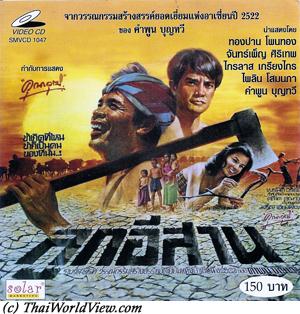
BKKIFF 2005 review: Son of the Northeast


  • Directed by Vichet Kounavudhi
  • Starring Tongparn Phontong, Chanpen Siritep, Krailad Kriang-krai and Pailin Somnapa
  • Screened as part of the Vichet Kounavudhi Retrospective at the 2005 Bangkok International Film Festival

This is Vichet Kounavudhi's masterpiece. Screened as part of a four-film retrospective, I saw three of his films, all from the early 1980s. The only one I missed was First Wife, which didn't have subtitles.

Based on the book, A Child of the Northeast (Luk Isaan) written by Kampoon Boontawee (winner of the 1979 Seawrite Award), this is Vichet's strongest film. The pandering and racism of Mountain People and heavy-handed melodrama present in Her Name is Boonrawd - is less evident here.

Son of the Northeast is more of a slice of life film about a group of close-knit familes living in hardscrabble northeastern Thailand - an area known as Isaan - in 1939. A drought has stricken the region, as it always seems to, so rice growing isn't happening. The families are reduced to eating whatever they can find - lizards, snakes, dung beetles (picked from cow manure piles that are territorially defended by the young boys), spiders, turtles, small birds, etc.

The king of the little manure pile is the titular son - Keng, and his parents are rock solid. Around them are the village drunkard, a younger horny guy, a pretty niece (object of a horny guy's affections) and a Vietnamese merchant.

Culturally, the area was traditionally rural and settled by farmers who speak a different dialect - more a mix of Lao and Khmer than Thai. This dialect was adhered to in the film. So there were Thai subtitles in addition to some haphazard English subs.

Part documentary, the wildlife photography is particularly vivid - lizards on tree limbs, turtles and snakes crawling through the grass.

The film opens with another group of families leaving the area. It's just too damn dry. But Father of Keng (as he's referred to by his friends and neighbors) wants to hold on. It's his ancestral land.

After about an hour and a half of sweating it out in the arid region - and dealing with an old drunkard, a greedy Vietnamese merchant, a horn-dog guy forced into marrying the pretty niece at machete- and gunpoint - the families decide enough is enough. They pull together and build nets, forge tools and build carts and head for the river to catch enough fish to make it through the season and have some foodstuffs to trade on. So more travelogue. But it's all really vivid and beautifully shot.

The only quibble I have with the film is one girl's character - a girl who wanted to run off with a folksinger but was locked up naked in her room by her mother. The girl escapes, gets some clothes and goes to the city. She returns wearing an outfit that is straight out of 1982, or 1965, or 1973. Whatever. I don't think they were wearing those colorful getups in 1939.

But other than that, the way of life in Isaan is depicted as it had been lived in 1939 and probably for hundreds of years before that and for at least a couple of decades afterward. Today, water buffalo are replaced by diesel-powered tillers and tractors. Pickups have taken the place of ox-carts. Grass and wood huts are replaced by stifling hot, land-eating concrete monstrosities. Rice paddy acreage is gobbled up by superhighways, factories, housing estates, military bases and golf courses -- progress.

Son of the Northeast is a love letter, a picture postcard, a souvenir to a long, lost, romantic past - a simpler, though very impoverished and hard-ship filled time in Thai history.

(Cross-published at Rotten Tomatoes)

BKKIFF 2005 review: Mountain People


  • Directed by Vichet Kounavudhi
  • Starring Montree Jenaksorn, Walaikorn Paovarat, Supavadee Thiensuwan and Petcharat Indharakamhaeng
  • Screened as part of the Vichet Kounavudhi retrospective at the 2005 Bangkok International Film Festival

A well-meaning movie in its day, Mountain People comes off today, in these more politically correct, sensitive times, as being horribly racist and condescending to the hilltribes of northern Thailand.

It starts out as a documentary, showing the various hilltribes and their characteristics as if the various groups were zoo exhibits to be gawked at. And if the specimens happen to be virgin Karen girls (you know their virgins because they wear white dresses) wading in the river, pulling up their dresses and showing their bare butts, there's really something to gawk at. Later on, there's some more skin shown with a whole bevy of hilltribe girls in the buff, bathing in the rapids of a stream.

The men, the documentary notes, know only four things: Eating, drinking tea, drinking whiskey and having sex with their women. That's all there is to life. The women do all the work.

The documentary ascends up the mountain. It depicts the all knowing, caretaking Thai government going into the village, telling the tribespeople about family planning. But they are stupid. A doctor demonstrates how to put the condom on his thumb. And that's exactly what one man did and he ended up with two kids. But another guy has had 12 kids. The doctor suggests a vasectomy. He is taken to a covered army truck for the operation. When it finally dawns on him what is to happen, he gets the heck out of there. So he's not so stupid.

After that bit of uncomfortable comedy, the drama starts, centering on a young guy named Ayo in Burma's Shan State who goes from village to village, selling dogs for people to, well you know, eat.

Back in Ayo's home village, he sees his best girl. Turns out she's pregnant. They have to get married. The woman has twins - a bad omen in the village. Rather than being seen as a blessing, the two fine strapping baby boys are viewed as the spawn of the devil and are killed. The new mother and father are banished from the village. Their hut is burned. But he gets some opium to take along so he can trade it for food. They are to go into Thailand and live with the guy's uncle. It's a long journey, involving a river crossing. The young woman doesn't make it.

Ayo forges on. He comes across a village that has been converted to Christianity. There is a white guy preacher leading the choir - singing hymns in hilltribe dialect. They help their fellow man, even though he's from different tribe. With some food and parting gifts, he's on his way.

Soon he spies a the bevy of primitive beauties bathing. A column of Chinese traders soon comes on the scene and heck breaks out. The Chinese are all over this part of the country. They are the bad guys in this movie. It's true, though way overdramatized. When Chiang Kai Shek's Kuomingting Nationalist forces fled China, some went to Taiwan and some went to northern Thailand and Burma's Shan State, where they remain a powerful force today.

Ayo ends up with a big bump on his head and is taken in by yet another tribe until he heals. Being a randy primitive guy, he gets involved with another tribal girl.

Soon it's time to move on. They head back to the Christian village and are given land and a hut. It's an interesting couple - different tribes, different governing spirits now under God and orders not to grow opium. But those pesky Chinese guys show up with pretty trinkets and the lure of opium growing can't be denied. Of course it leads to more soul-crushing drama.

Okay, with respect the drugs message - and today yaa baa (amphetamine) production is the big problem - the movie scores some good, socially conscious points. But it is still so heavy handed with showing how simple and stupid the hilltribe guy is. Those people need the Thai government's help, doesn't everyone see that?

(Cross-published at Rotten Tomatoes)
