Saturday, May 29, 2010

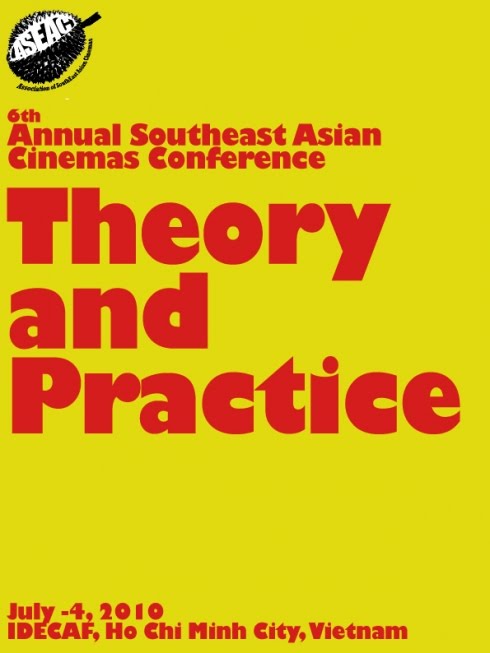
Southeast Asian Cinemas Conference set for Ho Chi Minh City

Scholars and film practitioners will gather for the sixth Southeast Asian Cinemas Conference from July 1 to 4 in Ho Chi Minh City, Vietnam.

They'll present papers, hold panel discussions and even have film screenings.

It's a pretty intense four days showcasing the deep thoughts by deep thinkers who are given time to do nothing but think about Southeast Asian cinema.

Co-sponsored by the Southeast Asian Studies Program at University of California Riverside, the conference opens on July 1 with the keynote by Associate Professor Adam Knee from Nanyang Technological University in Singapore. He'll talk on In(Qualified) Defense of "Southeast Asian Cinema".

Benjamin McKay from Monash University (Malaysia) moderates The Representation of History in Cinema with presentations by Liew Kai Khiun from National University of Singapore on Coping with the Past: History in Contemporary Thai Films, Delfin Tolentino Jr. from the University of the Philippines (Baguio) on The Narrative of Nation as a Tale of Prolonged Sorrow: The Historical Films of Raya Martin and Dr. David Teh from NUS on Pale Moons: Hauntology and the Ethnographic Surreal 1 and J Paul Manzanilla from the University of Philippines (Manila) with Multo, Kaluluwa, Espiritu: The Specter in Philippine Cinema.

Films in Southeast Asian History> is moderated by Katinka Van Heeren with Ekky Imanjaya from Rumahfilm.org on Wayang Kulit Performance and History of Pre‐Cinema: Inquiring Archaeology of Projection, Nadi Tofighian from Stockholm University on From Circus to Cinema: Early Travelling Entertainments in Southeast Asia, Charles Leary of the Asia Research Institute, Singapore, with Cooperation and Containment: A Brief Account of the Federation of Motion Picture Producers in Southeast Asia, and Thomas Barker from NUS on Trash or Cultural Treasure? Indonesia’s International Co‐Productions of the 1980s.

There will be Conversations with Film Producers modereated by Paolo Bertolin and Merv Espina with producers Khue Nguyen (SK Films) and Irene Trinh (Ho Chi Minh City), Meiske Dede Taurisia (Indonesia) and others to be confirmed.

Cinema and the Southeast Asian Diaspora is moderated by Sophia Siddique Harvey from Vassar College with Cherish Aileen A. Brillon from Far Eastern University and Edgardo A. Brillon, Jr from the University of the Philippines (Diliman) on In the Service of the Filipino Worldwide: The Filipino Overseas Worker in the Transnational Cinematic Space, Katrina Ross A. Tan from the University of the Philippines (Los Baños) on Constructing Philippine Modernity: An Analysis of Mainstream Diaspora Films and Emily Bullock, Macquarie University, Emotional Cartographies: Vietnam‐Australia Cinematic Journeys.

Alternative Pathways: Digital Screens and Cinephilia moderated by Christina Schwenkel from UC-Riverside has Jasmine Nadua Trice of Indiana University with Paths of Cinephilia in Philippine Cinema, Richard Lowell MacDonald from Goldsmiths, University of London, on Reflections of a Cursed Land: Screening Lav Diaz in Thailand, Eloisa May P. Hernandez, University of the Philippines (Diliman), The Role of ICT on Digital Cinema in the Philippines 3, and Davide Cazzaro, Goldsmiths, University of London, with From city to city, from screen to screen: toward a “self‐circulating cinema”? Kuala Lumpur alternative screen culture beyond Kuala Lumpur.

The Subjects of New Media: Revisioning Thailand, Cambodia, and Viet Nam is moderated by Mariam B. Lam of UC-Riverside. Catherine H. Nguyen from UCLA has Framing Portraitures: Tran An Hung’s Vietnamese Cinematic Subjectivity, Dredge Byung'chu Käng of Emory University and Nguyn Tan Hoang at Bryn Mawr College present Surfing the Korean Wave: Wonder Gay as Thai National Pride / Thai National Shame, Lan Duong from UC-Riverside with A Forgotten Cinema: Star Power and the Films from Pre‐1975 Sài Gòn, and Viet Lê from the University of Southern California on What Remains: Returns, Confrontations, Representation, and Traumatic Memory in S‐21: The Khmer Rouge Killing Machine and Refugee.

Genre and Theory moderated by Thu‐Huong Nguyen‐Vo from UCLA has Tito ImandaBinus International, Binus Business School, with Kiddie Cinema in Indonesia: Profit, Entertainment, and Pedagogy, Felizer Louie M. Lazada,
University of the Philippines, on The Temporal Turn: Deleuze and Asian Horror 4 (Visayas) and Katarzyna Ancuta of Assumption University (Bangkok)
with Global Spectrologies: Contemporary Thai Horror Film and the Globalization of the Supernatural.

Sexuality and Gender in Southeast Asian Cinema, moderated by Rolando Tolentino of the University of Philippines has Brett Farmer from Chulalongkorn University on Loves of Siam: Contemporary Thai Cinema and Vernacular Queerness, Laura Coppens from the University of Zurich with Queer Epistemologies in Indonesia: The (re)presentation of Queer Knowledge and Experience in Films, Ferdinand M. Lopez, University of Santo Tomas‐Manila on Decadent Desire and Darkness: Mapping Gay Manila of the 70s in Ishmael Bernal’s City After Dark, Sheryl Rose M. Andes from the University of the Philippines on A Peak at the Winners of the Most Gender Sensitive Film Award of the Metro Manila Film Festival.

Film Practices and the Law with moderator Hung Thai of Pomona College
has Wan Aida Wan Yahay of Monash University, Australia, on The Representation of Women in Southeast Asian Historical Films Reflecting Feudal Times, Intan Paramaditha, New York University, Protectors and Provocateurs: Reading the New Film Law as Cultural Performance in Indonesia 5, Andrew Ng, Nanyang Technological University, The Culture of Self‐Censorship in Singapore Films and Ramon Lobato, Swinburne University of Technology, Geographies of Film Piracy in the Asia‐Pacific Region,

Jack Yaeger from Louisiana State University takes a look at Religion with Hatib Abdul Kadir from teh Center for Religion and Cross Cultural Studies on Filming the Indonesian Muslim Piety after Post The New Order Regime, Eva F. Amrullah, Department of Anthropology, Australian National University, The Impact of the Representation of Face‐veiled Woman in Indonesian Ayat Ayat Cinta, Lito B. Zulueta, University of Santo Tomas‐Manila, Third Cinema and Brown Theophany: Criss Crossings between Contemporary Philippine Cinema and Contemporary Catholic Theology, Erin Cabanawan, University of the Philippines (Diliman), Dios Ina, Inang Pilipinas: Women and Nation in Filipino Religion‐themed Films.

Professor John A. Lent from Temple University moderates Filmic Perceptions of Southeast Asia with Daniel C. Tsang, University of California (Irvine), Vietnamese and Chinese Vietnamese Depictions in Colonial Hong Kong Cinema and Jennifer Verraes, University Paris III – Sorbonne Nouvelle, Remapping Admixtures: the Barbarian and the Neighbour, who is the Other (with)in Contemporary Southeast Asian Cinemas?

Space, Globalisation, and Nation moderated by Wan Zawawi, UiTM,
has Badrul Hassan of Monash University with Malaysian Cinema and the Public Sphere: A Vantage View, Natalie Boehler, University of Zurich, On Theorizing Thai Cinema, Veronika Kusumaryati, Jakarta Arts Institute, A New Urban Geography: The Case of OK Video Festival, William M. Owens independent scholar, Projecting Thailand: Strategies of Interpretation in the Films of Pen‐ek Ratanaruang.

And: Time, Space and the Works of Apichatpong Weeresethakul, moderated by May A. Ingawanij, University of Westminster, with Philippa Lovatt, University of Glasgow, Here Lies Memory: the Haunted Landscape of Nabua in Apichatpong Weerasethakul’s Primitive, Dianne Daley, RMIT University, Melbourne, An Empathetic Analysis of Time and Space in Films of Apichatpong Weerasethakul 7, Tony Day, Wesleyan University, Time and Freedom in Asian Film, and Ray Langenbach & Azmyl Md. Yusof, Sunway University College, Cinematic Vagrancy.

Finally there's Conversations with Filmmakers moderated by Tan Bee Thiam of the Asian Film Archive and Chuong‐Dai Vo, University of California, San Diego, with Sherman Ong, Pepe Diokno and others to be confirmed.

The venue for all this is IDECAF in Ho Chi Minh City. The full program and other details can be found on the SEACC website.

Tony Jaa enters the monkhood


Tony Jaa was ordained in a ceremony in Surin on Friday. Like a scene out of one of his movies, he rode atop an elephant to the ceremony, as depicted at the end of Ong-Bak.

Thai Rath has the story and photos.

His monastic name is Kitiposano, according to Urisara_NT, which means "elegant celebrity".

I am uncertain how long he will stay ordained. Thai Buddhist men routinely enter the monkhood at various auspicious times in their lives for short durations.

His mother told Korat Daily she hopes her 34-year-old son, real name Tatchakorn Yeerum (ทัชชกร ยีรัมย์) , formerly Panom Yeerum (พนม ยีรัมย์), finds a nice woman to marry afterward.

Update: Cinematical is in a tizzy over this latest move and Twitch lays a smackdown.

Friday, May 28, 2010

In memoriam: Payut Ngaokrachang

Pioneering Thai animator Payut Ngaokrachang (ปยุต เงากระจ่าง), hailed as the "Walt Disney of Thailand", died yesterday. He was 81 years old.

Payut made the first Thai animated feature, The Adventure of Sudsakorn (สุดสาคร), which was released in 1979. The fantasy tale is adapted from Phra Aphai Mani, a 30,000-line epic poem by Sunthorn Phu (1786–1855).

Production of Sudsakorn took three years, with Payut doing much of the work himself and nearly going blind in the process. He related his struggles in an interview with Professor John A. Lent in 1997 at the Animation World Network:

I made a lot of my equipment from pieces I got from junk of World War II military surplus. I'd find a screw here, a crank there, etc. I used a combat camera and adapted it. I pulled together pieces of wood, aluminum, whatever I could find."

"I did all the key drawings myself, even the layout and design ... I was almost blind from doing that film and now I wear contacts. My right eye is long, my left is short, crooked because of all that detailed work."

According to Wikipedia, Payut was born on April 1, 1929 in Klong Warl village, Warkoe in Prachuap Khiri Khan Province. As a child, he was interested in nang yai (หนังใหญ่) shadow-puppet plays and Felix the Cat.

He studied art by corresponding with illustrator Hem Vejakorn, whose work was seen on the covers of 10-satang pulp novels.

The artist and self-trained animator started out making short films. His first was Haed Mahasajan (เหตุมหัศจรรย์) in 1955, about a distracted traffic cop and the resulting pile-up of cars.

The "Hollywood like" animation caught the attention of the United States Information Service, which put him to work making anti-communist propaganda posters. He made one short for USIS that had the Ramayana's white monkey god Hanuman battling a red communist monkey.

Payut collaborated with pioneering filmmaker Ratana Pestonji after Ratana had stopped making films in the mid-1960s and was making commercials for a living.

One of their works was an ad for a brand of patent medicine or whisky (not sure which) that was racy and politically incorrect by today's standards. Ratana actually made Payut a camera to use for the animation, and the equipment is on display at the Film Archive Museum in Nakhon Pathom.

With Japanese funding, he made an educational short for girls in 1992 called My Way.

Pressed to explain his influences – was his animation Japanese-style or American-style? – he said he had his own style, Payut style.

Payut never made another feature after Sudsakorn. The animation process was too labor-intensive and took too long; Thai studios preferred to make live-action films, quickly and inexpensively.

But Sudsakorn is a historic achievement. It's often screened at film festivals, though I have yet to actually see it.

I met Payut a couple of times, and though hard of hearing and unable to see clearly, he was still enthusiastic and sharp.

The first was in 2007 at the Thai Film Foundation's Cherd Songsri Retrospective. He appeared for the screening of Cherd's landmark drama Plao Kao (The Old Scar), which starred his daughter, actress Nantana Ngaograjang, as half of a star-crossed couple in a tragic romance.

He was at the Film Archive in 2008 to celebrate the 100th birth anniversary of Ratana Pestonji. There, he was showing off an elaborate art book, chronicling his works. That night, in the rain, he put his hand and footprints in the concrete outside the Archive's Sri Salaya Cinema.

Last year's inaugural Bangkok International Animation Film Festival paid tribute to him with a "Payut Night" and a gala screening of The Adventure of Sudsakorn.

Payut's name also touches new generations of Thai animators through the Payut Ngaokrachang Prize for animation given by the annual Thai Short Film & Video Festival. The award is a medallion, designed by Payut.

According to Matichon, bathing rites are set for 4pm on May 31 at Wat Chonprathan Rangsarit, Bang Talat, Pak Kret, Nonthaburi, where the cremation ceremony will be held on June 5 at 4.30.

(Via Veen_NT)

In memoriam: The Siam Theatre


CNNGo Bangkok today has a last look at the Siam Theatre, which was gutted in the May 19 arson attacks that spread during the military crackdown on the red-shirt political protests.

The article includes valuable remembrances and photos by The Projectionist of the Southeast Asia Movie Theater Project, as well as a teary-eyed confession from taxicab-blogger Dale Konstanz of Still Life in Moving Vehicles.

And some other dude adds his thoughts as well.

The burning of the Siam is a great loss to the Bangkok cinema scene, but thankfully Siam Square's ornate Scala remains as the last first-run single-screen theater in the city.

The Nation had a piece in Thursday's paper. It's behind the website's experimental paywall now, but I was able to grab a choice nugget to share here:

The theatre nourished and reared the aesthetics of cinematic arts for audiences of several generations,” says movie critic Manotham Theamtheabrat.

“I was shocked to the point of tears when I realized that firefighters couldn’t go to Siam Square to extinguish the flames,” says GMM Tai Hub (GTH) president Visute Poolvoralaks.

Manotham’s first visit to the cinema was in 1976 to see the teen movie Wai Onlawon.

And Wai Onlawon was screened there again during the 2005 Bangkok International Film Festival.

At the time, I was unaware of the strong connection the Siam had to the Thai film industry. As The Nation article points out, back in the Siam's heyday in the 1970s, it was the place to premiere Thai films.

Today, most of the Thai movie premieres are at the glitzy Paragon Cineplex, which has reopened after being closed during the red-shirt protests, or at SF World Cinema at CentralWorld, which was also burnt in the May 19 attacks. But unlike the Siam – slated to become a shopping mall anyway – developers can rebuild the CentralWorld mall and its multiplex.

Even during the 1980s, Visute premiered his first production with his first company, Tai Entertainment, Suem Noi Noi Kalon Mak Noi, at the Siam.

GTH producer-director Jira Maligool recalls growing up hoping he'd one day see his name in lights at the Siam – a dream that came true in 2005 when his Maha'lai Muang Rae (มหา’ลัย เหมืองแร่ , The Tin Mine) played there.

Apichatpong Weerasethakul's Blissfully Yours and Tropical Malady also played at the Siam after their award-winning runs at the Cannes Film Festival. Though it should be noted that Blissfully was heavily censored.

In recent years, the Siam had mainly become the place to watch movies from Hong Kong, South Korea and Japan, with the original soundtracks and English and Thai subtitles.

The Apex chain's surviving Lido multiplex and House cinema on RCA will carry on that welcome tradition, but it won't be the same as seeing them on the big screen of the Siam.

Thursday, May 27, 2010

Culture Ministry's funding for Naresuan sequels cut in half


Parts three and four of The Legend of King Naresuan historical epic by director MC Chatrichalerm Yukol will get 46 million baht instead of 100 million baht from the Culture Ministry, according to news reports today.

The level of funding had been protested by independent filmmakers, among them recent Cannes Palme d'Or winner Apichatpong Weerasethakul but Culture Minister Teera Slukpetch said after a House meeting that the cut came after he learned the Commerce Ministry was giving Naresuan 3 and 4 Bt330 million.

The remaining 54 million baht will be plowed back into the Culture Ministry's budget for the Thai Khem Kaeng (Strong Thailand) "creative economy" stimulus plan for moving images.

The fund totalled 200 million baht, with half of it going to Naresuan. Indie filmmakers, led by Apichatpong and Manit Sriwanichpoom, protested that level of funding, saying the money would be better spent by spreading it out among more smaller projects.

The funds taken back from Naresuan might go to some of the 246 submitted projects that went unfunded, or more money might be given to some of the 48 other chosen projects, among them films by Apichatpong, Pen-ek Ratanaruang and Anocha Suwichakornpong.

Update: The Bangkok Post quotes Minister Teera: "This is not aimed at ending the allegation of special treatment. But there is an overlap between the funds from the two ministries. So the budget should be cut." And Pimpaka Towira chimes in to say there's nothing personal against Naresuan in the protest.

(Via Thai Rath, The Nation and thanks to Rikker)

Bad girls dressed that way in Sin Sisters 2

After finally seeing the release of his studio-banned 2003 katoey sports horror-comedy Phee Tum Tim (ผีตุ๋มติ๋ม) last year, Sukij Narin now follows up his controversial cult-hit 2002 sex comedy Sin Sisters (ผู้หญิง 5 บาป, Phu Ying Ha Bap) with Sin Sisters 2.

No longer hindered by police censorship, Sukij seeks to take full advantage of Thailand's new motion-picture ratings system and make the movie he presumably wanted to make eight years ago.

Opening in Thai cinemas today, Sin Sisters 2 has the rather dubious distinction of being the first commercially released Thai film to receive the 20- (unofficially stated as 20+) rating. This is the only restricted rating in the system, with I.D. checks at the theater supposed to be mandatory.

Previous 20- releases include Werner Herzog's Bad Lieutenant: Port of Call New Orleans (the first) and Anocha Suwichakornpong's Mundane History (yet to be commercially released in Thailand -- it had a festival screening only).

The premise of Phu Ying Ha Bap 2 is roughly the same as the first -- five saucy women confess the sexual secrets they are least proud of. Only here, instead of sitting around in an apartment as in the first film, there are five women being held captive under torturous conditions by a mysterious person. It all looks rather exploitive, in a "Women in Prison" sort of way.

With the censorship panel being beefed up, it's anybody's guess whether more films like this will be allowed.

There's an English-subtitled trailer at YouTube and it's embedded below.

Wednesday, May 26, 2010

Censorship panel beefed up

Little news item on Page 15A of today's Nation could have big implications for movie viewers in Thailand. It says:

The Culture Ministry will provide an office with 99 officials to help the Film Censor Committee, Culture Minister Teera Slukpetch said.

The censor panel screens films for rent, distribution and public screening in Thailand. Without its approval, local films cannot be exported either.

Teera said the Cabinet had already approved the establishment of the Film Censor Office, and had also given the green light to the plan to upgrade the Culture Watch Group under the ministry’s Office of Policies and Strategies.

The Culture Watch Group usually has just eight officials, but now it would have 28 officials, Teera said.

Why is it still called "censor panel" and not "ratings panel"? The old censorship habit is a hard one to kick.

Prachya and bands brave bullets to make music video


Entertainers are turning out in force to bring peace and cheerfulness back to Thailand after the clashes between the red-shirt anti-government protesters and the military left 85 dead and 1,378 injured in Bangkok.

Among the efforts is a song, "Khor Khwam Suk Khuen Klub Ma" ("May Happiness Come Back"), written in around two hours by tunesmith "Dee" Nitipong Hornak.

Quickly, a "We Are the World"-style chorus of 301 entertainers from all walks of show business and studio and label affiliations formed to record the number on a soundstage at MCOT.

And with the looming threat of whizzing sniper bullets, in the smoldering wreckage of charred buildings in the aftermath of the May 19 military crackdown and arson attacks, Ong-Bak director Prachya Pinkaew and his film crew hit the streets to make a music video to go with the song.

Their efforts are chronicled in The Nation today:

The director shows scenes of the damage caused by the arson and grenade attacks with Slur's guitarist Arak "Pe" Amornsupsiri in front of CentralWorld, the Richman Toy's singer Veeranat "Jap" Tippayamonthon on Rama IV, Thaitanium at Din Daeng and actor Nattawut “Por” Sakidjai at the Siam Theatre.

It was risky making the video.

"When I was filming Thaitanium, three military trucks drove very fast into the area, apparently after reports of a sniper hiding nearby. I had less than 10 minutes to finish the take as we had to leave then and there," Prachya says.

"I felt a little strange because I'd heard on the news that the Din Daeng area had not been completely secured. But we followed the production team and when we arrived, we were shocked to see how the road had been transformed into a black desert. After finishing the take, the military escorted us through the area," recalls Khan [of Thaitanium].

"It was the quickest way of learning the hook of the song," jokes Day.

Way merely shakes his dead, saying he thought he'd faced the most dreadful day in his life when he witnessed the September 11 attacks on the World Trade Centre while living in New York. "The Bangkok riots," he says, "were almost as bad."

The music video will be launched at 5pm on Thursday in front of Siam Paragon and will be broadcast on all Thai TV channels.

Tuesday, May 25, 2010

Cannes 2010: Hero's welcome promised for Apichatpong


Apichatpong Weerasethakul and his win of the Palme d'Or for Uncle Boonmee Who Can Recall His Past Lives at the Cannes Film Festival was on the front page of most daily newspapers in Bangkok today.

The response to the win in Apichatpong's native land is further gauged in an article by Agence France-Presse, which quotes Culture Minister Teera Slukpetch:

It's brilliant. I deeply hoped that his film would win," said Culture Minister Teera Slukpetch, promising the avant-garde filmmaker a hero's welcome when he returns to Thailand. "This kind of victory is what we really need at this time of crisis."

At the festival, Apichatpong had strong words about the Culture Ministry's censorship. But Teera praised Uncle Boonmee, saying "The film's content is very good, it's about Thai belief and traditions."

The Bangkok Post's Kong Rithdee notes that "Uncle Boonmee contains a scene showing a monk engaged in an activity to which the authorities might object. However, the film's credits show that it has received support from the Culture Ministry."

In fact, the Culture Ministry wants to give Apichatpong 3.5 million baht under the Strong Thailand "creative economy" film fund -- money that Apichatpong has said he'll refuse unless the mechanisms of the film fund are reformed and made transparent.

Anyway, Apichatpong's point about censorship wasn't necessarily about his films -- even though his 2006 feature Syndromes and a Century had six scenes snipped by censors, which included a guitar-strumming monk -- it's about filmmakers making movies about Thailand's current political troubles, which the film law might prohibit by invoking the vague and overly broad reasons of "national security".

The AFP article also has "man-on-the-street" interviews with people who never heard of Apichatpong.

And it quotes Songyos Sugmakanan, the director for the GTH studio who's made such mainstream Thai films as the boarding-school thriller Dorm, the teen romance Hormones and the zombie segment of the Phobia 2 horror anthology. He's also chairman of the Thai Film Director Association.

Songyos says the Cannes win won't mean much for the Thai film industry, because Apichatpong doesn't have a big following.

Besides, Apichatpong isn't part of the local film industry.

And with a Cannes win under his belt, he doesn't need to be. Everyone is going to want a piece of Apichatpong now, and he can make a movie just about anywhere he wants, except maybe Thailand.

The Chicago press, where Apichatpong graduated from the city's Art Institute, was full of news from Cannes.

NBC Chicago quoted Cannes jury president Tim Burton about Uncle Boonmee:

I felt it was a beautiful, strange dream you don't see very often. It's the type of cinema I don't usually see and again, that's what this festival is all about. ... You always want to be surprised by films and it did that for most of us."

Chicago Sun-Times movie critic Roger Ebert, who's covered the Cannes festival for decades, writes about Uncle Boonmee in his Cannes post-mortem:

I await a second viewing of Apichatpong Weerasethakul's winner of the Palme d'Or, Uncle Boonmee Who Can Recall His Past Lives. I felt affection and respect for it, but no passion. But reflect that when you see a subdued and challenging film late in the festival, you come to it dazed with movie overload. I know myself well enough to suspect it will play much better first thing on a Monday morning at a press screening here in Chicago.

Weerasethakul, who says we can call him Joe, has made a film about a man who moves through planes of existence that involve humans, animals, spirits, memories, dreams and fantasies. The man is in the last stages of kidney failure, being cared for by a male nurse in an unexplained house that seems to be surrounded by jungle. His dead wife and son come to visit. Mystical characters materialize and interact with nature. The voices are mostly muted. The forest is enveloping.

There are many theories about the film. I have one that may be completely off the wall. If the dying man is on pain medication, this may be a literal transcription of his hallucinatory dreams. At stages of my own surgeries, I was on a good deal of pain med, and had dreams or fantasies that remain, to this moment, more vivid than many of my actual memories. Even without drugs, he could be moving toward a mental reconciliation of death and nature. Then nothing needs to be explained, not even when his son appears as an ape with glowing red eyes. It is all his mind sorting through available images. The key, I think, is to declare the film to be entirely from his point of view, and not an objective one.

Maybe Ebert could take advice from one of his fellow Stateside critics, The New York Times' Manohla Dargis. In her coverage of Cannes, she writes:

Yet even as it feeds the art houses along with the red-carpet monster (or tries to), Cannes continues to make room for films that fall outside the commercial mainstream. The greatest proof of this is unequivocally Uncle Boonmee Who Can Recall His Past Lives, the single most adventurous film in the competition. It opens with a mysterious and lovely scene of a buffalo shaking loose its tether and roaming deep into the forest, an image that might be from one of Uncle Boonmee’s past lives. It is also a metaphor for how to watch Mr. Weerasethakul’s films: You need to shake loose all your preconceived ideas about how and why movies make meaning and just plunge in.

Or, "Relax!" as Apichatpong advises in an interview with Indie Movies Online:

Open your mind up and just let the images flow. Every film [that I make] I encounter a different, interesting interpretation, and I'm looking forward to it. People are different, you cannot force them, and there's gonna be people who shut off and there's gonna be people who share the sentiment. And for me too, sometimes when I watch a commercial movie, I don't understand.

It's an eclectic, wide-ranging interview, touching on Apichatpong's in-development art project Utopia, which involved putting Brigitte Bardot on the Starship Enterprise as well as the director's own thoughts on reincarnation and the clashes in Bangkok.

Actually lots of interviews with Apichatpong. Too much to digest in one sitting. But to start, here's another one at Huffington Post.

Update: Nanoguy has the text of Apichatpong's thank-you speech.

Update 2: The Nation has an editorial on Apichatpong's Cannes win: "But before the Thai Culture Ministry starts waving the flag in celebration, it should take a minute to recall Apichatpong's comments on the issue of film censorship. After all, strict censorship is obstructive to directors like Apichatpong, discouraging them from exploring innovative themes."

Update 3: The Bangkok Post has a Reuters piece on their editorial page today, quoting Monday's headline in Le Figaro: "'Uncle Boonmee', Palm of Boredom". There's also a nice round-up about Uncle Boonmee at the Arab Times website, "Thai festival winner steeped in spiritualism".

(Reuters photo via Yahoo! News)

Monday, May 24, 2010

Cannes 2010: Apichatpong and his Uncle Boonmee win the Palme d'Or


A drama that involves a monkey ghost with glowing red eyes, an uncle who's dying of kidney disease and a princess having sex with a talking catfish, won the Palme d'Or at the 63rd Cannes Film Festival.

Uncle Boonmee Who Can Recall His Past Lives (ลุงบุญมีระลึก ชาติ, Lung Boonmee Raleuk Chat) was the second win for director Apichatpong Weerasethakul in the main competition at Cannes. He won the jury prize in 2004 for Tropical Malady and won Cannes' second-tier Un Certain Regard competition in 2002 with Blissfully Yours. Uncle Boonmee is the first Thai film to win the top prize at what's arguably the planet's most prestigious film event.

"This is like another world for me, coming off the set [that is] full of jungle. So this is surreal," Apichatpong said.

"I would like to kiss all of you ... especially Tim Burton. I really like your hair style," he said, thanking the jury president and the panel. Burton totally blushed, according to film journalist Eric Kohn. Apichatpong himself served on the Cannes jury in 2008.

"And I would like to send message back home: The prize is for you," he said. "And also I'd like to thank all the spirits and the ghosts in Thailand. They make it possible for me to be here."

He also thanked his parents for taking him to his first movie. "I was so young, I didn't know what is on the screen ... With this award, I think I know a little more what cinema is but still it remains a mystery. And I think this mystery [is what keeps] us coming back here to share our world. And it'll be a long time [before] we discover the real power to crack the code."

Asked about the jury’s choice, Burton initially cut the discussion short, saying, “We’ve been talking about it all day, so we really don’t want to talk about it anymore,” he's quoted as saying by IndieWire. Pressed further, he added: “It’s like a beautiful, strange dream that you don’t see very often.”

The Cannes jury this year was headed by Burton with the panel comprised of film expert Alberto Barbera, actress Kate Beckinsale, writer Emmanuel Carrere, actor Benicio Del Toro, composer Alexandre Desplat, director Victor Erice, director Shekhar Kapur and actress Giovanna Mezzogiorno. A chair was kept open for a 10th panel member – jailed Iranian director Jafar Panahi.

The Grand Prix went to Des Hommes et Ds Dieux (Of Gods and Men) by Xavier Beauvois. Another film that garnered positive buzz was A Screaming Man (Un Homme Qui Crie) by Mahamat-Saleh Haroun from Chad. Giving a nod to Africa, the film won the jury prize. Check Mubi for the full list of winners.

Screening on Friday, Uncle Boonmee emerged as a darkhorse favorite for the Palme d'Or in a year that was widely seen as lackluster. Buzz about the Boonmee was overwhelmingly favorable, with mainstream reviews ranging from praiseworthy to not-so-excited. Press-room wags dubbed it Uncle Bonghit, according to Salon. Generally, Uncle Boonmee has been noted as the director's most accessible, most narrative work to date.

The director arrived in Cannes for Friday's screening after being delayed in Bangkok, where his passport had been trapped, awaiting stamps in the British Embassy, which had been closed because of the political protests. Issued a special passport, he was heading to the airport last Wednesday as the red-shirt anti-government protests culminated in a deadly crackdown by the Thai military that led to rioting and arson attacks in parts of the city. Ironically, one of the buildings that burned down was the Siam Theatre, which in the past had screened Apichatpong's Blissfully Yours and Tropical Malady.

The events in Bangkok heavily weighed on Apichatpong's statements to the press in Cannes, and he also had sharp words against the Thai government for its censorship of films. His previous film, 2006's Syndromes and a Century (which premiered at the Venice fest), had six seemingly innocuous scenes cut by censors who deemed them offensive to various institutions in Thailand, including the Thai medical establishment (both of Apichatpong's parents are physicians) and Buddhism.

Uncle Boonmee Who Can Recall His Past Lives is inspired by a sermon book by Phra Sripariyattiweti, a Buddhist monk in Apichatpong's hometown of Khon Kaen. The director made it the feature-film component of his Primitive art project, which explores the concepts of memory and transformation in Thailand's rural northeast. The art project also includes a massive seven-channel video installation that has been shown in Munich, Liverpool and Paris, as well as two other stand-alone short films, A Letter to Uncle Boonmee and Phantoms of Nabua, which won the first Asia Art Award.

The feature was shot on Super 16mm and is imbued with Apichatpong's nostalgia for the movies of his childhood. "The film became more of a memory of old cinema ... very antique. The acting, the lighting, is in a very old style," he told The Nation in an interview last month.

After Cannes, Uncle Boonmee Who Can Recall His Past Lives next heads to the Sydney Film Festival, and many, many other festival screenings will likely follow around the globe over the next year or more. It's uncertain when and where it will be screened in Thailand.

Update: His entire thank-you speech is at Nanoguy's blog.

(Reuters photos via Yahoo! News)