Showing posts with label Pimpaka Towira. Show all posts
Thursday, June 23, 2016
Extra Virgin unlocks indies with Distance, Rice Trilogy and Island Funeral
Extra Virgin, the indie production and distribution shingle run by producer-director Pimpaka Towira, has a new initiative with SF cinemas in Thailand, Unlock Indies, a film series that opened last week with the multi-country co-production Distance.
Others in the series will be The Rice Trilogy by Uruphong Raksasad and Pimpaka's own latest feature, The Island Funeral
.
The films are being released in a very limited run. Don't blink, or you will miss them. For example, Distance was initially released at SF World Cinema at CentralWorld and SFX Cinema Central Rama 9 in Bangkok, and at SFX Maya Chiang Mai. Today, it's down to just one screening a day at CentralWorld.
Next week, the program changes to what's now known as Uruphong's Rice Trilogy, with Stories from the North, Agrarian Utopia and The Songs of Rice (เพลงของข้าว, Pleng Khong Kao) taking turns on the big screen. They are among my favorites, and I hope he makes more films like these.
And on July 21, Pimpaka will release her own film, The Island Funeral (มหาสมุทรและสุสาน, Maha Samut Lae Susaan), which premiered last year in Tokyo and has been on a tear around the world, screening in places like Seattle, Aichi and Valetta and winning awards in Tokyo and Hong Kong. The Island Funeral will also be shown at the Singapore Festival of the Arts.
Meanwhile, Distance is an ambitious project headed up by Singaporean director Anthony Chen, winner of the Camera d'Or at the Cannes Film Festival for his 2013 debut drama Ilo Ilo. He gets help from Thai producer Aditya Assarat, who also wrote one of the segments.
With Distance, Chen and Assarat pay tribute to their Taiwanese and Chinese cinema influences and rounded up three young-buck award-winning Asian directors to do the job. They are Tan Shijie from Singapore, Xin Yukun from China and Sivaroj Kongsakul from Thailand. Each take a crack at directing Taiwanese actor Chen Bo-lin in segments that explore the notion of "distance" and what it means in our societies.
Labels:
Aditya Assarat,
Bangkok,
festivals,
indie,
Pan-Asian,
Pimpaka Towira,
posters,
Uruphong Raksasad
Sunday, April 3, 2016
Guest post: Pimpaka Towira a double winner in Hong Kong
![]() |
| Pimpaka Towira, second from left, at the HKIFF Awards Gala with, from left, Lam Kam‐po, Anita Piotrowska and Stephen Teo. |
Keith Barclay is editor of the New Zealand film industry publication Screenz. A sponsored journalist covering Filmart, he offers Wise Kwai's Thai Film Journal tailored coverage of Filmart, the Hong Kong-Asia Film Financing Forum, the Asian Film Awards and the Hong Kong International Film Festival.
As the Hong Kong International Film Festival closed, Thai filmmaker Pimpaka Towira took two awards at the festival's gala night on Saturday.
When Pimpaka's The Island Funeral (มหาสมุทรและสุสาน, Maha Samut Lae Susaan) had its world premiere at last year's Tokyo International Film Festival it was awarded the Asian Future Best Film Award. On Saturday evening in Hong Kong, it added the Fipresci Prize at the Hong Kong fest. The Fipresci Prize, a film-critics' honor presented at several festivals with a strong focus on Asian cinema, promotes Asian filmmaking.
Since its Tokyo premiere The Island Funeral has played a number of festivals and will head to the Buenos Aires Film Festival later this month.
As well as taking the Fipresci Award, Pimpaka picked up a second award in Hong Kong, for her short Prelude to the General (Nimit Luang). Premiered at this year's Berlinale in February, Prelude took the Jury Prize in the HKIFF's short film competition. It is a spin-off project of Pimpaka's upcoming feature The General's Secret. Portuguese director Leonor Teles' Batrachian’s Ballad won the short film competition.
The HKIFF presented awards for three competitive line-ups, Young Cinema, Documentary and Short Films, plus two other juried awards – the Fipresci and Signis awards. All together, the HKIFF presented more than 280 titles from more than 50 countries, selling more than 600,000 tickets.
This year's Hong Kong International Film Festival, the 40th edition, ran from March 21 to April 4.
Here is the complete list of HKIFF award winners:
Young Cinema Competition
- Firebird Award: Life After Life
- Jury Prize: Tomcat
Documentary Competition
- Firebird Award: Behemoth
- Jury Prize: Under the Sun
Short Film Competition
- Firebird Award: Batrachian’s Ballad
- Jury Prize: Prelude to the General
Fipresci Prize
- The Island Funeral
Signis Award
- Land of Mine
- Commended: Truman
Thursday, March 31, 2016
Guest post: Wrapping up Filmart 2016
![]() |
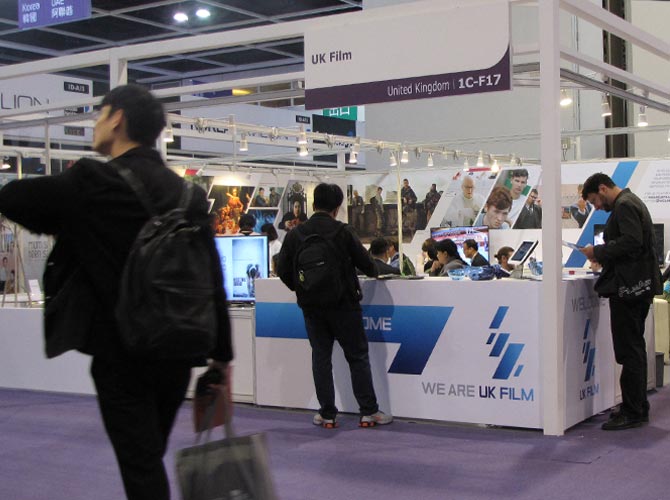
| Booths at Filmart. Photo by Keith Barclay. |
Hong Kong's Filmart wrapped on March 17. With 800 exhibitors and 7,300 registered buyers, the event set a new attendance record on the occasion of its 20th edition. It's a long way from the 75 invited exhibitors who took part in the inaugural 1997 event. Filmart is Asia's largest entertainment market event by some distance. Depending how it's measured, it's one of the world's top three or top five.
Strongly supported over the years by Hong Kong's own production and distribution community, a solid core of Thai distributors has been doing business there for several years. There are also several distributors from elsewhere carrying Thai product as part of a broader offer.
The most prominent Thai distributors at this year's Filmart were Five Star and Mono, each carrying a catalog of the more commercial Thai fare – mostly horrors, comedies and romantic comedies. Mono presented a large amount of its TV product as part of its offer. Both stands were busy during the market.
Five Star had Achira Nokthet's Ghost Ship (มอญซ่อนผี, Mon Son Phee) and Surussavadi Chuarchart's F.Hilaire (ฟ.ฮีแลร์), both released in Thai cinemas last year. Also in Five Star's catalogue, although a little older, was Issara Nadee's 2012 feature 407 Dark Flight. Thailand's first 3D horror feature, it has other Hong Kong connections having been shot by another of Filmart's regular exhibitors, Percy Fung's Hong Kong-based 3D Magic.
Representing the Thai government, the Thailand Film Office was one of a number of film offices from the region looking to attract business, productions looking to shoot in Asian locations or use services in the region. This year, the Thai team had a number of bites at the cherry with two umbrella organisations specializing in film attraction also exhibiting. AFCNet, the Asian organisation formed out of the worldwide International Association of Film Commissioners (AFCI) had a stand, as did Film Asean which, as it says on the box, represents the interests of the 10 member countries of the Association of Southeast Asian Nations. Film Asean arrived in Hong Kong having made a good splash at its launch at the Berlinale's European Film Market in February.
The organization has been in development for four years, and has set both outward and inward-facing goals. In Southeast Asia, Film Asean will offer services including a touring mini-festival to introduce films from other countries in the region to regional audiences. For industry members, it will also support training and upskilling initiatives to help develop each country's own production capability and to better service the (usually more lucrative) inbound productions.
In 2013 Thailand introduced its own initiative to increase awareness of the country's potential and attract more inbound production. In the face of improving incentive schemes offered by other countries' governments, the Thailand International Film Destination Festival focused on promoting international titles shot in Thailand. Over the years, many of those titles have used Thailand to double for another part of Asia – most frequently Vietnam for a spate of Hollywood war films from Casualties of War to The Deer Hunter.
More recent high-profile titles such as The Hangover and Xu Zheng's Lost in Thailand might help drive awareness of what Thailand has to offer but, as neighbor Malaysia has discovered at the Pinewood Iskandar studios, it's not all about the blockbusters. Often the longer-running, lower-profile international titles – especially TV shows – keep people working week in and week out and create better opportunities for developing crew members' skills.
As well as distributors selling product at Filmart, production service companies also promote their services. Thai post-production and visual-effects specialists Yggdrazil and Kantana were both present. While Yggdrazil is probably better known internationally for its work in advertising, Kantana has been well-known in Hong Kong for several years, not least for its work on Wong Kar-Wai's Cannes-premiered 2046.
Other Thai post houses also present in Hong Kong were G2D (the former Technicolor facility in Bangkok) and White Light, which presented prizes at the Hong Kong-Asia Film Financing Forum, which ran alongside Filmart. Sway director Rooth Tang's March April May was among the projects selected for this year's HAF.
Both events form part of the umbrella Hong Kong Entertainment Expo, which draws to a close this weekend with the presentation of the Hong Kong Film Awards and the end of the Hong Kong International Film Festival.
Thai titles playing in this year's HKIFF were Apichatpong Weerasethakul's Cemetery of Splendour, well-travelled since its Cannes premiere 10 months ago, and The Island Funeral by Pimpaka Towira, which won the Best Asian Future Film Award at last year's Tokyo International Film Festival.
Both directors' previous features, Apichatpong's Palme d'Or winner Uncle Boonmee Who Can Recall His Past Lives and Pimpaka's One Night Husband respectively, also played in past editions of the Hong Kong fest.
Filmart (14 – 17 March) ran as part of the Hong Kong Entertainment Expo, along with film financing forum/project market HAF (14 – 16 March), and the Hong Kong International Film Festival (21 March – 4 April).
Labels:
3D,
Apichatpong,
culture,
festivals,
Five Star,
horror,
industry,
Lee Chatametikool,
Mono Film,
Pan-Asian,
Pimpaka Towira
Friday, March 25, 2016
Freelance wins at Bangkok Critics, KCL Awards
Freelance .. Ham Puay Ham Phak Ham Rak More (ฟรีแลนซ์.. ห้ามป่วย ห้ามพัก ห้ามรักหมอ a.k.a. Heart Attack) is continuing its prize-winning run of Thailand's film and entertainment awards.
On Wednesday, Nawapol Thamrongrattanarit’s hard-working comedy-drama took six prizes in Bangkok Critics Assembly Awards, including Best Film, Director, Actor, Actress and Supporting Actress.
Another major winner was The Blue Hour (Onthakan, อนธการ), It was the leading nominee with 11 nods. The dark gay thriller, which premiered at the Berlin International Film Festival last year and was recently issued on DVD in the U.S., won awards for Best Editing, Production Design and Best Score. And director and co-writer Anucha Boonyawatana was given a special prize, the Young Filmmaker Award.
Uruphong Raksasad repeated his success with his documentary The Songs of Rice (เพลงของข้าว, Pleng Khong Kao). He won Best Documentary and Best Cinematography for his poetic portrait of rice cultivation across Thailand, the same prizes he won at the Subhanahongsa Awards. Producer Pimpaka Towira joined him on stage to collect the acrylic trophy.
And another favorite of Thai critics, P'Chai My Hero a.k.a. How to Win at Checkers (Every Time), picked up one prize, best supporting actor for Thira Chutikul, who played the gay older brother of the movie's 11-year-old lead character. The child star Ingkarat Damrongsakkul had won the supporting actor prize at the Subhanahongsas.
The success for Freelance follows a major haul of Golden Swan trophies at the film industry's Subhanahongsa Awards, where it won eight prizes. Freelance, or rather Heart Attack as its known internationally, has also collected prizes on the film festival circuit, winning the ABC Award for the most entertaining film at the recent Osaka Asian Film Festival. The Nation had more on that.
There's also the Kom Chad Luek Awards, an entertainment kudos ceremony put on for 13 years now by Nation Multimedia and covering film, television and music. It awarded Freelance five prizes – Best Film, Screenplay, Best Supporting Actress, Best Actress and Best Actor. Thira Chutikul of P'Chai My Hero got the supporting actor trophy and bouquet while Anucha and The Blue Hour were upset winners in the Best Director category.
| Three winning men at the Critics Awards, from left, Nawapol Thamrongrattanarit and Sunny Suwanmethanon from Freelance and Thira Chutikul of P'Chai My Hero. Nation photo by Rachanon Intharagsa |
- Best Film: Freelance Ham Puay Ham Phak Ham Rak More (Heart Attack)
- Best Director: Nawapol Thamrongrattanarit, Freelance
- Best Actor: Sunny Suwanmethanon, Freelance
- Best Actress: Davika Hoorne, Freelance
- Best Supporting Actor: Thira Chutikul, P'Chai My Hero
- Best Supporting Actress: Violette Wautier, Freelance
- Best Screenplay: Nawapol Thamrongrattanarit, Freelance
- Best Editing: Chonlasit Upanigkit and Anuphap Autta, The Blue Hour
- Best Cinematography: Uruphong Raksasad, Phleng Khong Khao (The Songs of Rice)
- Best Production Design: Phairot Siriwath and Vitune Tulakorn, The Blue Hour
- Best Original Score: Chupvit Temnithikul, The Blue Hour
- Best Song: Sud Sai Ta from The Down
- Best Documentary: The Songs of Rice
- Young Filmmaker Award: Anucha Boonyawatana, The Blue Hour
- Lifetime Achievement Awards: Marasri Israngkool Na Ayuthaya and Sompong Wongrakthai
(Via The Nation)
Labels:
awards,
culture,
GTH,
indie,
industry,
Nawapol Thamrongrattanarit,
Pan-Asian,
Pimpaka Towira,
Uruphong Raksasad
Friday, January 29, 2016
Festival, festival! Island in Rotterdam and Goteborg, General in Berlin, plus Motel and Executioner
![]() |
| One of the cleaner scenes I can use from Motel Mist. |
Pimpaka Towira is on a victory lap of the festival circuit, following her Asian Future Award win at the Tokyo International Film Festival last year, with her latest feature The Island Funeral (มหาสมุทรและสุสาน, Maha Samut Lae Susaan).
She’s joined the seasonal migration of Thai indie filmmakers, who each winter fly to such frigid northern cities as Rotterdam, Berlin and Goteborg, Sweden, where they are mated with funding, awards and critical acclaim. They then return to Thailand, where they further propagate the species.
In addition to the Bright Future section at the International Film Festival Rotterdam, Pimpaka will show The Island Funeral in Goteborg, where it is in competition for the Ingmar Bergman International Debut Award. Like Tokyo’s Asian Future Award, the Bergman prize is for filmmakers making their first or second feature, and Island Funeral, which is Pimpaka’s second drama film and has been eight years in the making, definitely qualifies. The Goteborg fest runs until February 8.
Starring Actors’ Studio-trained Heen Sasithorn, The Island Funeral is a road movie, covering the journey of a young Bangkok woman and her friends into the heart of Thailand’s restive Deep South.
Pimpaka might also be on the road to the Berlin International Film Festival, where to prove she has enough love in her heart to spread around, she has Prelude to the General, a short that that is spun from one of her many spinning plates, a work-in-progress feature called The General’s Secret (Kam Lub Khong Nai Phol), which she offered at the Thai Pitch in Cannes in 2013.
Perhaps she’ll stop by the Berlinale Talents Campus, where she’s a 2005 alumnae, and run into a few young filmmakers who look up to her as a mentor, including Thai indie director Sorayos “Minimal” Prapapan and Korean-American director Josh Kim, who broke into the Thai film industry last year with his debut feature How to Win at Checkers (Every Time), which garnered much acclaim when it premiered in Berlin last year. The Berlin fest runs from February 11 to 21.
Back in Rotterdam, Thai producer-director Anocha Suwichakornpong has arrived after a flight delayed by a psychotic passenger and a dented aircraft door kept her on the ground overnight in Warsaw. She’s there to be part of the jury for the Hivos Tiger Awards, of which she’s a past winner, for “Mundane History” in 2010. Rotterdam has been most kind to Thai films in past years, with other winners being Aditya Assarat with Wonderful Town in 2008, Sivaroj Kongsakul with Eternity in 2011 and Jakrawal Nilthamrong's Vanishing Point last year.
Among the entries to gander at this year will be Motel Mist, the debut feature of Prabda Yoon. A SEA Write Award-winning novelist, Prabda is best known in the movie world as the screenwriter of Pen-ek Ratanruang’s trippy 2003 classic Last Life in the Universe. His Motel Mist appears to be another existential freak-out, luridly taking place in the rooms of the Motel Mistress, an alien-looking love motel in Bangkok.
“Motel Mist was a film born out of a mixture of inspiration and frustration, but it was completed with great trust and support from a group of talented and devoted lovers of the cinematic art,” Prabda says in a press release from Thai film distributor Mosquito Films. “The film is about ‘otherness’ and ‘dislocation’ but the experience of making it has ironically given me the sense of acceptance and belonging. It’s been a very delightful and meaningful exercise.”
And if that’s not enough wonderful Thai weirdness for Rotterdam festival-goers, they can feast eyes on Painting with History in a Room Filled with People with Funny Names 3, a short film by artist Korakrit Arunanondchai that blends denim, drones and body paint. A crocodile is in the mix as well.
There's another Thai film in Rotterdam as well, but I will refrain from naming it.
In other festival news, director Tom Waller is continuing to win awards with his 2014 feature The Last Executioner, a biopic of Thai prison guard and executioner Chavoret Jaruboon. At the Dhaka International Film Festival recently, Waller was awarded Best Director, while Executioner leading man Vithaya Pansringarm shared the Best Actor prize with Iraqi’s Mahmoud Abu Abbas, who won for Samt Al Rai (Silence of the Shepherd), a slow-burn thriller by Raad Moshatat.
The Last Executioner was notably snubbed for the Thai film industry’s Subhanahongsa Awards last year, but won screenplay and best picture in the Surasawadee Awards, the long-running movie honors that’s also known as the Tukata Tong or Golden Doll Awards.
There is much more to report on the festival scene. Please be patient while I slowly catch up.
(Cross-published in The Nation; print only)
Monday, November 2, 2015
Festival festival! Awards in Tokyo and Lisbon, Motion in Toronto
![]() |
| Pimpaka Towira with her Asian Future Award at the Tokyo International Film Festival. Photo via The Nation. |
Though she's been making films since the late 1990s, it's taken awhile for the men in charge of world cinema to get around to recognizing Pimpaka Towira, who was honored over the weekend at the Tokyo International Film Festival with the Asian Future Award for her new film The Island Funeral (มหาสมุทรและสุสาน, Maha Samut Lae Susaan).
It's her sophomore fictional feature, which follows her 2003 debut One Night Husband and the 2007 documentary The Truth Be Told: The Cases Against Supinya Klangnarong.
Of course, Pimpaka has also been kept quite busy over the years making short films, producing films by other directors, lending her expertise to workshops and serving as a festival programmer, juror and panelist. The award for her new film seems quite overdue, but is still most welcome.
Here is more about her Tokyo award from The Nation:
"I am so excited right now. The film took so many years to complete. I'd like to thank the Tokyo International Film Festival and all the crew and the actors who made the big effort until we could finish this project," Pimpaka said in her acceptance speech.
The film tells the story of Laila, a Muslim woman from Bangkok who travels to Pattani to meet her long lost aunt. "I was not sure initially as my film was different from other films, but the feedback from the audience was very nice," Pimpaka said later in an interview. After One Night Husband, which premiered in the Forum Section of the Berlin International Film Festival in 2003, she had to put in a lot of effort to make her second feature.
"During the production stages, I was not sure if this film was good enough. I had to revise the editing so many times. The award proves that at least the jury and the audience saw something in this film," said Pimpaka, whose film was praised by the jury for showing the landscape and politics of the country with strong cinematic language. The jury members were Olivier Pere, managing director of Arte France Cinema, Jacob Wong of the Hong Kong International Film Festival and Tatsushi Omori, director of the critically acclaimed Japanese film The Ravine of Goodbye.
Shot partially in Pattani with 16mm film, The Island Funeral went through a lot of problems and was almost left unfinished. "At one point, I didn’t feel like I wanted to finish the project. There were lots of problems, from myself, from the source of funding, and what happened around me, but in the end I made a decision to finish the film even though the result was unforeseeable."
The Island Funeral premiered in Tokyo alongside another new Thai film, Kongdej Jaturanrasmee's Snap, which will open the upcoming 13th World Film Festival of Bangkok. Folks in Thailand will have to wait awhile for The Island Funeral though. Pimpaka and her team plan to tour the festival circuit for the next year or so, building up more anticipation for the film's eventual Thai release. There's more about the film in another article in The Nation.
Elsewhere in the festival world, the short film That Day of the Month was among the prize winners at the 19th edition of Queer Lisboa, which was held in September. Thanks to a Facebook reader for sending me the tip about this one.
Directed by Jirassaya Wongsutin, That Day of the Month was named the Queer Lisboa's best short film, winning a 1,500-euro prize and Portugal's RTP2 public TV channel picking up broadcast rights. Jirassaya had previously won the White Elephant Award for student films at last year's Thai Short Film and Video Festival.
Finally, here's news of an upcoming Thai film screening overseas – Bangkok in Motion, a short directed by Bangkok-based filmmaker Jimmie Wing – has been selected for the Toronto International Short Film Festival, which runs from November 11 to 13. It's a smoothly rolling portrait of Bangkok, shot from the perspective of a disabled cameraman in a wheelchair.
I found out about this one because Jimmie saw me at a film event, and actually walked over and spoke to me. He told me that his short film was going to be in the film festival in Toronto. So now I've reported that news here. Funny how that works.
Labels:
awards,
Bangkok,
festivals,
indie,
Kongdej,
Pan-Asian,
Pimpaka Towira,
short films
Thursday, March 19, 2015
Indie filmmakers recruited to tutor Bangkok, Jakarta academy sessions
Mofilm, the outfit that puts on short-film contests worldwide and serves as an online social network for filmmakers, has recruited guest tutors for the upcoming sessions of the Academy for Southeast Asian Filmmakers.
Set for Jakarta from May 11 to 13 and Bangkok from May 15 to 18, Mofilm's Academy for Southeast Asian Filmmakers has tapped established local indie film talents.
In Jakarta, the sessions will be led by director Mouly Surya (What They Don't Talk About When They Talk About Love, Fiksi) and Sheila Timothy, a producer whose credits include a pair of far-out freak-outs by Joko Anwar, Pintu Terlarang (The Forbidden Door) and Modus Anomali (Ritual).
Bangkok's sessions will have writer-director Kongdej Jaturanrasmee (Tang Wong, So Be It) and producer-director Pimpaka Towira (The Truth Be Told: The Cases Against Supinya Klangnarong, The Songs of Rice).
Other big names are expected to follow. Meanwhile, the March 31 deadline for applications is fast approaching. Check it out at mofilm.com/ASAF.
Labels:
indie,
industry,
Kongdej,
Pan-Asian,
Pimpaka Towira
Saturday, January 17, 2015
Songs of Rice hooping into Thai cinemas
My favorite film of 2014, The Songs of Rice (พลงของข้าว, Pleng Khong Kao), opens in a limited release in Thai cinemas on January 22.
Directed by Uruphong Raksasad and produced by Pimpaka Towira, The Songs of Rice is a joyous celebration of the often-lively (and even explosive) rites and festivities that accompany rice cultivation in Thailand. It premiered about a year ago at the International Film Festival Rotterdam, where it won the Fipresci Award, and made several other festival appearances. I saw it twice, at Salaya Doc and in Luang Prabang, and both times I was blown away by the film's gently building tempo and the vivid intensity of the images.
A documentary, it is the completion of a trilogy of farming films that Uruphong began with in 2005 with The Stories from the North, a collection of short stories from around his native Chiang Rai province. He followed that up with the ambitious documentary Agrarian Utopia, which followed two families growing rice by hand for a year on a small plot of land, also in Chiang Rai, way up in Thailand's North.
With The Songs of Rice, Uruphong starts out in that same location, but then moves further afield, travelling the length and breadth of the country as he documents religious ceremonies, beauty pageants, parades, communal food preparation, dancing and music. He covers the rocket festival in Yasothon in the Northeast, the buffalo races in Chonburi in the East and falls in with a travelling band of workers and their rice-harvesting spaceships in Roi Et.
Released by Extra Virgin, The Songs of Rice opens on January 22 in Bangkok's SF World Cinema at CentralWorld, and then spreads to other SF cinemas in the following weeks, hitting Chiang Mai's Maya on January 29 and Khon Kaen on February 5.
For more details, check the movie's Facebook page. There's also a trailer.
Labels:
culture,
documentaries,
indie,
Pimpaka Towira,
posters,
trailers,
Uruphong Raksasad,
videos
Friday, January 9, 2015
Top 10 Thai films of 2014
As the military strongmen took over and began to map out the country’s future, independent Thai filmmakers soldiered on in 2014 with more of their unique stories, told in a string of documentaries and dramas. And the mainstream film studios offered their own distractions, with a handful of gems among the usual crop of cross-dressing comedies, horror and weepy melodramas. Here are the 10 Thai films I most enjoyed over the past year.
The Songs of Rice (เพลงของข้าว, Pleng Kong Kao)
What’s it about? The colorfully festive rites that accompany rice cultivation across the length and breadth of Thailand are surveyed in this documentary that screened on the festival circuit last year. I saw it twice, and it blew me away both times. In Thailand, it comes to SF cinemas on January 22.
Who directed it? Uruphong Raksasad, completing his trilogy of rural films that began in 2006 with The Songs of the North and was followed by Agrarian Utopia in 2011.
Why’s it good? A genius lensman, Uruphong continues to demonstrate his knack for astonishing viewers with amazing photography. His eye-popping images are coupled with expert editing and sound design, so the blasts of those rockets in Yasothon or the thwacks of a whip on a racing buffalo in Chon Buri are all the more vivid.
Village of Hope (วังพิกุล, Wangphikul)
What’s it about? A young man on leave from the military returns to his poor farming village and feels uneasy as he gets reacquainted with his elderly relatives and the slow pace of life.
Who directed it? Boonsong Nakphoo, an indie director who specialises in hardscrabble stories, filmed with members of his own family around his hometown of Wangphikul in Sukhothai province. Village of Hope is a sequel to his 2011 effort Poor People the Great.
Why's it good? Somboon’s films are unpretentious and compelling portraits of folks who have been surpassed by society and are out of step with the increasingly urbanized, digitized, plastic-coated modern Thailand.
What’s it about? During the 1997 financial crisis, a New York currency trader (played by Ananda Everingham) returns home to Bangkok to settle affairs after the suicide of his father. While trying to bond with his younger brother (newcomer Prawith Hansten), he also seeks to rekindle romance with an ex-girlfriend (Jansuda Parnto), a former actress having mixed success as a businesswoman. And the brother strikes up a relationship with a lonely neighbor girl (Apinya Sakuljaroensuk).
Who directed it? Lee Chatametikool, making his long-awaited feature directorial debut after having helped shape Thai indie cinema as an influential film editor for the likes of Apichatpong Weerasethakul and Anocha Suwichakornpong.
Why's it good? A fantastic cast, eye-popping visuals and cool ’90s music lift Concrete Clouds, which captures the anxiety of the era with karaoke-video vignettes – super-saturated dreamy asides to the bittersweet twin romances of the screenplay.
Vengeance of the Assassin (เร็วทะลุเร็ว, Rew Talu Rew)
What’s it about? A young man (Chupong Changprung) becomes an assassin while looking for answers about the death of his parents. As he gets closer to the truth, his brother (Nathawut Boonrubsub) joins in to help.
Who directed it? Action maestro Panna Rittikrai, who died last July at age 53 of liver disease. Aside from his string of gritty action films like Born to Fight and Dynamite Warrior, Panna was best known as mentor and martial-arts choreographer to Ong-Bak and Tom-Yum-Goong star Tony Jaa, who last year broke from studio Sahamongkol to strike out on his own in Hollywood with Fast and Furious 7 and in Hong Kong on SPL2.
Why's it good? The first two minutes alone are worth seeking this out. Panna pulls out all his bone-crunching stops as he has his fighters playing combat football in a burning warehouse next to a lake of gasoline.
The Swimmers (ฝากไว้..ในกายเธอ, Fak Wai Nai Guy Ther)
What’s it about? Speedo-clad high-school swimming champions Perth and Tan come into conflict over a girl, who fell to her death from a diving platform into a drained pool.
Who directed it? Sophon Sakdapisit, GTH studio’s resident scare specialist. He previously did the 2011 psycho-thriller “Laddaland” and 2008’s “Coming Soon” and had a hand in writing the hit horrors “Shutter” and “Alone”.
Why's it good? The slickly produced flick keeps viewers off kilter with a taut psychological drama that has the added horror of having a message about teen sex.
W.
What’s it about? A brainy college freshman is thrown into the deep end of campus life when she is assigned to the faculty that was her last choice – sports – where her only friend is a slacker classmate who hopes to copy from her test papers.
Who directed it? Chonlasit Upanigkit, who made W. as his undergraduate thesis film at Silpakorn University. He had previously served as film editor on director Nawapol Thamrongrattanarit’s indie hits Mary Is Happy, Mary Is Happy and 36. A jaw-dropping three hours when he turned the film in, W. was shepherded by veteran indie filmmaker Aditya Assarat, who became a producer and guided it through an editing process that trimmed an hour off. It became bankable enough to enter the Busan film fest and secure a limited run at Bangkok’s House cinema.
Why's it good? With a burbling electronica soundtrack, moody natural lighting and overall dreaminess, W. fits solidly in the realm of “contemplative cinema” or “shoegaze”, sort of like Drive, though instead of Ryan Gosling staring blankly in silence over his steering wheel, you have college girls nattering as they double up on a bicycle for a ride across campus.
The Teacher’s Diary (คิดถึงวิทยา, Kid Tueng Wittaya)
What’s it about? A man and a woman, teachers at the same rural schoolhouse, but a year apart, fall in love over their writings in a shared diary.
Who directed it? Nithiwat Tharatorn, one of six directors of 2003’s Fan Chan, the film that built the highly successful GTH studio. He went on to direct the hit romantic dramas Season’s Change and Dear Galileo.
Why's it good? Toeing a fine line between sweetness and mawkishness, the sentimental romance mostly sticks to that line thanks to a fairly tight script, top-notch technical work, a memorable location and, of course, appealing performances by two fine lead actors, Sukrit “Bie” Wisetkaew as an ex-jock teacher whose enthusiasm makes up for his lack of brains, and Chermarn “Ploy” Boonyasak as a bright schoolteacher whose rebellious streak lands her in the rural post.
Fin Sugoi (ฟินสุโค่ย)
What’s it about? A young woman’s boyfriend becomes jealous after she gets to be in the music video of the Japanese rock star she’s been obsessed with all her life.
Who directed it? Tanwarin Sukkhapisit followed up the critically acclaimed transgender drama It Gets Better with two well-made, solidly commercial entries this year. In addition to Fin Sugoi, Tanwarin made Threesome, an entertaining romantic comedy about a woman who breaks up with her boyfriend and starts dating a ghost.
Why's it good? A surprisingly provocative script and a fun premise gives Fin Sugoi the edge over Threesome as well as the overly formulaic GTH blockbuster rom-com I Fine … Thank You … Love You. But the highlight of Fin Sugoi was the bravura performance by Apinya Sakuljaroensuk, whose portrayal of an obsessed fan was quite a departure from the usual quiet dramatic roles she lands in indie films like Concrete Clouds. She also was in a third film last year, the lesbian marriage drama 1448: Love Among Us.
Somboon (ปู่สมบรูณ์, Poo Somboon)
What’s it about? The documentary follows an elderly man as he cares for the overwhelming medical needs of his chronically ailing wife of 45 years.
Who directed it? Krisda Tipchaimeta, making his feature debut.
Why's it good? Documentaries were huge in 2014. Veteran writer-director Kongdej Jaturanrasmee turned in his first doc, So Be It, a portrait of two boys and Buddhism; and Nawapol Thamrongrattanarit did The Master, in which Kongdej and other film folk share memories about Van VDO, the infamous pirate-movie dealer. But the bittersweet Somboon, about a stand-up guy who doesn’t shirk his responsibilities, felt the most pure and poignant.
The Last Executioner (เพชฌฆาต, Petchakat)
What’s it about? The biographical drama spotlights Chavoret Jaruboon, the executioner at Bangkwang Prison, the “Bangkok Hilton”. He was the last to dispatch death-row inmates with a rifle before the switch to lethal injection.
Who directed it? Tom Waller, a Thai-Irish filmmaker who has for many years run a company that provides services to foreign movie productions. He broke into making his own indie arthouse films with 2011’s Mindfulness and Murder.
Why's it good? Chavoret struggled to reconcile his lethal duty with his Buddhist spirituality, and whether his killing in the name of justice was good or bad. Giving weight to that conflict is another excellent performance by Vithaya Pansringarm from Mindfulness and Murder and Only God Forgives, and a fine supporting cast that includes Penpak Sirikul as Chavoret’s wife and David Asavanond (Countdown) as a shadowy spirit figure. The backdrop, the inner-workings of Thailand’s prison system, is also interesting. Unfortunately, Thai audiences didn’t find the film’s morbid subject matter compelling, and The Last Executioner was largely gone from cinemas after just one week.
(Cross-published in The Nation)
Monday, October 6, 2014
Busan 2014: Mosquito puts Thieves, Exploding Durians, So Be It and W on autumn slate
![]() |
| River of Exploding Durians premieres at the Tokyo film fest. |
Mosquito Films Distribution, the indie film shingle launched earlier this year by several prominent Thai filmmakers, is expanding its reach in Southeast Asia, announcing the addition of two Malaysian entries to its slate of titles being promoted at autumn film festivals.
At Busan, the Mosquitos are touting The Second Life of Thieves by Malaysia's Woo Ming Jin, along with two new Thai features, W by Chonlasit Upanigkit and So Be It by Kongdej Jaturanrasmee. They'll also be at the Tokyo International Film Festival with River of Exploding Durians, the debut feature of Malaysia's Edmund Yeo.
Here's more from a press release yesterday:
Says Woo, “Edmund and I are excited to work with Mosquito. We are in good hands and look forward to a long-term relationship with them. I believe this is a collaboration that will serve not just Malaysian and Thai cinema, but also Southeast Asian cinema in general. Together, we can share more of our films with the rest of the world”.
The Second Life of Thieves is Woo’s highly-anticipated fifth feature while River of Exploding Durians is Yeo’s debut after many award-winning shorts. The two filmmakers collaborate closely on all their films with each taking the producing role while the other is directing.
Says Mosquito’s Aditya Assarat, “All of us Southeast Asians are making films under the same circumstances. Because of this, we share the same DIY spirit that is behind Mosquito Films to begin with. After launching the company in January with our own titles, we’re proud to take our first step towards representing regional films by partnering with the prolific Greenlight Pictures.”
In addition to Aditya, other partners in Mosquito Films Distribution are Apichatpong Weerasethakul, Pimpaka Towira, Soros Sukhum, Anocha Suwichakornpong and Lee Chatametikool.
The Second Life of Thieves has intertwining relationships of one man who discovers his wife has disappeared with his friend – a man he had a secret relationship for decades. He in turn forms an unlikely friendship with his friend's daughter. "They embark on an emotional journey that will open old and new wounds alike. Juxtaposing between present day and 30 years in the past, The Second Life of Thieves is a meditation on love, loss, and regret."
River of Exploding Durians, the first Malaysian film selected for the main competition of the Tokyo International Film Festival, is set in a coastal town is turned upside down by the construction of a radioactive rare earth plant. An idealistic teacher and a group of high school students find themselves battling for the soul of their hometown. "Based on real-life events, River of Exploding Durians is a sweeping tale of Malaysian history and its youth, where people are enveloped by politics and sadness while searching for love."
So Be It, meanwhile, is Kongdej's followup to his award-winning teen social drama Tang Wong. Here, he looks at two young boys, a seven-year-old city kid who is the star of a reality show and an 11-year-old hilltribe boy who become novice monks. "A documentary fiction hybrid film that uses as its starting point a popular TV show and ends up becoming a coming-of-age story of two boys from vastly different backgrounds."
And W, the debut feature of 24-year-old film editor Chonlasit Upanigkit, focuses on a young woman struggling with her first year of college as she and her new friends say goodbye to their youth and get ready to embrace an uncertain future. "The film is an epic of Thai college life made as the thesis project of the director at his university in the outskirts of Bangkok."
More about W and another Busan entry That Day of the Month, can be found at the Bangkok Post.
Thursday, September 4, 2014
Five projects picked for Bangkok Produire au Sud Workshop 2014
Film projects from Indonesia, the Philippines, Thailand and Vietnam have been chosen for the 2014 editon of the Bangkok Produire au Sud Workshop.
Initiated by the Produire au Sud workshop of the Festival des 3 Continents in Nantes, France and the World Film Festival of Bangkok, the Bangkok event runs around every other year.
Here's this year's selection;
Past Produire aud Sud projects have included Apichatpong Weerasethakul's Blissfully Yours, O Nothapan's A Moment in June and Wichanon Somumjarn's upcoming Beer Girl.
The workshop runs from October 23 to 25 as part of the 12th World Film Festival of Bangkok, October 17 to 26.
Initiated by the Produire au Sud workshop of the Festival des 3 Continents in Nantes, France and the World Film Festival of Bangkok, the Bangkok event runs around every other year.
Here's this year's selection;
- Arnold is a Model Student, directed by Sorayos Parapapan and produced by Donsaron Kovitvanitcha (Thailand)
- Nervious Translation, directed by Shireen Seno and produced by John Torres (Philippines)
- Orn. directed by Thammaruja Dharmasaroja and produced by Thammasiree Dharmasaroja (Thailand)
- The Science of Fictions, directed by Edwin Nazir and produced by Yosep Anggi Noen (Indonesia)
- Where Does the Mango Come From?, directed by Quy Truong and produced by Ha Vu (Vietnam)
Past Produire aud Sud projects have included Apichatpong Weerasethakul's Blissfully Yours, O Nothapan's A Moment in June and Wichanon Somumjarn's upcoming Beer Girl.
The workshop runs from October 23 to 25 as part of the 12th World Film Festival of Bangkok, October 17 to 26.
Tuesday, July 8, 2014
Relaunched Silpathorn Awards honor Kongdej
Award-winning writer-director Kongdej Jaturanrasamee (คงเดช จาตุรันต์รัศมี) will add another piece of hardware to his trophy shelf – the Silpathorn Award – announced yesterday during a press conference at the Culture Ministry's new Ratchadamnoen Contemporary Art Centre in Bangkok.
The Silpathorn, honoring mid-career Thai contemporary artists, was inaugurated 10 years ago by the ministry's Office of Contemporary Art and Culture (OCAC). It was presented annually until 2010, and has been on hiatus for the past four years.
For Kongdej, the Silpathorn adds to his haul this year for his latest film, Tang Wong (ตั้งวง), an indie drama that critiqued contemporary Thai culture with a story about four teenage boys who have to learn a traditional dance in order to fulfill a vow to a spirit-house shrine. Made with the support of the OCAC, Tang Wong premiered in last year's Berlin fest, and went on to win several awards at home, including four Golden Swans at the Subhanahongsa Awards, as well as gongs from the Bangkok Critics Assembly and the Thai Director Association.
Tang Wong was Kongdej's second feature as an independent director, following his quirk-filled 2012 psychological drama P-047, which was also a big award winner. His 2003 debut feature, the coming-of-age sex comedy Sayew, was released by Sahamongkol Film International, as was his sophomore effort, the comedy-drama Cherm (Midnight My Love), in which comedian Petchtai Wongkamlao made a dramatic breakthrough as a lonely taxi driver who strikes up a relationship with a massage-parlor girl. Kongdej then jumped over to GTH for 2008's Kod (Handle Me with Care), about a three-armed man on a road trip with a large-breasted woman.
Kongdej has also penned numerous mainstream-industry screenplays, including 2004's weepy romance The Letter, Tony Jaa's lost-elephant adventure Tom-Yum-Goong, the amnesiac Ananda Everingham drama Me ... Myself, Nonzee Nimibutr's high-seas swashbuckler Queens of Langkasuka, Kantana Animation's Echo Planet (for which he also provided voice talent and an original song) and last year's teen horror Last Summer.
His latest efforts, Tang Wong and P-047, were independent, with Soros Sukhum as producer. Their next project is So Be It, which has been picked up by the new Thai indie outfit Mosquito Films Distribution.
Previous Silpathorn film honorees are Pen-ek Ratanruang (2004), Apichatpong Weerasethakul (2005), Wisit Sasanatieng (2006), Thunska Pansittivorakul (2007), Nonzee Nimibutr (2008), Pimpaka Towira (2009) and Aditya Assarat (2010).
The Silpathorn Award's 10th anniversary was commemorated earlier this year with a performance series that included a screening of a shortened version of Thunska's The Terrorists.
According to The Nation, other Silpathorn Award honorees this year are conceptual artist Surasi Kusolwong, actress-playwright Jarunan Phantachat of B-Floor Theatre, architect Suriya Umpansiritatana, writer Rewat Panpipat, conductor Vanich Potavanich, typographer Pairoj Teeraprapar and product designer Chaiyut Plypetch.
Each winner receives 100,000 baht and a commemorative lapel pin. The awards presentation ceremony will be held on July 17 along with an exhibition that will run through July 27.
Labels:
Aditya Assarat,
Apichatpong,
art,
awards,
Bangkok,
culture,
indie,
industry,
Kongdej,
Nonzee,
Pen-ek,
Pimpaka Towira,
Thunska,
Wisit
Monday, March 31, 2014
Salaya Doc 2014 review: The Songs of Rice
- Directed by Uruphong Raksasad
- Screened as the closing film of the Salaya International Documentary Film Festival, March 29, 2014
- Wise Kwai's rating: 5/5
A crowd-pleasing jubilation, Uruphong Raksasad's The Songs of Rice (เพลงของข้าว, Pleng Khong Kao) is a poetic portrait of the various rituals and celebrations that accompany the cultivation of rice in Thailand.
It starts off quietly and gently, with only the sounds of chirping birds and the buzz of insects, and slowly builds up until it explodes. The sounds and tempo then gradually trail off until the movie is right back where it started.
As with Uruphong's previous features, Stories from the North and Agrarian Utopia, genius camerawork is the highlight. Uruphong shoots the moon and then zooms back out to focus on the head of a grasshopper.
He does this a lot, showing you something pretty amazing and then turning the camera to reveal something even more astonishing. One early dramatic scene involves a Buddhist temple blessing procession, featuring worshippers in white parading along a rural road with a pair of elephants. The procession leads to a hilltop temple adorned by a golden stupa. Fans of Agrarian Utopia will recognize the place. If all that isn't enough, there's a guy riding a para-glider, flying around above it all.
The Songs of Rice completes a trilogy for the director. Stories from the North was a compilation of vignettes of the director's neighbors in his native rural Chiang Rai, while Agrarian Utopia followed a pair of farming families as they struggled to make ends meet while growing rice by hand on a single plot of land in Chiang Rai.
That same spot in Thailand's far North is revisited in The Songs of Rice, but Uruphong casts his gaze further afield, filming up and and down the countryside. Places visited include Chon Buri on the Eastern Seaboard, for the water-buffalo races, and in Isaan, the Northeast, the bang-fai (rocket) festival in Yasothon and a visit with the travelling families and their spacecraft-like harvesting machines in Roi Et.
The rocket festival, an annual rite in which homemade rockets are launched in a prayer for fertility and abundance, has been depicted before in such movies as Kim Mordaunt's The Rocket and Panna Rittikrai's Dynamite Warrior. But there's another element of the festival that's probably not as widely depicted – along with the the usual bamboo and blue-PVC-pipe projectiles, there is also the spinning discs that spiral into the sky. These fertilizer-fueled Frisbees are huge – one is hauled in on a 10-wheel truck and placed on the launchpad with a crane. The men use long burning sticks to set off the fuse, made of old monk's robes, and then run and jump for cover behind a mound of dirt. When the rockets work, it's pretty dramatic and beautiful, but when they don't work, it's also pretty dramatic and beautiful.
And is if exploding rockets aren't enough, there's music and dance performances to further liven things up. Cross-dressing men, likely inebriated, bang drums and play traditional instruments. A beautiful transgender person prepares a spicy somtum-and-sticky-rice feast – watch for the symbolism of the mortar and pestle. Steaming sticky sweet dessert is ritually prepared – mounds of it. A granny hula hoops, teetering on the edge of a rice paddy. A rotund dancer waggles her behind to the delight of a provincial governor and other dignataries. A beauty queen rides in a golden cart pulled by water buffalo. It's a rig that the gods could use to fly across the sky.
Communities, young and old, pull together to celebrate. In this time of troubled politics polarizing Thai society, The Songs of Rice is a healing message. It gets back to the basics of stuff that really matters – traditions, culture, spirituality, food and just plain living.
Capping off the closing day of the Salaya International Documentary Film Festival, The Songs of Rice, along with Soundtrack for a Revolution and Cambodian director Rithy Panh's The Missing Picture, left me to ponder what really matters. The right to be treated like a human being. Honoring the haunting memories of family members who died at the hands of a genocidal regime. The act of growing the food that sustains us. These are basic things I think Thailand's warring political parties have lost sight of in their fight to protect their own comparatively petty, selfish interests.
There's nothing really political about The Songs of Rice, but with politics tearing apart the country right now, it's hard for me to come to any other conclusion than I just have.
Related posts:
Sunday, February 2, 2014
IFFR 2014: Songs of Rice wins Fipresci Award
The Songs of Rice, the new documentary by Uruphong Raksasad, won the Fipresci Award at the 43rd International Film Festival Rotterdam.
Making its world premiere in the Bright Future program, The Songs of Rice (Pleng Khong Kao) is about such rites as rocket festivals, buffalo races and other traditions that are connected to rice cultivation in Thailand. It is Uruphong's third feature, following his collection of short rural tales Stories from the North and his farm-family portrait Agrarian Utopia.
The Jury of the Fédération Internationale de la Presse Cinématographique selected it as the winner of all the 22 world premieres in Bright Future 2014. “Fully relying on its strong cinematography, it creates an immersive sensory experience that makes us part of a vivid community revolving around the cultivation of a tiny grain,” Fipresci said.
The Songs of Rice, produced by Pimpaka Towira and handled by the new company Mosquito Films Distribution, was among a large selection of Thai indie films at Rotterdam this year.
The main competition, the Tiger Awards for first or second-time features, included the European premiere of Concrete Clouds, the feature directorial debut of long-time film editor Lee Chatametikool.
The Tiger Awards went to filmmakers from Japan, Sweden and South Korea: Anatomy of a Paper Clip (Yamamori clip koujo no atari) by Ikeda Akira, Something Must Break (Nånting måste gå sönder) by Ester Martin Bergsmark and Han Gong-Ju by Lee Su-Jin.
Rotterdam also has a jury from the Network for the Promotion of Asian Cinema, and the NETPAC Award when to 28 by Prasanna Jayakody from Sri Lanka.
There's a trailer for The Songs of Rice posted by IFFR. It's embedded below.
Friday, January 24, 2014
IFFR 2014: Top Thai indie filmmakers launch Mosquito Films Distribution
![]() |
| The Mosquito people, from left, Anocha, Aditya, Soros, Apichatpong, Lee, Pimpaka and Sompot. |
Leading Thai independent filmmakers – directors Aditya Assarat, Anocha Suwichakornpong, Apichatpong Weerasethakul, Lee Chatametikool, Pimpaka Towira and producer Soros Sukhum – have banded together to start Mosquito Films Distribution.
The launch of the new company was announced this week at the International Film Festival Rotterdam, where several Mosquito titles are screening, among them Lee's debut feature Concrete Clouds, the world premiere of Uruphong Raksasad's The Songs of Rice, Nawapol Thamrongrattanarit's Mary Is Happy, Mary Is Happy and the omnibus Letters from the South.
Sompot “Boat” Chidgasornpongse, among the attendees at this year's Berlin Talent Campus, has been named as the company's general manager.
Here's more from the company's website:
The new company will handle international sales and festival distribution for the partners’ films as well as upcoming titles from the new generation of Southeast Asian filmmakers. The focus is on maximizing the potential of each individual film as well as aggregating the content into curated programs for festivals and educational institutions with a focus on Southeast Asian cinema.
Says Weerasethakul, “We are so busy day to day that we sometimes forget we have amassed quite a beautiful set of movies. I think its time we unite and share these films to the world. I, for one, am fascinated by the aesthetic of the new Thai films. I am certain we are heading towards something more and more innovative”.
Mosquito Films Distribution will kick off operations at the 2014 Rotterdam Film Festival with a high profile selection of new and recent films: Concrete Clouds, directed by Chatametikool and co-produced by Weerasethakul, The Songs of Rice, directed by Uruphong Raksasad and produced by Towira, Mary Is Happy, Mary Is Happy, directed by Nawapol Thamrongrattanarit and produced by Assarat, and the omnibus feature Letters from the South, co-directed by Assarat, Tsai Ming-Liang, Tan Chui Mui, Royston Tan, Midi Z, and Sun Koh, and produced by Tan Chui Mui.
Says Assarat, “we are all friends who have collaborated during the productions of our previous films. The new company is about extending that collaboration into distribution as well. Our strategy is to start with our own titles while at the same time finding and introducing to the world the next generation of filmmakers. We want to be the brand that comes to mind when you think of Southeast Asian cinema.”
The partners have hired Sompot Chidgasornpongs as General Manager. Chidgasornpongs, along with Towira, Sukhum and Chatametikool will be present at Rotterdam and Berlin to introduce the new venture and meet with potential clients.
Upcoming projects from Mosquito Films include So Be It by Kongdej Jaturanrasmee, By the Time It Gets Dark by Anocha, Beer Girl by Wichanon Somumjarn and Railway Sleepers, the long-in-the-works debut feature by Sompot. It was previously known as Are We There Yet?
Current offerings from the company also include a collection of Apichatpong’s short films, going all the way back to his first in 1994, 0116643225059 to 2012’s Cactus River.
Wednesday, January 15, 2014
IFFR 2014: World premieres for The Songs of Rice, Supernatural
World premieres of new features by celebrated Thai indie filmmakers Uruphong Raksadad and Thunska Pansittivorakul are among the highlights of yet another strong Thai selection at the International Film Festival Rotterdam, which has just completed its schedule.
Uruphong has The Songs of Rice (Pleng khong kao) premiering in the Bright Future program. It's a followup to his 2009 sophomore feature documentary Agrarian Utopia
.
Here's the synopsis:
In Thailand, a hymn to rice need not always be sung. A dance, or spectacular homemade fireworks can say the same thing. As can a film, as is convincingly demonstrated by this lyrical, beautifully filmed homage to this essential staple food.
In Thailand, rice is the basis of every meal. Little wonder then that the crop is praised in many ways. In this lyrical film, the rice cycle is given a musical accompaniment - from the moment the crop is planted in endless, moist fields beneath spectacular cloudy skies until the cooked rice is shared out in temples.
A significant part of the film is dedicated to the harvest celebrations, at which men race on bulls and set off huge (and potentially deadly) homemade fireworks, and women swathed in gleaming, colourful fabrics and headpieces move seductively to hypnotic, drawn-out beats.
There are songs praising the qualities of rice, songs about harvesting and preparing it - some simple, some accompanied by an exuberant film clip. And there are moments when the pace slackens - literally - when the images speak for themselves, in slow motion, and tell a story of deep-rooted traditions and affinity with the land that produces this celebrated foodstuff.
Thunska's latest opus is Supernatural (Nua dhamma chat), which makes its bow in the festival's Spectrum lineup. It looks to be exploring similar themes as 2010's Reincarnate and 2011's The Terrorists except that it's a fictional narrative feature – his first – marking a departure from his past efforts, which have all been documentaries or hybrid documentary dramas.
Here's the synopsis:
Science fiction about a future Thailand. Futuristic, experimental, homo-erotic and with elements of a political essay. With a richness of themes and impressions that wouldn’t get past the censor in Thailand. The maker doesn’t mince his words and isn’t afraid to look reality in the eye.
In a futurist world, the Thai kingdom has been transformed by ‘The Leader’ into 'the Realm of people who have done good deeds and earned merits'. It’s a nice place to be, even though the inhabitants are plagued by an indefinable nostalgia. In the old days, people could at least touch each other. Although the Realm has reached version 2.0, technical possibilities remain limited.
This wondrous story of the future is interwoven with stories set in the present and past. According to Pansittivorakul, known for his independently-produced and taboo-breaking documentaries on homosexuality and politics, his first feature is science fiction, yet it is about today’s Thailand. For instance he criticises the need for religion and superstition.
But in the end, this very idiosyncratic, homo-erotically charged essay is above all about time: ‘Time influences everything. The past has to do with the present, and the present is linked to the future.’
Dateline Bangkok has more about Supernatural, which similar to The Terrorists, is unlikely to ever be publicly screened in Thailand.
In the main Tiger Awards competition is previously announced Concrete Clouds, the feature directorial debut by well-known film editor Lee Chatametikool, which makes its European premiere following its debut in competition at last year's Busan International Film Festival.
Concrete Clouds received a lot of support from the IFFR's Hubert Bals Fund, which this year celebrates 25 years with a special program, Mysterious Objects – 25 Years of the Hubert Bals Fund. the title of course refers to Apichatpong Weerasethakul's 2000 debut feature, the experimental documentary Mysterious Object at Noon. It, alongside films by the likes of Chen Kaige, Carlos Reygadas and Elia Suleiman, will once again grace the big screen in Rotterdam.
Coincidentally, Apichatpong is among the producers of Concrete Clouds, with Lee having been the editor of most of Apichatpong's features.
Another European premiere is Letters from the South, an omnibus project about the Chinese diaspora in Southeast Asia. Among the six directors taking part is Thailand's Aditya Assarat, who describes between Paula and her friends, who have Chinese roots, with her cousin Mumu, who was born in China. Other segments are by Singapore's Royston Tan and Sun Koh, Myanmar's Midi Z and Malaysia's Tan Chui Mui. Tsai Ming-liang, also born in Malaysia, observes the seventh-storey apartment in which he grew up as a child.
Also in the Bright Future is the popular Mary Is Happy, Mary Is Happy by Nawapol Thamrongrattanarit, whose feature debut 36 was in the Tiger Awards competition last year.
The Thai selection is rounded out with a pair entries in the Spectrum Shorts program – Pimpaka Towira's Thai-Myanmar border drama Malaria and Mosquitos and Sorayos Prapapan's mistreated-maid tale Boonrerm.
Looks like another big year for indie Thai filmmakers freezing their butts off in the Netherlands. The International Film Festival Rotterdam runs from January 22 to February 2.
Friday, December 27, 2013
Top 10 Thai films of 2013
Slickly commercial horror thrillers and comedies, among them the record-setting blockbuster Pee Mak Phra Khanong, were the dominant force of 2013 and made for an entertaining year.
But the joy was balanced by documentaries and indie productions such as Boundary and Tang Wong, which offered sobering commentary on contemporary Thai society and politics.
Furthermore, politics and censorship left marks on two documentaries, Boundary and Paradoxocracy, and were directly addressed in a third, Censor Must Die.
Looking back, here’s 10 films that made 2013 a memorable year.
Tang Wong (ตั้งวง)
What’s it about? Four Bangkok schoolboys pray for success in their various endeavours at a spirit house. In return, they must fulfil a vow by performing a traditional Thai dance, which they know little about. A transgender dancer tries to teach them.
Who directed it? Kongdej Jaturanrasmee, the veteran screenwriter-director who made his debut as an “indie” filmmaker last year with the critically acclaimed P-047.
Why’s it good? Tang Wong has a refreshingly pessimistic view of contemporary Thai culture. While other teen comedies bubble with idealised optimism, Tang Wong doesn’t shy away from the harsh reality that cultural traditions are in a constant state of flux, influenced by technological advances and globalisation. Kongdej keeps things grounded, setting the action in a lower-middle-class apartment block, where life is an uphill struggle. And Thailand’s political problems also colour Tang Wong, with the backdrop being the 2010 red-shirt anti-government protests.
Mary Is Happy, Mary Is Happy
What’s it about? The tweets of a schoolgirl, 410 of them to be exact, are fashioned into a teen comedy following the ups-and-downs of Mary and her best friend as they work on their school’s yearbook.
Who directed it? Nawapol Thamrongrattanarit, who continues to innovate after making his feature debut last year with the award-winning experimental romance 36. Mary was a low-budget project generated out of the Venice Biennale College – Cinema.
Why’s it good? On an ultra-low budget and with an interesting cast of characters, Nawapol has succeeded in creating a fantastically entertaining and weird little world out of snippets from our fleeting digital conscious.
Boundary (ฟ้าต่ำแผ่นดินสูง, Fahtum Pandinsoong)
What’s it about? The Cambodian border conflict around Preah Vihear temple is the main focus for this documentary that also surveys the colour-coded political divide in Thai society.
Who directed it? Nontawat Numbenchapol, making his feature debut with “Boundary”, which premiered at the Berlin International Film Festival.
Why’s it good? With an artful, observational style, Nontawat takes a snapshot of a timely, complex issue. Though it was well received in Berlin, at home the director had to overcome censorship issues, and his film was initially banned when he sought a commercial release. After an outcry in the social media and coverage in the international press, the ban was rescinded. But the film’s political subject caused Thailand’s Major Cineplex movie chain to have second thoughts about showing it. In the end, Nontawat had to make his limited release even more limited as he hired out the theatres and sold tickets himself, shepherding the film around the country.
Censor Must Die (เซ็นเซอร์ต้องตาย)
What’s it about? Filmmakers chronicle their efforts to appeal against the banning of their controversial and politically tinged Macbeth adaptation, Shakespeare Must Die.
Who directed it? Ing K., with producer Manit Sriwanichpoom.
Why’s it good? While on the long side, as Ing’s films tend to be, Censor Must Die is an important and instructive look at the Culture Ministry and its role in administering a brand-new bureaucracy – the film-ratings board that was created by the Film and Video Act of 2007-08. Censor Must Die hasn’t been banned, but in a paradoxically non-committal ruling, the censors said “Censor Must Die is exempted from the film censorship process ... because [it is] made ... from events that really happened.” However, it wasn’t given a rating that would clear it for commercial release. nonetheless, Ing and Manit gave it a limited one-week run in Bangkok at a new private cinema, the Friese-Greene Club, which opened this past year.
Prachatiptai (ประชาธิป'ไทย), a.k.a. Paradoxocracy
What’s it about? Featuring interviews with academics and activists, this documentary covers the history and paradoxes of Thai democracy since the establishment of the constitutional monarchy in 1932.
Who directed it? Well-known filmmaker Pen-ek Ratanaruang and former A day magazine editor Pasakorn Pramoolwong. Thailand’s continuing political crisis spurred them into finding out for themselves why things are so messed up and confusing.
Why’s it good? In a relaxed, conversational tone, academics and activists patiently explain the history of Thai politics and the cycle of coups replacing democratic rule with dictatorships. The film was censored, with a few words about the monarchy muted out. But it was given a G rating and cleared for commercial release. However, during the film’s initial run at Paragon and Esplanade, the theatre chain removed it from the schedule, making it difficult for viewers to determine if it was indeed showing. Happily, there was a later limited release at House cinema, and now it’s out English-subtitled DVD.
Last Summer (ฤดูร้อนนั้น ฉันตาย, Rue Doo Ron Nan Chan Tai)
What’s it about? High-schoolers are haunted by the spirit of a classmate, a star pupil who died during a weekend of partying at a beach house.
Who directed it? Kittithat Tangsirikit, Sittisiri Mongkolsiri and Saranyoo Jiralak each helmed different segments of the story, which was scripted by Kongdej Jaturanrasmee. The first release by a new film shingle, Talent One, producers included industry veterans Rutaiwan Wongsirasawad and Pimpaka Towira, with further behind-the-scenes help from indie film figures Aditya Assarat, Soros Sukhum and Pawas Sawatchaiyamet as line producers.
Why’s it good? Indie filmmakers who are better known for their slow-moving arthouse dramas proved they can craft a cracking horror thriller that’s as slick as anything put out by the big studios. It’s also notable for strong performances by the two more-experienced of the young cast, actor Jirayu La-ongmanee and actress Sutatta Udomsilp. They usually play more-wholesome teens, so it’s refreshing to see them rise to the occasion of portraying darker, flawed characters.
Pee Mak Phra Khanong (พี่มาก...พระโขนง)
What’s it about? It’s the classic ghost story of Mae Nak Phra Khanong – husband Mak returns home from war to his loving wife and newborn child. But he doesn’t know that she’s a ghost, having died giving birth to a stillborn baby. The tragic tale is given a comic spin as Mak’s four war bumbling war buddies try in vain to clue him in.
Who directed it? Banjong Pisanthanakun, co-director of the GTH studio’s immensely successful horror thrillers Shutter and Alone and director of the hit romantic comedy Hello Stranger.
Why’s it good? Banjong and his co-writer Chantavit Thanasevi put a fresh twist on a ghost legend that’s been told dozens of times already. It’s the usual historic setting of a hundred or so years ago and hits all the expected story beats, but is updated with contemporary comic references. But more than being hilarious, there’s real heart and sweetness to the romance, which is lifted by appealing turns from Mario Maurer as Mak and especially Davika Hoorne as the powerful ghost wife. They are well supported by Nattapong Chartpong, Kantapat Permpoonpatcharasuk, Pongsatorn Jongwilak and Wiwat Kongrasri, the quartet of actors from Banjong’s comedic contributions to GTH’s Phobia horror compilations. Further polish on the production comes from art director Arkadech Keawkotr, who also was the set designer on Nonzee Nimibutr’s version of the tale, 1999’s Nang Nak. Everything clicked into place and Pee Mak proved to be a winner at the box office, earning more than Bt500 million to beat the 12-year-old record held by Suriyothai. GTH estimates it’s earned more than Bt1 billion, which may or may not include revenue from releases all across Southeast Asia and other Asian territories.
Thongsuk 13 (ทองสุก 13, a.k.a. Long Weekend)
What’s it about? Teenagers head to an isolated island for a weekend of merriment. They are met there by the disabled classmate they hoped to leave behind, and the savant is in turn possessed by evil spirits who pick the kids off one by one.
Who directed it? Taweewat Wantha, director of the genre-blending zombie comedy SARS Wars and the sci-fi comedy The Sperm. Long Weekend was the first release from a new company called Wave Pictures, with veteran producer Adirek “Uncle” Watleela among the guiding hands.
Why’s it good? Taweewat’s trademark outrageousness is toned down only a bit for this slasher-thriller. Just when you think things can’t get any crazier, they do. In a memorable turn, Cheeranat Yusanon emerges as the film’s heroine, and it’s her character’s lifelong friendship with the disabled kid Thongsuk (Chinnawut Intarakusin) that gives the story emotional depth.
The Cop (สารวัตรหมาบ้า, Sarawat Maa Baa)
What’s it about? A hard-driving, hard-drinking “mad dog” cop investigates the murder of a government minister’s daughter while a figure from his past aims to cause him more trouble.
Who directed it? MR Chalermchatri “Adam” Yukol, son of veteran director MC Chatrichalerm Yukol, making his feature directorial debut.
Why’s it good? In a year dominated by horror, horror-comedies, documentaries and indie dramas, “The Cop” provided a welcome change of pace with gritty police-procedural action. Somchai Khemklad is perfectly cast as the hot-headed police inspector, supported by veteran comedian Note Chernyim as his cooler-headed world-weary partner and fresh-faced actress Krystal Vee as a rookie lieutenant with a hidden agenda. Unfortunately, The Cop received only minimal marketing support and didn’t exactly set the box office on fire – I’m not even sure it registered on the charts. Hopefully that won’t deter Adam from directing another feature.
Oh! My Ghost Khun Phee Chuay (โอ้! มายโกสต์ คุณผีช่วย a.k.a. OMG!)
What’s it about? A talent-show contestant (Sudarat “Tukky” Butrprom) gets hair extensions and is haunted by the spirit of her new hair’s former owner – a dancer-model (Cris Horwang) who seeks Tukky’s help in patching things up with her old boyfriend.
Who directed it? Puttipong Promsakha Na Sakon Nakhon, co-director of the 2011 cult-hit teen romance First Love and director of last year’s romantic comedy 30+ Singles on Sale.
Why’s it good? The initial appeal is in the pairing of diminutive cherub Tukky with the lithe and long-limbed actress-model Cris. Lifted by the unlikely pair’s easy chemistry, the ghost comedy sticks to a script that clears the way for Tukky to show off her considerable comic talents, playing an essentially ordinary northeasterner trying to make it in Bangkok.
See also:
(Cross-published in The Nation)
Subscribe to:
Posts (Atom)


.jpg)