Showing posts with label Mitr Chaibancha. Show all posts

Sunday, September 14, 2014

Review: Tukkae Rak Pang Mak (Chiang Khan Story)


  • Directed by Yuthlert Sippapak
  • Starring Jirayu La-ongmanee, Chonthida Asavahame
  • Released in Thai cinemas on August 28, 2014; rated 15+
  • Wise Kwai's rating: 3/5

Yuthlert Sippapak pays homage to his roots with the partly autobiographical romantic comedy Tukkae Rak Pang Mak (ตุ๊กแกรักแป้งมาก, a.k.a. Chiang Khan Story.

Spanning 20 years from the 1970s to the '90s in the Mekong River town of Chiang Khan in Yuthlert's home province of Loei, it's the story of childhood friends, the poor little orphan boy with the odd name of Tukkae (after the large chirping house lizard that's believed be a bad omen) and the wealthy girl Pang. They later grow apart, but are forced back together by circumstances that only happen in romantic comedies.

The first half of the movie, featuring a cast of child actors, is energetic, sweet and nostalgic, weaving in memories of 4-baht wooden cap guns with the rubber-band action, the then-newfangled foreign treat of jellybeans and GAF Viewmasters.

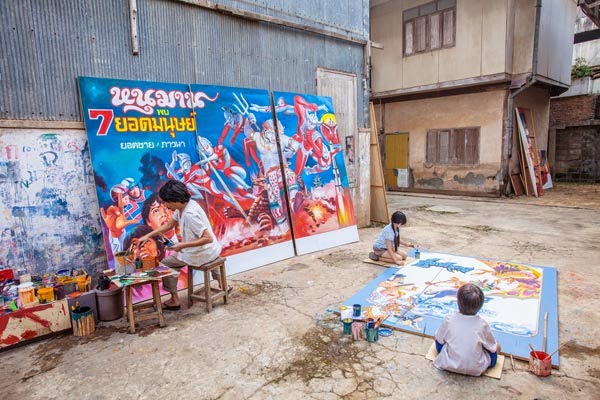
Tukkae and Pang take to hanging around the town's wooden shophouse cinema. It's during a magical time when such Thai cinema classics as Sombat Metanee's gritty actioner Chumpae is playing alongside Payut Ngaokrachang's animated triumph The Adventures of Sudsakorn and Sompote Sands' insane Hanuman vs. 7 Ultraman.

The kids are mentored by the theater's poster painter, played by Yuthlert's longtime collaborator "Uncle" Adirek Watleela. His character Pong Poster is a heartfelt tribute to still-living 1970s' director Piak Poster, who started out as a poster artist, as well as Uncle's late Buppa Rahtree co-star, character actor and production designer Bunthin Thuaykaew.

Tukkae, always on the defensive because of his funny nickname and his status as a poor orphan kid, seeks to play with the gang of chubby boys who always bully him. In lively action scenes, they blast away with their cap guns while wearing Red Eagle masks, like Mitr Chaibancha. And Tukkae accepts a dare that drives Pang out of his life, seemingly forever.

Flash forward a few years to Bangkok, Tukkae is a comic-book artist with aspirations of getting in the movie business. He's partnered up with a level-headed and experienced film hand, amiably played by Slice director Kongkiat Khomsiri, one of several film industry hands in the cast. In another scene, Thanit Jitnukul (Bang Rajan) turns up as a producer. He can't believe Tukkae doesn't know what a "treatment" is.

The guys are tasked with making a Mae Nak "liverscape" movie by a hilariously marble-mouthed B-movie producer who sees nothing wrong with moving the famous ghost story from Phra Khanong to Chiang Khan. Tukkae has other ideas, and he writes an "untitled" screenplay that is basically his life story, with a focus on his relationship with Pang.


The implausibilities stack up as Tukkae encounters Pang by chance in a Bangkok disco, and she doesn't remember him at all. In fact, nobody from Tukkae's old school remembers what anybody looks like. But this is, refreshingly, before Facebook and selfies, so I suppose the disbelief can be suspended somewhat. Mistaken identities and misunderstandings add to Tukkae's woes as Pang wakes up in Tukkae's bedroom and doesn't recognize Tukkae or any of his stuff (not even the Viewmaster she gave him).

But the two are thrown together anyway when Pang, now a famous actress, is cast for the role in Tukkae's movie. Awkwardness ensues on the set as Pang is confronted with the guy she only recognizes from that bad night out. She doesn't realize it's her old childhood friend, nor does she seem aware that he actually wrote the screenplay for the movie she's in.

The energy and sweetness of the movie's first half gives way to a wallowing slackness that's struggling to find an ending. It's not helped by the rather wooden performances by Kao Jirayu and Pleng Chontida. Kao, a former child actor with many credits, has better chemistry in later scenes with his character's dementia-addled grandmother who raised him. Pleng, the celebrity offspring of singer Nantida Kaewbuasai and scandal-plagued politician Chonsawat Asavahame, is making her screen debut, but seems to let a curly hairstyle and aviator sunglasses do all the work for her.


The supporting cast, especially the Tukky-type actress who plays Pang's best friend and manager, help to liven things up. She is friends with soldiers at the local army base, and they turn up on command to dish out beatings to anyone getting on her wrong side. Boriboon Chanruang portrays a director who spent so long in New York he's forgotten to speak Thai. He becomes Tukkae's chief rival in romancing Pang.

Yuthlert seems to have suppressed his infamous genre-jumping tendencies in an effort to make what he's called his first romantic comedy, though melodrama, horror and slapstick all creep their way in, just not as much or as often as his past films.

Tukkae Rak Pang Mak also marks a comeback of sorts for Yuthlert, who has done more than a dozen films over around half as many years up until a year or so ago. However, his last effort, the potentially controversial Deep South drama Fatherland (ปิตุภูมิ พรมแดนแห่งรัก, Pitupoom) was yanked from release by the film's producer. So Yuthlert retreated to Loei to regroup.

His new film is the first release from a new studio, Transformation Films, which is a joint venture of M Pictures, Bangkok Film Studio (formerly Film Bangkok), True I-Content and Matching Studio.

Box-office performance for Tukkae has been middling, with 12.7 million baht in earnings at last count, but hopefully the company will soldier on and perhaps give one of Thai cinema's most distinctive voices yet another chance to tell his stories.

See also:


Friday, October 5, 2012

25 more films picked for Thai historical registry

A still from Chok Song Chan (Double Luck). Only about one minute of the 1927 film survives.

King Rama VIII's arrival in Bangkok, a fragment of a 1927 silent and aerial footage of Bangkok being bombed during World War II are among the additions this year to the Thai Culture Ministry's Registry of Films as National Heritage.

The listing by the Culture Ministry and the Thai Film Archive coincides with Thai Film Conservation Day. The registry was initiated last year with 25 entries, and this year's list has 25 more historic films.

From 1938, King Rama VIII's Arrival in Thailand is "rare and precious" footage, archive director Dome Sukwong was quoted as saying by The Nation today. The newsreel chronicles the arrival of 13-year-old King Ananda Mahidol and members of his family, including his younger brother, the present king, the Princess Mother and sister Princess Galyani Vadhana. Picked as king when he was 9 years old, the boy monarch was born in Germany and raised overseas. He was chosen king after the abdication of King Rama VII, following a coup that established the constitutional monarchy.

The earliest entry on this year's list is 1927's Chok Song Chan (โชคสองชั้น, Double Luck), the first film produced by a Thai company, the Sri Krung studio. Before then, there was the Hollywood co-production Miss Suwanna of Siam, which has been lost. King Kong director Merian Cooper's jungle adventure Chang was made around the same time. But Double Luck is considered the first actual Thai feature film. Unfortunately, all that remains is about 82 feet – around 1 minute – of a car chase.

The World War II footage was shot aboard a B-29 bomber on December 14, 1944. Thailand, having been occupied by Japan, actually issued a declaration of war against the Allied powers. Another news clip from the World War II era is a parade of soldiers fighting for the Seri Thai or Free Thai movement, which was opposed to the Japanese occupation and the totalitarian Thai government of the time.

An interesting artifact is 1967's Gnathostoma Spinigerum and Gnathostomiasis in Thailand, a short film made by a Thai physician to present his findings about roundworms and the illness caused by them.

Another historic reel is the first Thai animated film, 1955's Hed Mahassajan (The Miraculous Incident), by the "Walt Disney of Thailand", Payut Ngaokrachang. The short depicts a humorous city outing by a gentleman – Payut himself – and culminates in a traffic pileup caused by a policeman being distracted by a popped button on an attractive lady's outfit.

Feature films on the list include the 1958 musical drama Dark Heaven, the first color film by pioneering auteur RD Pestonji. There's also 1959's Mae Nak Phra Khanong, the first of many adaptations of the famous legend of the ghost wife.

The romantic drama Reun Pae (The Houseboat) from 1961 is another enduring classic. Even today, youngsters can hum along to the theme song. Historic for a number of reasons, it was a Hong Kong co-production and was shot on 35mm with sound, rare for the era when post-dubbed 16mm films were still prevalent. It was chosen for restoration through a grant by Technicolor and the Thomson Foundation a few years ago.

Iconic screen couple Mitr Chaibancha and Petchara Chaowarat star in the 1965 entry, the sprawling musical comedy Ngern Ngern Ngern (Money, Money, Money) and 1970's action drama Insee Tong (Golden Eagle), which Mitr died making, being killed in a fall from a helicopter while filming the last scene. Petchara's first film, 1961's The Love Diary of Pimchawee, is also on the list.

Even the costumed B-movie antics of notorious cult director Sompote Sands are honored in this year's list, with Hanuman vs Seven Superheroes from 1974 making the cut. It has footage of Thai mythological characters intercut with footage from a Japanese Ultraman movie.

There are also examples of "social problem" movies, with Kru Bannok (The Country Teacher) from 1978 and MC Chatrichalerm Yukol's taxi-driver drama The Citizen starring Sorapong Chatree from 1977. Another social-realism stalwart, Vichit Kounavudhi, is represented with his early effort, 1961's Hands of a Thief.

Newer notable films are also included, such as 1999's gritty urban homelessness drama Kon Jorn. The most recent entry on the list being Uruphon Raksasad's award-winning farmer drama Sawan Ban Na (Agrarian Utopia) from 2009.

Registry of Films as National Heritage, 2012

  1. Chok Song Chan (เรื่องโชคสองชั้น , Double Luck), 1927
  2. Cheewit Kon 2475 (ชีวิตก่อน 2475, Life Before 1932, 1930
  3. Hae Rattathamanoon (แห่รัฐธรรมนูญ , National Constitution Parade, 1933
  4. King Rama VIII's Arrival in Thailand, 1938
  5. The bombing of Bangkok, 1944
  6. Seri Thai March, 1945
  7. Hed Mahassajan (เหตุมหัศจรรย์ , The Miraculous Incident), 1955
  8. Sawan Meud (สวรรค์มืด , Dark Heaven), 1958
  9. Mae Nak Phra Khanong (แม่นาคพระโขนง), 1959
  10. World Boxing Championship, match between Hua Hin native Pon Kingphetch and Argentina's Pascal Peres, Bangkok, 1960
  11. Meu Jon (มือโจร, Hands of a Thief), 1961
  12. Reun Phae (เรือนแพ , The House Boat), 1961
  13. Bunteuk Rak Khong Pimchawee (บันทึกรักของพิมพ์ฉวี, The Love Diary of Pimchawee), 1962
  14. Ngern Ngern Ngern (เงิน เงิน เงิน, Money, Money, Money), 1965
  15. Saneh Bangkok (เสน่ห์บางกอก , Charming Bangkok), 1966
  16. Gnathostoma Spinigerum and Gnathostomiasis in Thailand, 1967
  17. A Drug Inmate's Execution by Firing Squad, 1967
  18. Insee Thong (อินทรีทอง, Golden Eagle), 1970
  19. The Dalai Lama Visits Suan Mokkh, 1972
  20. Hanuman Pob 7 Yod Manut (หนุมานพบ 7 ยอดมนุษย์ , Hanuman vs the Seven Superheroes, 1974
  21. Thongpoon Khokpho Rassadon Temkhan (ทองพูน โคกโพ ราษฎรเต็มขั้น, The Citizen), 1977
  22. Kru Bannok (ครูบ้านนอก, The Country Teacher), 1978
  23. Muang Nai Mhok (เมืองในหมอก , City in the Mist), 1978
  24. Kon Jorn (คนจร ฯลฯ ), 1999
  25. Sawan Ban Na (สวรรค์บ้านนา, Agrarian Utopia), 2009

Kong Rithdee further details the list in his article today in the Bangkok Post.

Monday, September 10, 2012

In memoriam: Pawana Chanachit, the 'Pearl of Asia'

Pawana at the Thai Film Archive on Mitr Chaibancha memorial day in 2009.

Thai leading lady Pawana Chanachit (ภาวนา ชนะจิต) has died. At the height of her career in the 1960s and '70s, she was known as the "Pearl of Asia", famed for her many roles in Hong Kong movies, among them Duel of Fists, the Shaw Brothers' Bangkok action drama starring David Chiang and Ti Lung and directed by Chang Cheh.

She began her acting career in 1960, starring in Saeng Soon (แสงสูรย์) with Mitr Chaibancha and Amara Assavanonda and winning a Golden Doll award for her role.

Born Aranyaporn Laosaengthong on December 20, 1943 to a Mandarin Chinese family, her nickname was Yin.

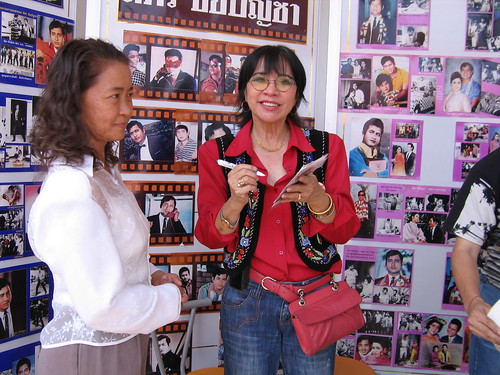
An action film heroine, Pawana remained a fan favorite long after she stopped acting. At the Mitr Chaibancha memorial day at the Thai Film Archive in 2009, the still-bubbly and bright actress attracted dozens of autograph seekers. Her hand and footprint impressions at the archive is signed "the Pearl of Asia".

According to the Bangkok Post and other news reports, she was found in a pond at her home in Nakhon Pathom. She was 69.

Update: The Nation has a story in which relatives cite "suspicious circumstances".

(Via Ninja Dixon)

Thursday, October 13, 2011

Culture Ministry lists 25 films as Thai national heritage


Thailand's Culture Ministry and the Thai Film Archive have started a registry of national heritage films. The initial 25 titles go back as far as the beginning of film history up to the accomplishments of today and range from shorts to features. It includes newsreels, travelogue, documentaries, experimental films and fictional features.

The earliest is 1897's Berne: Arrivee du Roi de Siam, chronicling the arrival of King Chulalongkorn in Berne, Switzerland, likely the first filmed record of a Siamese person.

The most recent is last year's history-making Uncle Boonmee Who Can Recall His Past Lives by Apichatpong Weerasethakul, the first Thai film to win the prestigious Palme d'Or at the Cannes Film Festival.

A news release says that according to Culture Minister Sukumol Khunpluem "the films deserved to be the national heritage for they are the masterpieces of Thai filmmakers and are about Thai people and Thai culture."

Among the entries is The Flood in Bangkok 1942 by Tae Prakardwuttisan, which has been making rounds at a time when Bangkok is threatened by a record deluge of water. It's embedded above. Many other examples on the list, including episodes from Thai history that are politically sensitive topics, can also be found on YouTube.

Here's the list of 25 Films as National Heritage 2011, in Thai alphabetical order:

  1. การต่อสู้ของกรรมกรหญิงโรงงานฮาร่า, The Struggle of Hara Factory Workers (1975) by Jon Ungpakorn – A documentary about the women workers in the Hara Jean factory who seized the factory to fight back at the owner.
  2. คล้องช้าง, Klongchang (1938) – An elephant round-up filmed by a Japanese crew, the first half is a look at old Bangkok's streets and lifestyle, which even today is popular stock footage for TV shows and news programs. The second half is the actual elephant round-up.
  3. ทองปาน, Tongpan (1977) – This documentary-style drama, directed by Euthana Mukdasanit and Surachai Jantimatorn and written by Khamsing Srinawk, Paijong Laisagoon and Mike Morrow, is a look at a man who lost his farm because of dam construction attending a seminar about the building of another dam. Because of its socialist leanings, the film was actually banned for a time.
  4. ทวิภพ (ฉบับผู้กำกับ), Siam Renaissance (Director’s Cut) (2005) by Surapong Pinitkha – This is one of many adaptations of writer Thommayanti's novel Thawipob, about a present-day woman who time-travels through her mirror to Rama V-era Siam and falls in love with a man from the past.
  5. โทน, Tone (1970) by Piak Poster – The debut feature by Piak, this sweeping romance, musical and action drama follows a poor young man (Chaiya Suriyun) as he's spurned by the girl he has a crush on, eventually moves to Bangkok to attend college but trouble from his home village follows him. Roj Ronnapop, Aranya Namwong, Jaruwan Panyopas, Sa-ad Piempongsan and Sangthong Seesai also star. The movie is notable for the music of the popular "string music" group of the 1960s and '70s, the Impossibles.
  6. นิ้วเพชร, The Diamond Finger (1958) by Ratana Pestonji – A khon (masked dance) episode of the Ramakien is lavishly mounted by the pioneering filmmaker.
  7. น้ำท่วมกรุงเทพ 2485, The Flood in Bangkok 1942 (1942) by Tae Prakardwuttisan – Tae was a photographer, journalist and film producer who was named a National Artist of Performing Art (Cinema and Drama) in 1999.
  8. Record of October 6, บันทึกเหตุการณ์ 6 ตุลา (1976) – This was the date of the 1976 Thammasat University Massacre, which was a deadly crackdown on anti-dictatorship students and protesters by the police and military.
  9. Pi Tong Leaung, ผีตองเหลือง (1962) – An ethnographic film about the Mra Bri people, also known as the "yellow banana leaf tribe".
  10. ผีเสื้อกับดอกไม้, Butterfly and Flowers (1985) by Euthana Mukdasanit – Adapted from the award-winning 1978 book by the writer Nipphan, this drama is about a boy who sells ice treats at a southern Thailand railway station and is forced by economic hardships to smuggle rice across the border.
  11. แผลเก่า, The Scar (also Plae Kao, 1977) by Cherd Songsri – Classic star-crossed romance in the ricefields, with the headstrong Kwan (Sorapong Chatree) hopelessly in love with Riam (Nantana Ngaokrachang), the daughter of a rival village chief.
  12. พระเจ้ากรุงสยามเสด็จ ฯ ถึงกรุงเบิร์น, Berne: Arrivee du Roi de Siam (1897) – King Chulalongkorn's arrival in Berne, Switzerland, was recorded and when the entourage returned the king's brother Prince Thongthaem "the Duke" Sambassatra brought filmmaking equipment, making him "the father of Thai cinema".
  13. พระเจ้าช้างเผือก, The King of White Elephant (1941) by Santi Wasutharn – Statesman Pridi Banomyong produced this epic, set during the Ayutthaya Kingdom era, about a monarch who is reluctant to go to war, but then does so when he's attacked. Made as the threat of Japanese occupation loomed, the English-language film, featuring students and faculty from Pridi's Thammasat University, was intended as anti-war propaganda and a statement to the outside world that not everyone in Thailand were ready to side with Japan.
  14. พระราชพิธีเฉลิมกรุงเทพมหานครและพระราชวงศ์จักรีอันประดิษฐานมาครบ ๑๕๐ ปี, The Celebrations of the 150th Anniversary of the Founding of Bangkok (1932)
  15. The Coronation of King Prajadhipok (1925) – King Rama VII ruled 25 from 1925 until his abdication in 1935.
  16. ไฟเย็น, Fai Yen (also Cold Fire, 1965) – An anti-communist propaganda film.
  17. ประมวลภาพเหตุการณ์สูญเสียพระเอกผู้ยิ่งใหญ่ มิตร ชัยบัญชา, Chronicle of the Loss of Mitr Chaibancha (1970) – This film clip is a record of the outpouring of grief over actor Mitr Chaibancha, who fell to his death from a helicopter on October 8, 1970, while performing a stunt for the movie Golden Eagle.
  18. มนต์รักลูกทุ่ง, Monrak Luk Thung (1970) – This musical romance, set in the countryside, starred the era's classic screen couple Mitr Chaibancha and Petchara Chaowarat. The soundtrack was hugely popular and the movie remained in cinemas for six months.
  19. รัฐประหาร 2490, Coup d' Etat (1947) by Tae Prakardwuttisan – The coup, led by Lt-General Phin Choonhavan, ousted the unpopular government of Rear Admiral Thawan Thamrong Nawasawat and eventually led to the return to rule by the wartime dictator Field Marshal Plaek Pibulsonggram.
  20. โรงแรมนรก, The Country Hotel (also Rong Raem Narok, 1957) by Rattana Pestonji – A cavalcade of music acts, arm-wrestling, boxing and comedy skits enliven this crime drama about a mysterious man and woman on the run from the mob hiding out at a bizarre bar and one-room guesthouse.
  21. ลุงบุญมีระลึกชาติ, Uncle Boonmee Who Can Recall His Past Lives (2010) by Apichatpong Weerasethakul – A terminally ill man is visited in his last days by his closest surviving family members who pay witness to the strange and spiritually supernatural aspects of their dying uncle's incredible life.
  22. ลูกอีสาน, Son of Northeast (also Look Isaan, 1982) by Vichit Kounavudhi – This landmark drama follows the migrations of a close-knit group of struggling farming families in northeastern Thailand of the 1930s.
  23. สุดสาคร, Sudsakorn Adventure (1979) by Payut Ngaokrachang – The first Thai animated feature is adapted from poet Sunthorn Phu's epic Phra Aphai Mani and follows the adventures of a boy who is the son of a mermaid and a minstrel prince.
  24. อนุทินวีรชน ๑๔ ตุลา, Diary of October 14 Heroes (1974) – Recounting the events of October 14, 1973, in which a deadly crackdown on pro-democracy student activists resulted in His Majesty the King removing a field-marshal dictator and the country's return to a democratically elected government. It's an earlier bookend to 1976's Record of October 6, which marked a bloody return to military dictatorship.
  25. ! (1977) by Surapong Pinitkha – An exclamation mark is the title of this experimental film about poverty.

Many thanks to Chalida Uabumrungjit, deputy director of the Thai Film Archive, for translation of the list.

Thursday, October 6, 2011

In Memory of Mitr Chaibancha on Saturday at the Film Archive


Forty-one years ago this Saturday, October 8, superstar actor Mitr Chaibancha fell to his death from a helicopter while making Insee Thong (Golden Eagle).

As they do each year in memory of Mitr, the Thai Film Archive will have a special program including some of Mitr's movies.

They'll screen the 1966 comedy Sam Kler Jer Long Hon (สามเกลอเจอล่องหน, "three friends meet the invisible man") at 10.30am, with a team of live dubbers. Petchara Chaowarat and Ruj Ronnapop also star.

Following lunch, at 2pm, actress Butsakon Sakonrat, who co-starred with Mitr in some other movies, will have her hand-and-foot impressions made in the Star Terrace outside the Sri Salaya Theatre.

And at 3.30, there will be a presentation of a voice clip of Mitr from 1965, obtained from the Rank Organization in the U.K. It's a rare opportunity to hear Mitr's voice, because in all his films, his voice was dubbed.

Thursday, December 23, 2010

Outdoor movie dubbers stage swordfights with forks and spoons


Movies on the Beach in the nang klang plang tradition of Thai outdoor cinema are continuing this week at the Ramada Plaza Menam Riverside Bangkok.

I caught last Saturday's double feature of 1966's Suek Bang Rajan and 2000's Bang Rajan.

The setting is a sand-covered plaza on the riverfront at the Ramada hotel, which is downstream from the Saphan Taksin pier. It's easily reachable from the pier by a shuttle boat from the hotel that runs every half hour.

Instead of movie-theater seating, there are beach-style lounge chairs set up in rows.

Starting well after dusk, at around 7.30, the first feature was 1966's Battle of Bang Rajan, starring Sombat Metanee in a commanding performance that won him a Tukata Tong (Golden Doll) award, which was handed to him personally by His Majesty the King.

Instead of the soundtrack, a team of five dubbers handled all voice work, music and sound effects. They worked from a table next to the projector tent, which was set up behind the beach chairs.

Two men and two women handled all the voices, from the heroic leading man to the comic-relief characters. Sound effects for this historical action epic were simple but effective – forks and spoons from dinner provided the clanging of swords, a pair of small coconut shells were the sound of pounding horse hoofs. Braying horses, trumpeting elephants, gunshots, cannon fire and the cries of dying men and women were all covered by the men and women behind the mic. A fifth member of the team worked a cassette player, swapping tapes in and out with music suited to the mood – rousing orchestral cues for the action scenes, and slow Thai traditional instrumentals for the romantic settings.

Fantastic as the movie was – it's the Alamo-like tale of heroic villagers who put themselves between the capital at Ayutthaya and the entire army of invading Burmese – it was hard to not turn around and see how the dubbers worked their magic.

Just how effective they were became evident when director Thanit Jitnukul's 2000 remake Bang Rajan was the second feature and the dubbers went away to let the soundtrack play. I felt like it was missing something, even with all the modern movie magic of CGI blood and digitally hacked-off limbs.

Compared to the newer version, the first Bang Rajan is lots more colorful, with lots of reds, yellows and greens, especially the women's costumes. The stories are the same. The village is up against overwhelming odds. Even the women get in on the two-handed swordfighting action. And yes, the village drunk climbs aboard a water buffalo to gallop into battle, though in the old version, the ride is short-lived – a letdown compared to the awesomely heroic ride Bin Binluert takes in 2000's version.

They showed films. Actual film reels, running through a projector. That was good to see in this age of DVDs and digital projectors. In previous outdoor film screenings I've been to, they have two projectors, which the projectionist uses to keep the flow steady, with no discernable interuption between reels. I swear I've even seen that feat accomplished with one projector, but the projectionists handling Saturday's screening had trouble keeping up with the cigarette burns, so there were pauses between reels.

And I was surprised at just how bad a shape the print of 2000's Bang Rajan was in. It seemed just as scratched up and jaggedy as the 1966 film.

Shows just how fragile a medium film is.

Movies on the Beach continue through Sunday.

Tonight's show is the 1970 smash-hit musical Monrak Luk Thung (Magical Love in the Countryside), starring Mitr Chaibancha and Petchara Chaowarat. Back in the day, it played in cinemas for six straight months.

Christmas Eve has 1970's Insee Tong (Golden Eagle), which features the fateful helicopter stunt that killed Mitr on October 8, 1970. I expect the dubbing team will be handling that one.

It's on a double bill with this year's Insee Dang (The Red Eagle), an action-packed reboot of Mitr's long-running franchise by director Wisit Sasanatieng, featuring Ananda Everingham in the lead role of the masked vigilante crimefighter.

Christmas night has a pair of monastic comedies, Luang Ta 3: Seeka Khang Wat from 1991 and Phranakorn's 2005 smash-hit Luang Phee Theng (The Holy Man).

The screening series closes on Sunday with the 2001 romantic drama Khang Lang Phab (Behind the Painting), the final film by the late director Cherd Songsri, starring "Ken" Theeradej Wongpuapan and Cara Pholasit.

The price is a bit steep, which may be the reason audiences are so sparse – 350 baht for the one-movie nights and 450 baht for the double-feature nights. That includes your choice of beverage and/or food.

Wednesday, December 15, 2010

Eagles and Mitr fly in outdoor movie shows


Thai films will be screened in the classic nang klang plang (open-air) style – including live dubbing – nightly from Friday until December 26 in the Movies on the Beach show at the Ramada Plaza Menam Riverside Bangkok Hotel on Charoenkrung Road.

Filmmaker Pantham Thongsang curates the program, mixing classics with contemporary Thai movies.

The program starts with Khoo Kam, a classic tale of star-crossed lovers during World War II. Many versions of this story have been filmed, and they'll show two of the best remembered – the 1973 version starring Nat Phoowanai and Duangnapha Attapornwisan and 1996's with Thongchai "Bird" McIntyre in the role of a Japanese officer and Apasiri Nitibhon as the Thai woman he's in love with.

Saturday's show will have dueling historical dramas, starting with 1966's Suek Bang Rajan, starring Sombat Metanee in a performance that won him a Tukata Tong (Golden Doll) award, which was handed to him personally by His Majesty the King. Phitsamai Wilaisak also stars. It's in a double-feature bill with Thanit Jitnukul’s blood-soaked battle epic Bang Rajan, which became an international cult hit after its release in 2000.

Sunday will feature the martial-arts exploits of legendary actor Mitr Chaibancha and his leading lady Petchara Chaowarat in the high-flying Hong Kong wire-fu swordfighting fantasy Atsawin Daap Gaaiyasit (อัศวินดาบกายสิทธิ์). According to Thai Worldview, another actor named Chat Chayaphum from Chayaphum province was brought in to complete the film after Mitr died.


During the week, there will be the films by Pantham and Somkiet Vituranich: the talking-dog drama Ma Mha (Mid-Road Gang) on Monday, and 2004's social drama Ai Fak (The Judgement) on Tuesday.

Nonzee Nimibutr's 1997 debut feature Dang Bireley's and Young Gangsters about teenage hoodlums in the 1950s (screenplay by Wisit Sasanatieng) shows on Wednesday.

And there's the smash-hit 1970 musical Monrak Luk Thung (Magical Love in the Countryside), starring Mitr Chaibancha and Petchara Chaowarat.

Christmas Eve has more Mitr action in 1970's Insee Tong (Golden Eagle), which features the fateful helicopter stunt that killed Mitr on October 8, 1970. It'll be in a double bill with this year's Insee Dang (The Red Eagle), an action-packed reboot of Mitr's long-running franchise by director Wisit Sasanatieng, featuring Ananda Everingham in the lead role of the masked vigilante crimefighter.

Christmas night will offer spirituality and laughs in the Buddhist monk movies Luang Ta 3: Seeka Khang Wat from 1991 and Luang Phee Theng (The Holy Man).

The program closes with the 2001 romantic drama Khang Lang Phab (Behind the Painting), the final film by the late director Cherd Songsri, starring "Ken" Theeradej Wongpuapan and Cara Pholasit.

Tickets are Bt350 for one screening and Bt450 for two movies on Friday and Saturday. Part of the proceeds will benefit the Thai Film Foundation. Call (02) 688 1000.

Thursday, October 28, 2010

Inseedang-a-rama: Reviews and political views on The Red Eagle


Still lots of strands in this old duder's head about The Red Eagle (Insee Dang, อินทรีเเดง).

Heck, I've seen it twice and still haven't counted the three Wilhelm screams director Wisit Sasanatieng says he's embedded his in his film.

The much-anticipated action thriller stars Ananda Everingham in a role made famous by screen legend Mitr Chaibancha in a series of Thai action films in the 1960s, and ending in 1970 when Mitr died in a fall from a helicopter while making The Golden Eagle.

The hyped superhero movie has been met with mostly negative or mixed criticism, mainly because the ultra-violent Dark Knight-style action flick is seen as a major departure from the colorful stylizations Wisit displayed in his earlier films, Tears of the Black Tiger and Citizen Dog. It's also being assailed for its 130-minute length. And there's the ending, which only briefly shows the much-hyped shot of Ananda dangling from a helicopter ladder to complete the stunt Mitr died for. It's a teaser for a part two, The Red Eagle: War of the Deadly Psychobots, which in all likelihood will never happen because Wisit says making The Red Eagle was such a struggle, creatively and budget-wise, that he's leaving the film industry.

A Nutshell Review and TwitchFilm.net critic Stefan Shih, who came to Bangkok for the October 4 premiere, has already issued his review.

Oh, and Asian Cinema – While on the Road was stirred from dormancy to review The Red Eagle. A momentous occasion.

And since the movie had its international premiere at the Pusan International Film Festival, the industry press has weighed in.

Maggie Lee of The Hollywood Reporter saw it. Here's a bit from her review:

Visual wizard and fantastical yarn-spinner Wisit Sasanatieng seems to be flying with clipped wings in directing The Red Eagle?, the anticipated remake-cum-homage to the 1960s Thai superhero action series Insee Daeng. There is not a trace of the gloriously colorful retro camp of his debut Tears of the Red Tiger nor the flights of CGI fancy in his sophomore Citizen Dog. Had Sasanatieng's name not been attached, the project may qualify as technically high-end Asian genre fare but marketing to his cinephile fans would turn converts into skeptics. Locally, Insee Daeng's cult status would prompt Thais to see Red Eagle for old time's sake.

On to Richard Kuiper's review for Variety:

A Thai superhero is reborn with middling results in The Red Eagle. Reboot of a popular 1960s pulp franchise arrives with special effects galore and a Batman-like protag burdened with the now de rigueur psychological hang-ups, but aside from a few eye-catching setpieces, there's little excitement or cinematic flair on display. Souped up for young auds by usually super-inventive stylist Wisit Sasanatieng (Tears of the Black Tiger), pic underperformed on October 7 local release, casting doubt over whether its "to be continued" tag will come to fruition. Overlong actioner has modest regional claims and much stronger ancillary prospects.

Uh, yeah. About that box-office performance. It opened at No. 2, way behind Zack Snyder's 3D Australian talking-owl cartoon, earning 5.5 million baht, with the latest Box Office Mojo figures showing earnings of around 10.8 million baht. Before The Red Eagle opened, the No. 1 had been a Thai action-comedy, Yuthlert Sippapak's Saturday Killer, which at latest count had raked in around 17.6 million baht.

Meanwhile, The Red Eagle's place in history has been the subject of political pundits, with Asian Correspondent's Siam Voices posing the view that the movie is an allegory to the current Thai political situation.

The Nation got some guy on video and had him blather on a bit about the movie. I don't think he knows what he's talking about.

Whatever. The beauty of The Red Eagle is that could represent anytime, anyplace and any particular situation in its depiction of corrupt government and business forces running roughshod over the little guys. When you can't go to the cops, who ya gonna call? Insee Dang!

A couple other strands:

  • Wisit has always been known from his interesting and unique casting choices, which started with the Columbian-Italian model Stella Malucchi as his leading lady in Tears of the Black Tiger. In addition to TV-commercial actor Jonathan Hallman, who makes his big-screen debut as the Black Devil, there's TV host, musician and writer Wannasingh Prasertkul playing the brash young police detective Chart. The Nation had a profile of him. Even Lieutenant Chart's boss in the movie is played by a newcomer – it's veteran Nation Auto Talk columnist Pattanadesh Asasappakidj.
  • Singer Burin Boonsvisut claims he was the first choice for the role of Insee Dang that was taken by Ananda Everingham. He turned it down. Instead, the former Groove Riders frontman recorded a ballad that's used as the theme for The Red Eagle.

Update: Film Business Asia's Derek Elley has his review, summing it up as a "messy Thai superhero movie [that] sledge-hammers the viewer into submission."

Friday, October 22, 2010

Review: The Red Eagle (Insee Dang)


  • Directed by Wisit Sasanatieng
  • Starring Ananda Everingham, Yarinda Bunnag, Pornwut Sarasin, Jonathan Hallman, Wannasingh Prasertkul
  • Released in Thai cinemas on October 7, 2010; rated 18+
  • Wise Kwai's rating: 5/5

Perhaps the most Hollywood-like movie yet made by the Thai film industry, The Red Eagle (Insee Dang, อินทรีเเดง) is a big, loud and brash superhero action flick that is mostly relentless in its pace and hyper-stylized violence.

Wisit Sasanatieng directs this much-anticipated reimagining of the 1960s action franchise that starred the legendary Mitr Chaibancha, which was originally based on a series of crime novels by writer Sake Dusit.

Fans hoping for the colorful camp and dry wit of Wisit's previous films like Tears of the Black Tiger and Citizen Dog might come away disappointed with the director's latest effort. He was disappointed too, and creative differences and budgetary pressures have prompted Wisit to say this will be his last studio film.

Restrained as he might have been stylistically, there's still loads of Wisit's cheeky brand of satiric humor. I think he had the most fun with the over-the-top product placements in this film, covering just about everything from a local roasted-chicken chain to an energy drink. Villains fight to the death atop a life-insurance company's billboard. And copious amounts of certain local beer is consumed, surely all with the knowledge that the labels on those little brown bottles will be blurred out by censors when the movie airs on Thai TV, because of restrictions on alcohol advertising.


There's also health advisories built in, like when a man smoking a cigarette has his head lopped off by Red Eagle's sword, and as the still-puffing noggin is rolling on the ground, there's the warning, "smoking is hazardous to your health."

And, in a nod to the in-jokes and cliches of Hollywood action filmmaking, Wisit's even included a few Wilhelm screams (there are three, he says) – characteristic painful yelps by random henchguys who are disposed of in various diabolical ways. I don't know where Wisit got the idea to include the Wilhelms.

Thailand's current top leading man, Ananda Everingham, capably steps into Mitr's role. The Red Eagle he portrays is a much darker and brooding character. Instead of the fun-loving drunken playboy lawyer that was Mitr's alter ego, this Rome Rittikrai is an angry loner – a former special forces operative who was betrayed on the battlefield. One cool customer, he lives in the basement of an icehouse, and takes morphine because of a bullet wound to the head.

Fueled by pain and self-loathing over his addiction, he strikes out with great vengeance and furious anger those dark and corrupt forces who are poisoning and destroying Thai society. Cool gadgets at his disposal include a sword with a collapsible blade, a powerful big motorcycle, bullet-resistant clothes, infra-red goggles built into his mask, rubber masks so he can disguise himself and an arsenal of firearms.

But the sides are closing on him.


Squeezing him from one direction is a shadowy organization known as the Matulee, whose members dress all in black, meet in dark rooms and wear scary black masks. (It's said this is a nod to the traditions of khon dance theater and the Thai saying that if you wear a khon mask you are acting in a role different from your true self.) The Matulee control the government and the big-business interests, and they have tasked a fierce killer to go after the Red Eagle – the Black Devil, a Dr. Doom-like hooded character with a wild curved blade, who pounces from the rooftops. Black Devil and his alter ego are played by Jonathan Hallman, a model who's acted in TV commercials – another new find by Wisit and his casting director.

Crowding Red Eagle on another side is a brash and impatient young police lieutenant, Chart Wutthikrai (Wannasingh Prasertkul). A stock character if there ever was one, if he were older, he could easily say "I'm gettin' too old for this shit." Here, the character's conceit is that whenever he gets ready to smoke a cigarette, he never gets to light it – also a possible nod to planned TV airings of the movie, in which cigarette smoking will be blurred out.

As it turns out, Chart is actually an old army buddy of Rome, and yet even he can't see that it's his friend's face behind that high-tech red mask.


The breathless pace of the action – spurred on by a fast-paced recurring orchestral theme – only lets up for tender moments between Ananda and his leading lady, the folk singer and actress Yarinda Bunnag, who previously appeared in the GTH romantic drama Best of Times. She's the socialite ex-fiancee of the Thai prime minister – played with quiet menace by Pornwut Sarasin, the Thai Coca-Cola executive who previously acted in Pen-ek Ratanaruang's Ploy.

Politics has changed the former grass-roots activist, and he's now in bed with the powerful interests that want to build a nuclear power plant in Thailand. And she's taken over his role as the leader of the anti-nuclear grass-roots NGO.

So the Red Eagle becomes her protector.

There's been much talk about the political message of The Red Eagle, but I don't see anything that's specific to the current Thai situation. Maybe it's just because I'm not Thai. Sure, there's relevance, but the message about big business and politics colluding and being corrupted by power is universal. The Red Eagle could take place anywhere. He could be a hero to anyone.

And I hope he will be, even if the teased part 2 of The Red Eagle never does actually happen.


Related posts:

Thursday, September 30, 2010

Film Archive remembers Mitr 40 years later

This is the year of The Red Eagle.

Wisit Sasanatieng's new version of the Thai action franchise of the 1950s and '60s will be released in Thai cinemas next Thursday, October 7.

That's one day before the 40th anniversary of the death of the original Insee Daeng, superstar actor Mitr Chaibancha, who died on October 8, 1970, in an accident while filming Golden Eagle (Insee Tong, อินทรีทอง).

Each year around this time, the Thai Film Archive remembers Mitr with film screenings and other activities at the Sri Salaya Theater and Thai Film Museum in Salaya, Nakhon Pathom, and this year is a bit more special because of the 40th anniversary and because of the new Red Eagle.

The activities start on Friday, October 1, with a screening of Golden Eagle, which closes with Mitr's fatal helicopter stunt, filmed near Jomtien Beach, Pattaya.

Other Mitr movies screening are 1967's Jet Phra Karn (7 พระกาฬ), directed by Charlie Intaravichet and also starring Adul Dulyarat and Ruj Ronapop; Atsawin Daap Gaaiyasit (อัศวินดาบกายสิทธิ์), a 1970 martial-arts fantasy that was a Hong Kong co-production; 1966's Diamond Cuts Diamond (Pet Dtat Pet, เพชรตัดเพชร); 1970's Jom Joh Rom Hay (จ้าวอินทรี); and 1968's Jao Insee (จ้าวอินทรี ).

On October 8, the archive will screen last year's award-winning romance October Sonata (Ruk Tee Ror Koi, รักที่รอคอย) a period drama that has lovers fatefully meeting in Pattaya on October 8, 1970 – at the funeral of Mitr Chaibancha.

And on Saturday, October 9, there will be a talk and exhibition about Mitr at the Sri Salaya Theatre.

The rest of October, the Film Archive's screenings and activities consist of other recent Thai films that are set during the politically turbulent Octobers of the 1970s. These include October Sonata, Blue Sky of Love (Fah Sai Huajai Chuenbaab, ฟ้าใสใจชื่นบาน), Haunted Universities (Maha'lai Sayong Kwan, มหา’ลัย สยองขวัญ), Meat Grinder (Cheuat Gon Chim, เชือด ก่อน ชิม) and Bhandit Rittikol's The Moonhunter (14 tula, songkram prachachon, 14 ตุลา สงครามประชาชน, literally "14 October: war of the people"), as well as other social-message movies, such as MC Chatrichalerm Yukol's Hotel Angel, Sunset at Chao Phraya 2 and the banned 1977 docu-drama Tongpan (ทองปาน).

Showtimes are at 5.30 on weekdays (except Wednesdays) and 1pm on Saturday and Sunday. Please see the Film Archive website for the schedule. English subtitles aren't typically available, but if it matters to you, call ahead before visiting to verify.

Thursday, August 26, 2010

A new Red Eagle poster and behind-the-scenes clip


Here's a new character poster for Red Eagle (อินทรีเเดง, Insee Daeng), the superhero tale starring Ananda Everingham, directed by Wisit Sasanatieng.

It's a reboot of the Red Eagle franchise of the 1950s to '70s that starred action hero Mitr Chaibancha, about a masked vigilante crimefighter.

There's also the first behind-the-scenes reel, posted by Five Star on YouTube, showing Ananda working with trainers, doing stunts, firing guns and generally kicking butt. It's embedded below.

Also on YouTube is a Pattaya People newsclip, showing Ananda in action during last week's stunt show at Central Festival in Pattaya, in which he used modern safety devices to complete the stunt that killed Mitr 40 years ago during the filming of Golden Eagle.

If you haven't already, join the Red Eagle Facebook page for continued updates, much of it personally handled by master of promotion, Wisit himself. There's lots of great fan art there and even a Red Eagle comic.

Red Eagle hits Thai cinemas on October 7.


(Via NangDee.com)

Wednesday, August 18, 2010

Ananda Everingham in action as Red Eagle

Tempting fate, a red-masked, black-leather-clad Ananda Everingham dangled from a rope ladder and rode a motorcycle yesterday in a live stunt-show promotion in Pattaya by Five Star Production for the October 7 release of Insee Daeng (อินทรีเเดง, Red Eagle).

It was 40 years ago on October 8, 1970 at Dong Tan Beach, Jomtien, a few miles down the Gulf of Thailand coastline from Pattaya, where the original Red Eagle star, superstar actor Mitr Chaibancha, fell to his death while dangling from a rope ladder on a helicopter as it soared into the skies. He was making Insee Thong (Golden Eagle), the last in his long-running series of Red Eagle movies. There's a shrine to Mitr at Jomtien that to this day receives daily visits from fans and people praying for luck.

And, it was just a couple years ago that leading man Ananda himself took a nasty spill on a motorcycle and suffered serious injuries that delayed his work on this reboot of the Red Eagle franchise, which being directed by the imaginative director of Tears of the Black Tiger and Citizen Dog, Wisit Sasanatieng.

The original series, which started in the 1950s, is based on crime novels by Sake Dusit, about drunken playboy lawyer Rome Rittichai, whose alter-ego is the masked vigilante crimefighter Insee Daeng, similar to Green Hornet or Batman. Mitr starred in the series, with actress Petchara Chaowarat as his plucky confidante and assistant. There've also been other movie incarnations of Red Eagle, as well as TV dramas.

The Pattaya Daily News has an account of the stunt show with more photos, and says a helicopter was involved in yesterday's events at the Central Festival shopping mall on Pattaya Beach.

Actually, the sturdy steel-cable ladder was suspended on a sling between buildings at the shopping center, as photos show.

And, had the actor's grip on the ladder loosened, as Mitr's did back on that fateful day in 1970, Ananda would have been okay, because he was rigged into a climbing harness, attached to a safety rope.

Though the actors weren't in danger, it still must have been a thrill for Pattaya folks to get a look at the red-masked man and the movie's heroine, musician and actress Yarinda Bunnag.

You can get another look at Ananda in action in the Red Eagle trailer.

Wednesday, August 4, 2010

A quick and dirty teaser for Red Eagle

CGI trickery, explosions, weird weaponry, wire work and fast-paced cuts are involved in the 90-second teaser for Wisit Sasanatieng's Red Eagle, which is on YouTube. It's embedded below.

But there is at least a good look at Ananda Everingham on the move as a brooding hero who dons the red mask and tight black leather outfit to become the vigilante crimefighter, Insee Daeng (อินทรีเเดง ).

The Thai release date is penciled in for October 7, to coincide with the October 8 memorial day for actor Mitr Chaibancha, the original star of the Red Eagle series in the 1950s and '60s, who perished while filming a stunt for Insee Thong (Golden Eagle). This year marks the 40th anniversary of his passing.

But Red Eagle might still be delayed, as Film Business Asia reports:

Five Star Entertainment has warned that the timing could still slip backwards.

“It's our target date. We'll try to finish by this day but could not confirm yet due to post production with so many CGI shots. We have had a total of seven months to complete all CGI work,” a Five Star spokesman told Film Business Asia.

The effects wizards at Kantana, which is co-producing with Five Star, are likely putting in long hours to wrap things up in time.

Meanwhile, Wildgrounds somehow snagged a photo of Ananda in the mask.


(Via Five Star)

Thursday, July 29, 2010

Teaser poster and Thai release date for Red Eagle


Red Eagle is really happening.

The much-anticipated reboot of the Thai action-movie franchise by Tears of the Black Tiger director Wisit Sasanatieng has a Thai release date of October 7.

Red Eagle (Insee Dang, อินทรีเเดง ) stars Ananda Everingham as a masked vigilante crimefighter.

Ananda steps into a role most famously played by Thai screen legend Mitr Chaibancha from the 1950s to 1970, when Mitr took a fatal fall from a helicopter while filming Insee Tong (Golden Eagle).

The release date of Red Eagle is timed to coincide with the 40th anniversary of Mitr's death on October 8, 1970.

Musician and actress Yarinda Bunnag, who previously starred in Best of Times (Kwaam Jam San Dtae Rak Chan Yaao, ความจำสั้น แต่รักฉันยาว), co-stars.

During the Mitr Chaibancha era, Red Eagle was backed up by screen siren Petchara Chaowarat, making for one of Thai cinema's most popular pairings.

The plot of the new Red Eagle goes like this:

A nuclear power plant is about to be commissioned upon the signing of corrupt and power hungry politicians. The citizens are in frenzy, as they oppose this plan but they cannot do a thing about it. And so, a hero was born, chasing down the criminals and the corrupt, killing of whatever threatens the city's well being. He leaves a card with his name simply as "THE RED EAGLE". However, the hero becomes the hunted, when the politicians send out their best defense, known as “THE BLACK DEMON”.

A teaser trailer will coming soon.

I hope to be among the first to see it.

Meanwhile, there's also Wisit's Iron Pussy: A Kimchi Affair, a short that Wisit did with Michael Shaowanasai as part of Camellia, a.k.a. the Busan Project, due to premiere at this year's Pusan International Film Festival.

It's going to be a busy October for Wisit and his fans.

Update: Oh, check this out.

Tuesday, March 23, 2010

CNNGo's 'best films and greatest actors from Thai cinema'


It's Asia Film Week at CNNGo, and with the Subhanahongsa Awards, aka the "Thai Oscars" coming up on Sunday, the travel website's Bangkok bureau has a new list to peruse: "The best films and greatest actors from Thai cinema."

It includes the likes of screen icons Mitr Chaibancha and Petchara Chaowarat and their 1970 musical, Monrak Luktung (มนต์รักลูกทุ่ง). "It is our Star Wars, our Wizard of Oz, the birth of modern Thai cinema," writes Cod Satrusayang, better known as @fishmyman.

I like that 1970's Tone (โทน) is included on the list.

Have a look yourself and see if there's any movies or actors you think have been left out.

Tuesday, January 19, 2010

Jarunee Suksawat is 'proud eagle'

Recovered from his traumatic experience reviewing the ouevre of Sompote Sands, Todd at Die, Danger, Die, Die, Kill once again braves the grave dangers of old-time Thai cinema with a look at Insee Daeng: Insee Payong (อินทรีแดง ตอน อินทรีผยอง).

With Mitr Chaibancha killed in a mishap on the set of 1970's Golden Eagle, a succession of different actors donned the mask of the Red Eagle franchise, and this 1980s incarnation had a heroine. Jarunee Suksawat, the top actress of the era, becomes the vigilante crimefighter Red Eagle. She's supported by the main leading man of the time, Sorapong Chatree.

Here's a snip from the review:

Her basic m.o. seems to be to show up wherever the criminals are and immediately kill all of them. Not that Chaibancha's version of the hero was markedly more noble in his comportment -- if perhaps not as bloodthirsty, he was a terrible philanderer -- but Jarunee really does just seem to be all about the "kill, kill, kill".

Jarunee and Sorapong were back in action in the same movie with 2008's Queens of Langkasuka by Nonzee Nimibutr. Only English-friendly home-video version of that film is bootlegged, sad to say.

Happily, there will be more Red Eagle with Wisit Sasanatieng's reboot of the franchise set for release sometime this year. Hopefully.

Update: See recent comments at Limitless Cinema for details about Jarunee's career implosion.

Friday, January 1, 2010

Review: October Sonata


  • Directed by Somkiat Vituranich
  • Starring Ratchawin Wongviriya, Thanawat Wattanapoom, Pitsanu Nimsakul
  • Released in Thai cinemas on December 23, 2009; rated G
  • Wise Kwai's rating: 4/5

Fresh and surprisingly engaging, even as it is steeped in dusty nostalgia and soggy melodrama, October Sonata hits the right notes as it touches on 1970s historical events and follows the misfortunes of a couple who meet one night and fall in love but can never quite get back together.

The couple, Sangchan ("Koy" Ratchawin Wongviriya) and Rawee ("Pope" Thanawat Wattanapoom) run into each other on October 8, 1970 in Pattaya at the funeral of superstar actor Mitr Chaibancha. Rawee is driving his car and in trying to negotiate the throngs of people in the rain-soaked streets around the Pattaya temple, he almost hits the crying and confused Sangchan. She's mourning the death of Thailand's most famous actor, who fell from a helicopter while making Insee Tong (Golden Eagle).

The couple drives through the night. They stop for a moment at the beach where Sangchan thinks Mitr fell, and she cuts her foot on sharp rocks. Then in a magical moment, they encounter a swarm of fireflies. It's as if they are fated to be together. They spend the night -- in all innocence and chasteness -- in a hotel beach bungalow. He gives her his shirt to put on while her clothes dry and dresses the wound on her foot. It's true love. Rawee is the sun and Sangchan is the moon. And he is leaving the next day to go overseas to study. Hooking pinky fingers together -- oh, how cute -- they promise to meet two years later at that very spot. Sangchan memorializes the moment by carving a sun into the bed's wooden headboard.

But Sangchan's life changes. During that fateful night with Rawee, he read to her -- reciting author Sri Burapha's classic 1932 novel Songkram Chiwit (The War of Life), a story of tragic romance and class conflict -- and then gave her the book. Inspired, the illiterate Sangchan enrolls in night classes, and it's at school where she meets Lim, a Chinese-Thai immigrant, who with much embarrassment points out that the zipper on Sangchan's school-uniform skirt isn't functioning. The son of a garment-district wholesaler, Lim ("Boy" Pisanu Nimsakul) helps Sangchan leave her sweatshop seamstress job and abusive aunt for an apprenticeship with a fine dressmaker.

But nice guy that he is, Lim's also a bit creepy and he doesn't stand a chance. Not with Sangchan, not against Rawee and not with the audience.

October 8, 1972 comes, and Sangchan puts on a pink chiffon dress she saved up to make herself and goes to the bungalow, but Rawee does not show up.

It seems Sangchan is doomed to life with Lim, who is pragmatic about relationships and holds no romantic notions, even as he expresses his love for Sangchan, and begs her to give him a chance, because, after all, he is here and her storybook boyfriend Rawee is not.

But Sangchan cannot forget Rawee, and she goes back to the bungalow on October 8 year after year in hopes that Rawee will turn up.

October Sonata (Thai title รักที่รอคอย, Ruk Tee Ror Koi, literally "love that waits") falls into a rhythm that is perhaps reminiscent of 1978's Same Time, Next Year, in which Alan Alda and Ellen Burstyn carry on an affair for years, meeting annually in a hotel. While sex is implied in the Hollywood film, it's not the first thing that comes to mind in this Thai drama. It's about being together and sharing a moment, not a bed. There's sobbing. And hooked pinkies and hugs. When sex does happen in October Sonata, it's a traumatic experience.


Rawee does eventually turn up at the bungalow, and boy does he have some explaining to do. It turns out he is a communist, or at least suspected of being a communist with his liberal ideas about educating poor people and reading novels by the communist author Sri Burapha. The story touches on key dates in Thailand's student democracy demonstrations -- October 1973, which saw students, including Rawee, arrested but also got a military dictatorship briefly removed, and October 1976, when the right wing, fuelled by Vietnam War-era anti-communist fervor, staged a bloody coup and caused the activists to flee into the jungles and join the communist fighters.

Sangchan, meanwhile, has never been satisfied in her life as a seamstress. Taking the Sri Burapha novel to heart, she leaves her apprenticeship when it becomes clear that her mistress is not going to pay her. When Sangchan dares to question about whether she's being treated fairly, the high-born woman ends the argument simply by asking "what is my family name?" And that is that. But even lower in the social strata than an illiterate Thai country girl is an immigrant Chinese -- Sangchan looks down on the industrious Lim even as he marries her, gives her a home and names his business after her.

Sangchan becomes a writer herself, with that bungalow hotel serving as her writing retreat. The pages pour out of the typewriter. And so do the tears. One tumultuous night, the manuscript pages and the tears mix together violently. The years continue, life goes on, the pages turn yellow, relationships change and more tears flow. It's a dizzying mix that transcends the run-of-the-mill melodrama and makes October Sonata a bit unpredictable.

Handsomely mounted, with fine performances all around by Koy, Pope and Boy, the film is written and directed by Somkiet Vituranich, who previously penned the screenplay to 2005's Ai Fak, which is adapted from Chart Korbjitti's Khamphiphaksa (The Judgment), a novel on class warfare and societal ills. Somkiet also wrote and co-directed 2007's canine comedy Ma-Mha 4 Ka Krub (Mid-Road Gang), which also managed to have social commentary even though it was about talking dogs performing stunts.

Produced by NGR, executive producer Napat Pavaputanont na Mahasarakham, has stated she'll commit suicide if October Sonata doesn't become a hit.

Hopefully she's just joking or being overly dramatic, because the crowds have been drawn away from her film by the special-effects-laden magic of Hollywood's Avatar. Distant second and third places were taken by Sherlock Holmes and the Pang Bros.' green-screen Hong Kong martial arts fantasy Storm Warriors. October Sonata debuted at No. 4 at the box office, according the website Nang Dee, earning around 3.4 million baht. It's an official flop.

In another time and place, October Sonata might have been a hit. In 2004, it was the weepy melodrama The Letter (Jod Mai Rak, a remake of the 1997 South Korean drama Pyeon ji), that drew record Thai audiences. And this year the top Thai film was a contemporary romantic comedy-drama Bangkok Traffic (Love) Story (Rod Fai Fah ... Ma Ha Na Ther).

Perhaps Thai audiences were turned off by the retro look of October Sonata and thought it was "nam nao" (stinky water), or was just too sad-looking for holiday-time viewing. It's too bad, because October Sonata doesn't stink, and seeing it made me happy, because afterward I thought I'd seen a great film.


See also:

Related posts:

Tuesday, November 10, 2009

New teaser art for Red Eagle


Red Eagle
(Insee Daeng) is Wisit Sasanatieng's reboot of the movie series of the 1950s and '60s that starred Mitr Chaibuncha. Ananda Everingham is now in the lead, and you get a glimpse of him in the red mask of the vigilante crime fighter in the new teaser art.

If you want it bigger, go to Twitch, which says the production is about a third complete, with shooting to wrap up next month and then a lengthy post-production process.

Or, take a look at the official website.

Sunday, October 25, 2009

Thai classics online at Asia Pacific Film


Classics of Thai cinema, including films by Ratana Pestonji, are available at Asia Pacific Films, a new online film library that is offering free viewing until November 1.

From Thailand are three classics by Ratana Pestonji -- 1957's crazy musical-comedy-film noir Country Hotel, 1958's tale of tragic love Dark Heaven and 1961's film noir Black Silk. There's also 1955's story of chained-up cheating lovers Forever Yours, which had Pestonji as cinematographer and was directed by Tawee na Bangchang.

And there are two more films from Thailand's classic era, 1965's musical Ngern Ngern Ngern (Money Money Money) starring Mitr Chaibancha and Petchara Chaowarat, and the 1969 musical comedy Paradise Island, starring Sombat Metanee and Aranya Namwong. They are directed by Prince Anusornmongkolgan.

Apart from Thailand, other countries represented include Indonesia, Malaysia, the Philippines, Singapore and Vietnam. These selections tend to be newer, indie titles, such as Riri Riza's pot-smoke-tinged Three Days to Forever, James Lee's romances like Things We Do When We Fall in Love, John Torres' Years When I Was a Child Outside and Kan Lume's The Art of Flirting.

There's also movies from China, India, Iran, Japan, South Korea and Sri Lanka. There's nothing yet from Cambodia, Laos or Burma, but give them time.

AsiaPacificFilms.com is offering unlimited access in a free trial until November 1, after which the subscription rate will be US$8.99 a month for unlimited access.

According to the website, the money will be filtered back to the filmmakers and rights-holders in the form of royalties, and also benefit the work of the Network for Promotion of Asian Cinema (NETPAC). From the website:

By acquiring digital rights and streaming our film collection on our website, we give our subscribers access to half of the world’s films: films made by Asians and Pacific Islanders.

Fact: 95 percent of these films are never seen outside of their own countries because mainstream distributors don’t bring them to the global market, or filmmakers from these areas lack access to distribution channels.

Our curators -- experts in Asian and Pacific cinema studies – hand-pick our films for their cultural nuances and historical significance, and for their themes, filmic techniques and styles.

Our film selections present artistic works that offer viewers a broad historical and cultural context about Asia and Pacific. We are creating an online library and archive because we believe the virtual environment is the best way to keep our cinematic heritage in perpetual circulation.

AsiaPacificFilms.com features high-quality reviews, excusive interviews, theme-based searches, online commenting, podcasts, and much more.

Our filmmakers -- among them, renowned directors from China, Korea, India, Iran, and Southeast Asia -- receive royalties. A portion of our profits go to support the important work of NETPAC. In the future, a special research and development fund will support future film projects of filmmakers who have contributed films to this website.

All the Thai films so far are available on DVD with English subtitles from the Thai Film Foundation, but for well-connected Internet users, the Asia Pacific Online Film Library might be an appealing alternative. I can't use it myself, because my Internet connection sucks.

(Via ThorGB and Babel Machine)