Friday, April 15, 2016

Festival, festival (and awards)! The Forest in Udine, Thai Pitch in Cannes, honor for Patong Girl


Paul Spurrier, the Bangkok-based British filmmaker who makes Thai films, has been making the rounds of the festival circuit with his new feature The Forest (ป่า), a thriller about a former monk who takes a teaching post at a rural school and becomes involved in a conflict with corrupt local officials.

The story also involves the friendship between a mute girl and a mysterious boy who lives in the woods. Those two kids, Wannasa Wintawong and Tanapol Kamkunkam, are first-time actors who lived near the remote filming location in Udon Thani, and were picked from a field of around 400 or schoolchildren.

The cast is additionally burnished with a pair of well-known Thai screen talents, Vithaya Pansringarm from Only God Forgives and Asanee Suwan, an actor who best known for his breakout performance in Beautiful Boxer.

Already screened at Cinequest in San Jose, California and the Palm Beach fest in Florida, The Forest is among the Thai selection at the 18th Far East Film Festival, running fomr April 22 to 30 in Udine, Italy.

A micro-budget indie project, which the multi-hyphenate director-cinematographer-writer-propmaster Spurrier made with his wife Jiriya recording sound, The Forest will play in Udine alongside a couple of Thai studio releases from last year, Nawapol Thamrongtattanarit's award-winning Freelance.. Ham Puay Ham Phak Ham Rak More (ฟรีแลนซ์.. ห้ามป่วย ห้ามพัก ห้ามรักหมอ, a.k.a. Heart Attack) and Runpee (รุ่นพี่, a.k.a. Senior), which marked the return to the scene of Wisit Sasanatieng.

The Forest, meanwhile hasn't been released in Thailand, and Spurrier is still in the hunt for a local distributor. He has some censorship concerns, owing to the film's sexual subject matter and some nudity. Worth noting, Spurrier's debut feature, the Thai horror P never got a release in Thailand. And I still haven't seen it. I hope The Forest doesn't suffer the same fate. I mean, even if The Forest doesn't get a big-theater release in Thailand, Paul could always show it at his own private film club.

There's more about the Udine fest at Twitch.


After Udine, the next big thing is the Cannes Film Festival, which has announced the line-up for the 69th edition.

It includes the latest by Filipino Cannes fixture Brillante Mendoza, Ma'Rosa, in the main competition. And Singapore's Boo Junfeng returns to Cannes with The Apprentice in the Un Certain Regard program.

And while no Thai films have yet been included in this year's official selection, there will of course be Thai filmmakers there, thanks to the Culture Ministry, which is flying three directors and their producers to France for the annual Thai Pitch or, more awkwardly and officially, the Thai Pitching Event. This year's trio of directors vying for funding will be Nawapol Thamrongrattanarit, Anucha Boonyawatana and Rutaiwan Wongsirasawasdi.

With producer Pacharin Surawatanapongs, Nawapol will seek to follow up his multi-award-winner Freelance with Die Tomorrow, which according to The Nation, will be six segments that are inspired by the grisly death photos that are splashed on the front pages of the mass-market Thai daily newspapers.

He has even come up with a concept poster, which is a newspaper page with a photo of young women staring and giggling at the their cellphones. The headline tells what happens to them: "Overloaded boat causes death of three schoolgirls".

Anucha, who had a great year with The Blue Hour storming the festival circuit and winning awards, will be pitching Malila, a Buddhist-themed drama that is being produced by John Badalu and Donsaron Kovitvanitcha.

And, finally, veteran industry hand Rutaiwan has To Become a Butterfly, a drama about a mother devoted to raising an autistic boy. Rutaiwan is perhaps best known for directing the 2005's comedy-drama Wai Onlawon 4 a.k.a. Oops ... There's Dad. She's been a long-time guiding hand behind the scenes at various film companies (she has a cameo as a music-video director in 2011's SuckSeed). Lately, Rutaiwan has been assisting Pen-ek Ratanaruang, working on his made-for-TV effort The Life of Gravity and his new film Samui Song, which everyone assumed would be showing in Cannes, but no. So maybe Venice?

Back in Thailand, the local press has been reporting on Patong Girl (สาวป่าตอง), the Thai-German indie romance about a young German man who falls head-over-heels for a mysterious Thai lass while on vacation in Thailand.

Though the winners were announced sometime back, the Grimme Prize ceremony was held in Marl, Germany, last weekend, with Thai transgender actress "Amp" Aisawanya Areyawattana appearing on German television to accept the award for Patong Girl in the best fiction/special category.

Directed by Susanna Salonen, Patong Girl is getting a release in Thai cinemas on April 21.

There's an interview with Salonen in an article in The Nation today.

Actress Aisawanya Areyawattana at the Grimme Prize ceremony on April 8 in Marl, Germany.

Monday, April 11, 2016

On DVD: Zero Tolerance

I saw the action thriller Zero Tolerance more than a year ago as part of the very unique Thailand International Film Destination Festival.

It was a treat to see, because it was accompanied by a question-and-answer session with director Wych Kaosayananda, star Dustin Nguyen, plus actors Sahajak "Pu" Boonthanakit and Kane Kosugi.

The film, which went on to home-video releases in the U.K. and other territories, has finally come out on DVD in Thailand. In celebration of that, I want to link to an article I did for The Nation back in February 2015.

It was written out of devotion to Dustin, Thai action cinema, the Thailand Film Office's very strange festival, and as a mea culpa to Wych Kaos, who I had so heartlessly trashed in my early blogging days, back when he was trying to make it in Hollywood with the roundly assailed Ballistic: Ecks vs Sever, a film I think everyone would rather forget.

I reckon it was the outspoken Wych's participation in the documentary The Stunt that altered my view on his place in the biz.

Here's an excerpt from The Nation piece:

"What happened with Ballistic really pretty much broke me," Wych told the audience. "I didn't want to make films for a while. I turned to music videos and commercials. I worked on other people's films.

"Now I'm over all that. When I started my first professional job, I was 23. Now I'm in my 40s. So, perspective," he said. "I've done three movies that I consider my own – Fah, Ballistic and Zero Tolerance. And ironically, the world has only seen one my movies that is my version, and that's Fah.

"If I'd seen [Zero Tolerance] 10 years ago, it would have upset me. But sitting back there just now, I enjoyed it."

Viewers who have only seen Ballistic might also enjoy Zero Tolerance, with its relative coherence and zippiness being an eye-opener – a more-accurate representation of what the passionate and savvy Kaos is capable of accomplishing.

The rest of the piece is still available on The Nation website.

The DVD, meanwhile, has English and Thai soundtracks and subtitles and is available in Thai shops, including retailers like Boomerang and Cap records.

The story has Dustin in the lead as a former paramilitary operative who comes to Bangkok seeking answers about the death of his daughter Angel. He’s assisted by a former covert-ops colleague, Royal Thai Police officer Peter (Sahajak Boonthanakit). They tangle with various bad guys, including a drug-dealing Westerner (Scott Adkins) and (at least in the version I saw) the owner of a sleazy bar (Gary Daniels). Kane Kosugi also gets his kicks in.

As for the Thailand International Film Destination Festival, which is all about foreign-film productions made in Thailand, word around town is that it might happen again. However, details remain sketchy and probably won't be fully known until right before the festival is set to actually take place.

Wednesday, April 6, 2016

In Thai cinemas: Luang Phee Jazz 4G


It's holiday time in Thailand, with today's Chakri Memorial Day kicking off anticipatory celebrations of next week's Songkran Thai New Year, which is a three-day public holiday from next Wednesday to Friday.

In the cinemas, the big Thai tentpole is the Songkran-flavored Luang Phee Jazz 4G (หลวงพี่แจ๊ส 4G, a.k.a. Joking Jazz 4G). It's about a bespectacled, gauge-eared, tattooed hipster with a checkered past who is hiding out as a monk at an isolated mountaintop temple. He's played by hipster comedian Phadung “Jazz Chuanchuen” Songsang. He and his temple-boy friends have an adventure as they are sent to Bangkok on a mission during Songkran.

Directed by Poj Arnon, Luang Pee Jazz 4G is the first release under the prolific producer-director's rebooted Film Guru production marque, which has been relaunched in a new partnership with Major Cineplex, the Kingdom's biggest movie-theater chain.

Poj and Film Guru were formerly associated with Phranakorn Film, a film studio owned by the Thana Cineplex chain of upcountry cinemas. Phranakorn released a string of hit country comedies in the early 2000s, including the original Luang Phee (Holy Man) movie in 2005.

Originated by comedian, actor and director Note Chernyim, the first Luang Phee Teng starred ubiquitous comedian and TV host Pongsak "Theng Terdterng" Pongsuwan as a former street hood who has entered the monkhood and ministers to colorful residents in a provincial town

 Other Luang Phee Teng installments followed in 2008 and 2010, with rapper Joey Boy and actor-musician Krissada Sukosol Clapp taking respective turns as the saffron-clad lead character. As each movie stands alone, with different characters in the lead, they aren't really sequels but are part of a franchise all the same.

The Nation had more on this latest Luang Phee movie, which is the fourth in the series.


Still hanging around after being released a week ago is the anthology horror 11 12 13 Rak Kan Ja Tai (11 12 13 รักกันจะตาย a.k.a. Ghost Is All Around).

Directed by Saravuth Wichiansarn (Ghost Game), it is released by M-Thirtynine, another film-production company that is partnered with Major Cineplex.

The stories will sound familiar if you watch a lot of these Thai horror anthologies – one about a guy haunted by the spirit of his suicidal girlfriend and another about goofball pals haunted by a friend who is dead but doesn't know it. A third story follows a woman who is in for terror in her travels with her gay chum. Heartthrob actor "Weir" Sukollawat Kanarot is among the stars.

As detailed over on my other blog, other movies in Thai cinemas include the Documentary Club release of All Things Must Pass: The Rise and Fall of Tower Records, which came out last week. This week's offerings include The Huntsman: Winter's War and the South Korean adventure drama The Himalayas, which is presented in the 270-degree True Cinema X at the EmQuartier mall in Bangkok.

Sunday, April 3, 2016

Guest post: Pimpaka Towira a double winner in Hong Kong

Pimpaka Towira, second from left, at the HKIFF Awards Gala with, from left, Lam Kam‐po, Anita Piotrowska and Stephen Teo.

Keith Barclay is editor of the New Zealand film industry publication Screenz. A sponsored journalist covering Filmart, he offers Wise Kwai's Thai Film Journal tailored coverage of Filmart, the Hong Kong-Asia Film Financing Forum, the Asian Film Awards and the Hong Kong International Film Festival.

As the Hong Kong International Film Festival closed, Thai filmmaker Pimpaka Towira took two awards at the festival's gala night on Saturday.

When Pimpaka's The Island Funeral (มหาสมุทรและสุสาน, Maha Samut Lae Susaan) had its world premiere at last year's Tokyo International Film Festival it was awarded the Asian Future Best Film Award. On Saturday evening in Hong Kong, it added the Fipresci Prize at the Hong Kong fest. The Fipresci Prize, a film-critics' honor presented at several festivals with a strong focus on Asian cinema, promotes Asian filmmaking.

Since its Tokyo premiere The Island Funeral has played a number of festivals and will head to the Buenos Aires Film Festival later this month.

As well as taking the Fipresci Award, Pimpaka picked up a second award in Hong Kong, for her short Prelude to the General (Nimit Luang). Premiered at this year's Berlinale in February, Prelude took the Jury Prize in the HKIFF's short film competition. It is a spin-off project of Pimpaka's upcoming feature The General's Secret. Portuguese director Leonor Teles' Batrachian’s Ballad won the short film competition.

The HKIFF presented awards for three competitive line-ups, Young Cinema, Documentary and Short Films, plus two other juried awards – the Fipresci and Signis awards. All together, the HKIFF presented more than 280 titles from more than 50 countries, selling more than 600,000 tickets.

This year's Hong Kong International Film Festival, the 40th edition, ran from March 21 to April 4.

Here is the complete list of HKIFF award winners:

Young Cinema Competition

  • Firebird Award: Life After Life
  • Jury Prize: Tomcat


Documentary Competition

  • Firebird Award: Behemoth
  • Jury Prize: Under the Sun


Short Film Competition

  • Firebird Award: Batrachian’s Ballad
  • Jury Prize: Prelude to the General


Fipresci Prize

  • The Island Funeral


Signis Award

  • Land of Mine
  • Commended: Truman

Friday, April 1, 2016

Salaya Doc review: The Scala


Note: An encore screening of The Scala has just been added to the Salaya International Documentary Film Festival. It's at noon on Sunday, April 3, at the Bangkok Art and Culture Center.

"What if we're still doing this when we're 50?"

"It would be nice to have that kind of job security."

That exchange from young downwardly mobile tech professionals in the movie Office Space came to mind as I watched The Scala last weekend, the opening film of the Salaya International Documentary Film Festival. A documentary by Thai filmmaker Aditya Assarat, The Scala is an intimate and mournful portrait of Bangkok's last operating single-screen movie palace.

To put a relatable human face on the grand old lady of Siam Square, Aditya chose four theatre employees, all of whom have been working at the Scala since it opened in 1970. Like those Office Space characters, they probably never imagined they'd still be there more than 40 years later doing the same job.

Here are the characters:

  • The Caretaker – From vacuuming the carpets to totalling up the day's receipts, the Caretaker does it all. A thin man in a crisp white button-down shirt, he's generally the guy who rips your ticket as you enter. He also washes the linen headrest covers, by hand. Remember that next time you think about wiping your popcorn-grease hands there, you slob. And the Caretaker is never very far away. He's always watching. After two marriages, he now resides with his true love, the Scala, and stays in an apartment on the cinema's roof.
  • The Manager – Phuangthong Siriwan was put to work in her uncle's theatre when she was a young woman. Now with a bobbed mop of grey hair, she still carries a youthful gleam in her eyes, a bright spark to let folks know someone's there. She frets over the chipped marble in the Scala's signature curving double staircase, which has become worn under the billions of feet that have made their ascent to movie heaven.
  • The Technician – The lights in the marquee. He keeps them lit. The sound in the speakers. He makes sure it's heard clearly. He's the guy behind the guy who ensures the Scala is running smoothly. He's also responsible for keeping the Scala's sister cinema the Lido spruced up. Take note of the new lights on the sign as you pass by next time.
  • The Projectionist – Showing movies off a hard drive or satellite network just isn't as much fun as spooling up films for the projector, says the Projectionist, a thin, shaven-headed man who has weathered the recent changes in movie-going technology. He has to make a couple trips back and forth from his spiffy new digital system to the office to get a password to show the film. You will know his pain. Another resident of the Scala, with his own designated sleeping corner, he takes solace in his early morning bicycle rides around Siam Square.

A highlight of The Scala is the cleaning of the five-tier chandelier, a laborious process that requires all hands on deck. You won't believe how they do it, and it's something you have to see to believe.

Running a concise 50 minutes, The Scala overviews the history of the place, which opened in 1970 with the 70-millimetre John Wayne western The Undefeated. It joined a trio of similarly grand Siam Square movie palaces operated by Pisit Tansacha and his Apex group, the Siam, which mysteriously burned in the 2010 anti-government protests, and the Lido, which caught fire in 1991 and was converted to the three-screen multiplex we know today.

Back when the Scala opened, movie-going was something special, and all 1,000 seats in the theatre were filled with patrons, who had dressed in their finest for the evening out. Over the years, the number of seats has shrunk to around 700, with most of the seats taken out to accommodate a large stage that's used for concerts, talk shows and special events, which help supplement the Scala's dribs and drabs of income from movies.

Anywhere else, the Scala probably would have closed ages ago, but with the Tansacha family earning its bones from the Nong Nooch Gardens tourist attraction in Pattaya, the Scala and Lido remain in business out of sheer devotion to the theatres themselves and the loyal staff.

But there's a sinking feeling among the staff, as well as the filmmaker, that the Scala's days are numbered. After all, movie can be watched on phone screens, or at fancy mall multiplexes, all over the country. Siam Square landlord Chulalongkorn University has indicated it is keen on tearing down the old cinemas in order to build more shopping malls, though currently there's an agreement in place to keep Lido and Scala running through 2018.

Part of the Power of Asian Cinema documentary series commissioned for last year's Busan International Film Festival by KBS Busan television, The Scala is an enduring portrait of an endangered landmark. Following the one-off screening at Salaya Doc, Aditya says he's sold The Scala to TrueVisions' Thai movie channel, so keep an eye out for it there later in the year. He also reckons he'll one day screen The Scala at the Scala.

"My real hope is that one day, if the Scala does indeed close, I would hope they can show this at the farewell party," he says.


Related posts:


(Cross-published in The Nation)

Thursday, March 31, 2016

Guest post: Wrapping up Filmart 2016

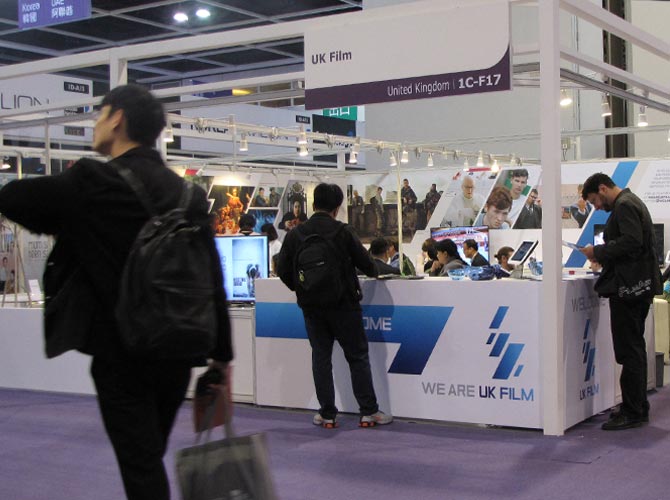
Booths at Filmart. Photo by Keith Barclay.
Keith Barclay is editor of the New Zealand film industry publication Screenz. A sponsored journalist covering Filmart, he offers Wise Kwai's Thai Film Journal tailored coverage of Filmart, the Hong Kong-Asia Film Financing Forum and the Asian Film Awards.

Hong Kong's Filmart wrapped on March 17. With 800 exhibitors and 7,300 registered buyers, the event set a new attendance record on the occasion of its 20th edition. It's a long way from the 75 invited exhibitors who took part in the inaugural 1997 event. Filmart is Asia's largest entertainment market event by some distance. Depending how it's measured, it's one of the world's top three or top five.

Strongly supported over the years by Hong Kong's own production and distribution community, a solid core of Thai distributors has been doing business there for several years. There are also several distributors from elsewhere carrying Thai product as part of a broader offer.

The most prominent Thai distributors at this year's Filmart were Five Star and Mono, each carrying a catalog of the more commercial Thai fare – mostly horrors, comedies and romantic comedies. Mono presented a large amount of its TV product as part of its offer. Both stands were busy during the market.

Five Star had Achira Nokthet's Ghost Ship (มอญซ่อนผี, Mon Son Phee) and Surussavadi Chuarchart's F.Hilaire (ฟ.ฮีแลร์), both released in Thai cinemas last year. Also in Five Star's catalogue, although a little older, was Issara Nadee's 2012 feature 407 Dark Flight. Thailand's first 3D horror feature, it has other Hong Kong connections having been shot by another of Filmart's regular exhibitors, Percy Fung's Hong Kong-based 3D Magic.

Representing the Thai government, the Thailand Film Office was one of a number of film offices from the region looking to attract business, productions looking to shoot in Asian locations or use services in the region. This year, the Thai team had a number of bites at the cherry with two umbrella organisations specializing in film attraction also exhibiting. AFCNet, the Asian organisation formed out of the worldwide International Association of Film Commissioners (AFCI) had a stand, as did Film Asean which, as it says on the box, represents the interests of the 10 member countries of the Association of Southeast Asian Nations. Film Asean arrived in Hong Kong having made a good splash at its launch at the Berlinale's European Film Market in February.

The organization has been in development for four years, and has set both outward and inward-facing goals. In Southeast Asia, Film Asean will offer services including a touring mini-festival to introduce films from other countries in the region to regional audiences. For industry members, it will also support training and upskilling initiatives to help develop each country's own production capability and to better service the (usually more lucrative) inbound productions.

In 2013 Thailand introduced its own initiative to increase awareness of the country's potential and attract more inbound production. In the face of improving incentive schemes offered by other countries' governments, the Thailand International Film Destination Festival focused on promoting international titles shot in Thailand. Over the years, many of those titles have used Thailand to double for another part of Asia – most frequently Vietnam for a spate of Hollywood war films from Casualties of War to The Deer Hunter.

More recent high-profile titles such as The Hangover and Xu Zheng's Lost in Thailand might help drive awareness of what Thailand has to offer but, as neighbor Malaysia has discovered at the Pinewood Iskandar studios, it's not all about the blockbusters. Often the longer-running, lower-profile international titles – especially TV shows – keep people working week in and week out and create better opportunities for developing crew members' skills.

As well as distributors selling product at Filmart, production service companies also promote their services. Thai post-production and visual-effects specialists Yggdrazil and Kantana were both present. While Yggdrazil is probably better known internationally for its work in advertising, Kantana has been well-known in Hong Kong for several years, not least for its work on Wong Kar-Wai's Cannes-premiered 2046.

Other Thai post houses also present in Hong Kong were G2D (the former Technicolor facility in Bangkok) and White Light, which presented prizes at the Hong Kong-Asia Film Financing Forum, which ran alongside Filmart. Sway director Rooth Tang's March April May was among the projects selected for this year's HAF.

Both events form part of the umbrella Hong Kong Entertainment Expo, which draws to a close this weekend with the presentation of the Hong Kong Film Awards and the end of the Hong Kong International Film Festival.

Thai titles playing in this year's HKIFF were Apichatpong Weerasethakul's Cemetery of Splendour, well-travelled since its Cannes premiere 10 months ago, and The Island Funeral by Pimpaka Towira, which won the Best Asian Future Film Award at last year's Tokyo International Film Festival.

Both directors' previous features, Apichatpong's Palme d'Or winner Uncle Boonmee Who Can Recall His Past Lives and Pimpaka's One Night Husband respectively, also played in past editions of the Hong Kong fest.

Filmart (14 – 17 March) ran as part of the Hong Kong Entertainment Expo, along with film financing forum/project market HAF (14 – 16 March), and the Hong Kong International Film Festival (21 March – 4 April).

Tuesday, March 29, 2016

Guest post: Catching up with Rooth Tang at HAF

Rooth Tang on the hunt for backers at HAF. Photo by Keith Barclay.

Keith Barclay is editor of the New Zealand film industry publication Screenz. A sponsored journalist covering Filmart, he offers Wise Kwai's Thai Film Journal tailored coverage of Filmart, the Hong Kong-Asia Film Financing Forum and the Asian Film Awards.

This year’s Hong Kong-Asia Film Financing Forum (HAF) ran in mid-March. From a record-breaking 350+ submissions, 31 projects from 15 countries and regions were selected. Among those 31 was Thai director Rooth Tang's proposed second feature, March April May.

Tang's first feature, Sway, premiered at Toronto in 2014. It had a limited release in Thailand late last year, which the Thai Film Journal reviewed, and later named in its Top 10 Thai films of 2015.

During the events in Hong Kong, Rooth took time out from meeting with potential partners and financiers to talk about his experiences.

The logline for March April May is “Science and spirituality collide when a young woman haunted by hallucinations embarks on a journey to America in the wake of her lover's suicide.”

A story about loss, holding on and letting go, Rooth completed his first draft of the script over a year ago, shortly after the Toronto premiere of Sway. He's spent time since moving it forward, to a point where he considers it “pretty close”. He's storyboarding at present and shared some of those images, although not for publication. The storyboard, Rooth explained, is he preferred tool to work from during a shoot, rather than a script. The script for March April May requires some VFX shots, and storyboarding is helping Tang plan those.

If possible Rooth hopes to reassemble the team he worked with on Sway, partly because Rooth is an admirer of Steven Spielberg's workflow and his commitment to regular team members, partly because he knows what he'll get from people he's worked with before. “It's good to work creatively, and we're a well-oiled machine.”

On a low-budget feature, minimizing risk is a very important part of planning.

Rooth also shared location photos to demonstrate his intentions for the story's color palate, the stark monochrome of a Pennsylvania winter a sharp contrast to the vibrancy of Bangkok streets and the natural warmth of red rock caves in China.

Halfway through the three days of HAF, Rooth had met with several Chinese producers and financiers. While there was interest in his project, there was also quite a lot of discussion about how to marry Tang's vision with China's censorship regulations, particularly around supernatural elements in the story.

There are a number of ways around those regulations, most obviously to create one cut for China and another other territories, so Tang was in no way discouraged. Tang intends March April May's high-concept science-fiction premise to have greater potential for overseas sales than the arthouse-leaning Sway. Also helping drive international interest will be the fact that March April May's story plays out across a number of countries, similar to Sway.

In Thailand as elsewhere, theatrical potential is diminishing for arthouse features. But as one door closes, the Internet opens, and for Sway Tang has sold worldwide online rights excluding Thailand to a video-on-demand platform.

While one Hong Kong project announced a sale during HAF, Tang was more cautious. While some projects at HAF were sharing scripts with potential partners ahead of meetings, Tang planned to share the script for March April May only after HAF closed, and only with the potential partners he was interested in having further discussions with.

Tang moves back and forth between Thailand and the U.S. After HAF, he was heading back to Thailand, taking on editing work to pay the bills as he moves March April May toward production.

The film financing forum HAF (14 – 16 March) ran as part of the Hong Kong Entertainment Expo.

Monday, March 28, 2016

Luang Prabang fest set for December 2-7 with Philippines in the Spotlight

Big crowd for films in the Handicraft Market. LPFF photo.

The dates have been set for the seventh edition of the Luang Prabang Film Festival, which will run from December 2 to 7 in Luang Prabang, the World Heritage Site former royal capital of the Lao PDR. It's a chance to catch up on Southeast Asian films and nothing but Southeast Asian films in a unique and memorable setting.

Francis X Pasion at last year's LPFF.
Photo by Wise Kwai.
This year, the festival plans a Spotlight on the Philippines. The choice is a bittersweet one, since it comes after the death of Filipino director Francis Xavier Pasion, who was at last year's Luang Prabang fest with his well-made and gripping social drama Bwaya (Crocodile). He died on March 6 at age 38, the victim of an apparent heart attack.

Film blogger Oggs Cruz, who serves as the Luang Prabang Film Fest's "Motion Picture Ambassador" for the Philippines, recently reflected on his "final conversation" with Pasion.

The LPFF initiated the Spotlight section last year, devoting a whole day at the festival's daytime venue to Cambodian films. It was a good addition to the festival's regular programming.

"On the back of this great success, LPFF has decided to turn its Spotlight this year to the Philippines. Not only will new works be shown, but a wide-shot perspective on some of the great influences of the past will be included," says the festival's press release. "As one of the region’s most vibrant and prolific industries, this Spotlight on the Philippines will give audiences a lot to talk about."

Programming suggestions come from the Luang Prabang Film Festival's network of "Motion Picture Ambassadors". In addition to Oggs, the others are Sok Visal from Cambodia, Lulu Ratna from Indonesia, Somsanouk Mixay from Laos, Amir Muhammad from Malaysia, Thaiddhi from Myanmar, Aishah Abu Bakar from Singapore, Kong Rithdee from Thailand and Cát Khuê from Vietnam.

They have already submitted their recommendations for this year’s festival, and so the selection process will begin shortly, say the LPFF organizers.

In addition to a line-up of around 30 features, the LPFF will present short films in various venues throughout the historic city, hold industry-focused panel talks and masterclasses and entertain with nightly performances of dance and music.

For more details, check the festival website or Facebook page.

Friday, March 25, 2016

Freelance wins at Bangkok Critics, KCL Awards

Actor Jason Young from F. Hilaire presents the Best Documentary award for The Songs of Rice to producer Pimpaka Towira and director-cinematographer Uruphong Raksasad. Nation photo by Rachanon Intharagsa 

Freelance .. Ham Puay Ham Phak Ham Rak More (ฟรีแลนซ์.. ห้ามป่วย ห้ามพัก ห้ามรักหมอ a.k.a. Heart Attack) is continuing its prize-winning run of Thailand's film and entertainment awards.

On Wednesday, Nawapol Thamrongrattanarit’s hard-working comedy-drama took six prizes in Bangkok Critics Assembly Awards, including Best Film, Director, Actor, Actress and Supporting Actress.

Another major winner was The Blue Hour (Onthakan, อนธการ), It was the leading nominee with 11 nods. The dark gay thriller, which premiered at the Berlin International Film Festival last year and was recently issued on DVD in the U.S., won awards for Best Editing, Production Design and Best Score. And director and co-writer Anucha Boonyawatana was given a special prize, the Young Filmmaker Award.

Uruphong Raksasad repeated his success with his documentary The Songs of Rice (เพลงของข้าว, Pleng Khong Kao). He won Best Documentary and Best Cinematography for his poetic portrait of rice cultivation across Thailand, the same prizes he won at the Subhanahongsa Awards. Producer Pimpaka Towira joined him on stage to collect the acrylic trophy.

And another favorite of Thai critics, P'Chai My Hero a.k.a. How to Win at Checkers (Every Time), picked up one prize, best supporting actor for Thira Chutikul, who played the gay older brother of the movie's 11-year-old lead character. The child star Ingkarat Damrongsakkul had won the supporting actor prize at the Subhanahongsas.

The success for Freelance follows a major haul of Golden Swan trophies at the film industry's Subhanahongsa Awards, where it won eight prizes. Freelance, or rather Heart Attack as its known internationally, has also collected prizes on the film festival circuit, winning the ABC Award for the most entertaining film at the recent Osaka Asian Film Festival. The Nation had more on that.

There's also the Kom Chad Luek Awards, an entertainment kudos ceremony put on for 13 years now by Nation Multimedia and covering film, television and music. It awarded Freelance five prizes – Best Film, Screenplay, Best Supporting Actress, Best Actress and Best Actor. Thira Chutikul of P'Chai My Hero got the supporting actor trophy and bouquet while Anucha and The Blue Hour were upset winners in the Best Director category.

Three winning men at the Critics Awards, from left, Nawapol Thamrongrattanarit and Sunny Suwanmethanon from Freelance and Thira Chutikul of P'Chai My Hero. Nation photo by Rachanon Intharagsa 


  • Best Film: Freelance Ham Puay Ham Phak Ham Rak More (Heart Attack)
  • Best Director: Nawapol Thamrongrattanarit, Freelance
  • Best Actor: Sunny Suwanmethanon, Freelance
  • Best Actress: Davika Hoorne, Freelance
  • Best Supporting Actor: Thira Chutikul, P'Chai My Hero
  • Best Supporting Actress: Violette Wautier, Freelance
  • Best Screenplay: Nawapol Thamrongrattanarit, Freelance
  • Best Editing: Chonlasit Upanigkit and Anuphap Autta, The Blue Hour
  • Best Cinematography: Uruphong Raksasad, Phleng Khong Khao (The Songs of Rice)
  • Best Production Design: Phairot Siriwath and Vitune Tulakorn, The Blue Hour
  • Best Original Score: Chupvit Temnithikul, The Blue Hour
  • Best Song: Sud Sai Ta from The Down
  • Best Documentary: The Songs of Rice
  • Young Filmmaker Award: Anucha Boonyawatana, The Blue Hour
  • Lifetime Achievement Awards: Marasri Israngkool Na Ayuthaya and Sompong Wongrakthai

(Via The Nation)

Tuesday, March 22, 2016

Sixth Salaya Doc to open with The Scala


The Thai Film Archive's sixth annual Salaya International Documentary Film Festival  opens at 1pm on Saturday with The Scala, a 50-minute made-for-TV piece by Thai filmmaker Aditya Assarat, who takes his cameras inside Siam Square's imperiled landmark cinema.

Although the Scala has been threatened with redevelopment plans for years, the latest word is that it will be in business through 2018, and maybe longer. But Aditya seems resigned to a future without the Scala, and is seemingly bidding it farewell.

Here's Aditya's synopsis:

I always like to watch movies at The Scala. It reminds me of my childhood when all the cinemas in Bangkok were standalone cinemas. At the time, I never thought it was anything special. But now that I am older, I have become nostalgic. There are many things about it I wanted to document: the staff, who are all old now, the space, which is very beautiful, and the ideal, of movie-watching as a special event. In a way, The Scala is similar to all of us who persevere, despite the difficulties, to celebrate cinema in the way we remember it to be.

The Scala opened its doors in 1970. It had one thousand seats and every night, they were filled. In those days, going to the movies was something special. The cinema was a place where people got dressed up, went on dates, and fell in love. But today, everything has changed. There is a multiplex in every mall and the young generation watch movies on their phone. But at The Scala, time has stood still. The cinema is still run by many of the same staff who have been there from the beginning. It is now the last remaining standalone cinema left in Bangkok. And soon, its time will come to an end too. 

The Scala will get just one screening during the sixth edition of Salaya Doc.

Screening at the Busan fest last year, The Scala is part of a special Power of Asian Cinema package, co-produced by the Busan International Film Festival and Korean Broadcasting.

Other Salaya Doc programs are Sense and Sensibility, which groups together documentaries by female directors, and the Asean Documentary Competition, which has entries this year from Vietnam, Myanmar, Singapore, the Philippines and Indonesia.

A major highlight is The Memory of Justice, a 1976 film that looked at wartime atrocities, by the Germans in World War II, and by the Americans in Vietnam. Running 278 minutes, the landmark documentary was recently restored and presented at last year’s Toronto International Film Festival.

Another marathon screening will be Homeland: Iraq Year Zero, an award-winning chronicle of everyday life in Iraq before and after the U.S. invasion. It runs 334 minutes and will be presented in its entirety.

The fest is at the Film Archive in Salaya, Nakhon Pathom, from Saturday through Monday, and then from Tuesday shifts over to the Bangkok Art and Culture Center, where it runs through April 3.

The schedule is embedded below. You can state your interest in attending the opening film and ceremony on the Facebook events page. For more details, please check the fest's Facebook page.