Thursday, May 7, 2009

Ananda ready for High Society, Red Eagle and more


After six months of inactivity due to injuries from a motorcycle wreck last November, Ananda Everingham is getting geared up for his next big film projects, High Society, the sophomore feature by Wonderful Town director Aditya Assarat, and the much-anticpated Red Eagle by Wisit Sasanatieng.

Lekha J. Shankar caught up with Ananda at a function in honor of director Ekachai Uekrongtham last night at the Italian ambassador's residence, and the busy actor says High Society and Red Eagle are both expected to start production toward the end of the year.

In the interim, Ananda says he's been interacting with young film students and acting in their thesis films -- so there's some more projects that we'll see Ananda in. He was in last year's student film, Wings of a Blue Angel by "Ong" Tongpong Chantarangkul.

After recent trips to Malaysia, where he promoted the release of Nonzee Nimibutr's Queens of Langkasuka, and Singapore, where he served on the jury of the Singapore International Film Festival, Ananda has more traveling in mind. Here's more from Lekha:

He was also excited about a driving trip he planned, around the country, not on a motorcycle but a motor van, and indulging in his new passion for photography. It’s obvious that after six months of inertia following his accident, the actor is out to make up for all those frustrating indoor moments.

Ananda's played a photographer in at least three films -- 2004's Shutter and last year's Good Morning Luang Prabang and Happy Birthday. His father John Everingham is the legendary photojournalist, and Ananda took to photography himself to document his injuries and recovery after the motorcycle wreck. I'm not on Facebook myself, but I hear he posted some grisly pictures there.

Meanwhile, Aditya's Pop Pictures has news about another Ananda project with the working title of Bui Kem (meaning "salted plum"). It's Aditya's segment of the upcoming Bangkok short-film omnibus being produced by TV Thai.

Here's more details from the Pop Pictures blog:

Bui Kem stars Ananda Everingham and Louis Scott as … Ananda and Louis. Yes, they basically play themselves because Aditya is short on imagination and always writes stories about the people he just had a beer with the night before. Also starring is the lovely Sajee Aphiwong, who also happened to be sitting at the beer table.

Ekachai receives medal of knighthood from Italy


Singapore-based Thai director Ekachai Uekrongtham was awarded the Cavaliere dell’Ordine della Stella della Solidarieta’ Italina award at a function last night in the residence of the Italian Ambassador in Thailand, HE Ignazio di Pace and his wife Helen di Pace.

Lekha J. Shankar was there and she sent this information.

The honor, announced last month, is a third-class Star of Italian Solidarity with the ranking of knight. It comes with a certificate and a medal.

Ekachai, the director of Beautiful Boxer, Pleasure Factory and The Coffin, is the first Thai filmmaker to get this award from the Italian government.

Ekachai's debut feature, 2003's Beautiful Boxer, was much acclaimed in Italy, winning best film prizes at the Milan International Lesbian and Gay Film Festival and the Torino International Gay & Lesbian Film Festival in 2004 and also screening at the Berlin Film Festival's Berlin in Rome (Berlino a Roma) program, the Thai Festival in Rome and the Udine Far East Film Festival in 2005.

Yesterday's function was attended by the director’s family and friends, including his mother, two brothers, as well as his colleagues from the Thai film industry.

Coffin producer Pantham Thongsaeng attended as did Coffin co-star Mamee Nakprasit, with Coffin and Pleasure Factory star Ananda Everingham making a surprise appearance toward the end of the event. Other actors included Beautiful Boxer star Asanee Suwan and another Coffin cast member, the veteran actor Suchao Pongvilai. Bangkok-based composer Bruno Brugnano, who's done the scores for nearly all of Ekachai's features, was also present.

Pantham, who's heading up motif+ (the former Mono Film), is ready to release his company's latest production, Roommate, next month.

Mamee, who stars in the Hollywood-Thai romance Bitter/Sweet, says she's training for her next role -- kickboxing in another Muay Thai movie being planned by Muay Thai Chaiya director Kongkiat Komesiri.

And Lekha has more about Ananda's activities.


Group photo time, from left, Ananda Everingham, Helen di Pace, Ambassador Ignazio di Pace, Ekachai, Suchao Pongvilai, Mamee and Asanee Suwan.

(Top photo by Lekha J Shankar, bottom photo courtesy of Ekachai's office. Thanks Lekha! More photos at Bangkok 1080)

Wednesday, May 6, 2009

Fireball director is telling Bangkok Fable

An ancient curse is deforming a family and the only way to stop it is to find a secret tomb hidden somewhere in Bangkok.

It's Bangkok Fable, the next project by Fireball director Thanakorn Pongsuwan.

Here's the synopsis:

Anek is the last remaining descendent of the Brahmin priesthood. However, he rejected the heritage of the ancient bloodline to become a normal husband and father in present day Bangkok. Out of the blue, a rich woman called Krittiya asks for his help to break a curse that has returned from the distant past. All the women in her family, including the children, are becoming physically deformed. To protect his own family, Anek returns to his childhood home and learns that two hundred years ago a young woman swore revenge on Krittiya's ancestors. His great-great-grandfather sealed the woman's angry spirit in a secret tomb. Anake must solve the puzzles that lead to her resting place in the maze of modern Bangkok, encountering evil spirits and other secrets that had best stay buried.

Hopefully it will be another showcase of Bangkok's gritty underbelly, which Thanakorn has portrayed pretty well in his Muay Thai-basketball combat drama Fireball and his first film, the romantic drama Fake. That's blended with the supernatural, like his thriller Opapatika (Demon Warrior).

Co-writen by Thanakorn, Suthiporn Tabtim and Siwaporn Pongsuwan, it's being produced by Bangkok Film Studio's Sa-ngar Chatchairungruang, and is listed as being "in production" by the Film Catalogue.

The year of Apichatpong comes to Bangkok


The heavy topics of human rights and artistic freedom took center stage on Monday night at the Foreign Correspondents Club of Thailand, where Thai independent filmmaker Apichatpong Weerasethakul came for a screening of Stories on Human Rights. A lively, free-ranging question-and-answer session followed.

Apichatpong's short, Mobile Men, was the third of the 22-film omnibus, which was put together by the United Nations High Commissioner for Human Rights and the European Union in celebration of last year's 60th anniversary of the Universal Declaration on Human Rights.

The shorts were grouped under the six themes of the Declaration: Culture, Development, Dignity and Justice, Environment, Gender and Participation.

It was the first time the filmmaker had seen the complete omnibus, and the first time the whole thing had been screened anywhere in Asia. A resident of Chiang Mai in northern Thailand for the past couple of years, Apichatpong came to Bangkok especially for the screening.

Mobile Men features the filmmaker operating the camera himself, riding in the back of a pickup truck as it speeds down the highway with two other men. One of the men is a taciturn soul, a Thai-Yai man, who points to his Converse canvas shoes and other articles of clothing. Then another man grabs the lens of the camera, and he steals the show -- a guy from Surin in Northeast Thailand who becomes increasingly bold about showing off his tattoos, finally whipping off his shirt, and putting the microphone that had been taped to his chest on his elaborately inked left shoulder while he screams to illustrate how painful getting the tattoo was. But all you can hear is the wind whipping past.

"It was intended for Dignity and Justice," said Apichatpong, who also goes by the nickname Joe. But Mobile Men was seemingly arbitrarily shuffled under the theme of Culture, even if it fits there too.

Apichatpong said he intended to show the beauty, dignity and confidence of migrant workers in Thailand who are subject to repression. Among the issues that Apichatpong said inspired him was a government order that migrant workers from Thailand's neighboring countries are under a curfew, limited from holding gatherings and barred from owning mobile phones.

The notion of making the film in a truck came from Apichatpong's belief that a car is like a moving, autonomous island with no boundaries.

Culture is heavy on Apichatpong's conscience, as he's still smarting from butting heads with censors over his recent feature film Syndromes and a Century. After it played at festivals and in general release in countries around the world, and was cited as one of the best films of 2007 by many critics, in Thailand the film was heavily scrutinized by censors. It was submitted in 2007 and then resubmitted last year, and ultimately the censors ordered that six scenes be removed. For a limited Thailand theatrical release, Apichatpong replaced the six scenes with lengths of scratched black film leader so there would be no mistaking that something's missing.

His battle with the censors highlights the many contradictions in Thai society, which in Apichatpong's case is symbolized by the Culture Ministry's conservative branch -- the cultural watchdogs heavily censoring him and saying his work lacks artistic merit -- and the more freedom-oriented, artistic-minded branch -- the Office of Contemporary Art and Culture, honoring him with a Silpathorn Award for living contemporary artists and providing him with funds to make his films.

The conservatives in the Culture Ministry "don't see culture as something that can grow ... they don't want to accept different ideas ... people with different identities and sexualities have been pushed to the margin."

For Apichatpong, filmmaking is an intensely personal process, but he's edging toward more political commentary.

"I was a yellow shirt," Apichatpong admitted, saying he supported the early political protests that led to a military coup that ousted prime minister Thaksin Shinawatra in 2006. Apichatpong says he's seen things since that have made him change his mind about supporting any of the political protest movements. "Everyone has become a puppet," he said.

"It's time for filmmakers to weigh in," he says. "You cannot avoid the politics."

A new law that covers the handling of film by the government was passed by the military-installed legislative assembly at the end of 2006. Filmmakers had hoped a new law would be a progressive step up from the old censorship regime that had been in place since 1930. But the new law, while it includes Thailand's first-ever motion-picture ratings system -- a positive measure -- it also contains provisions for cutting and banning films. Apichatpong organized protests against the law, but the filmmakers' pleas were ignored.

"Now I am starting to work at the bottom level," he said, "with film students."

But making films with social commentary these days is "very difficult" for Thai filmmakers. Independent filmmakers have to struggle for funding, and often have to make compromises depending on where their financial support comes from.

"You can't make a film critical of the system," he said.

He also addressed yet another contradiction, when one journalist in the audience stood up cited the example of a commercial Thai comedy films that place Buddhist monks in demeaning positions, while Apichatpong's depictions of a monk playing a guitar and monks playing with a flying saucer in Syndromes and a Century were censored.

"It's because I'm an independent filmmaker. Without studio backing, it's a different story," he said, pointing to a bias against indie films and perhaps collusion between the censorship board and the film industry. "I don't know if there's money under the table, but I speculate that's the cause."

"I understand more about why Thai films are so shitty," he quipped.

Apichatpong's latest work, Primitive, has been noted as his most ambitious and most political yet.

The massive multi-platform work includes a video-art installation, short films and a feature. The project stems from Apichatpong's stay in the village of Nabua in northeastern Thailand, a place that was at the epicenter of a brutal purge of communists by the Bangkok government in the 1960s. Apichatpong worked with the youths in the village, trying to help them discover their village's violent past. "We built a spaceship together." One of the short films that's part of the project is Phantoms of Nabua, featuring young men kicking a burning soccer ball around at night in a grass field. A feature film segment is Uncle Boonmee: A Man Who Can Recall His Past Lives, is about a man and his hundreds of years of memories.

He makes films the way he wants to "because I can", given that he's lucky enough to have found backing in Europe. Primitive, for example, is commissioned by the Munich art museum Haus der Kunst, Liverpool's Foundation for Art and Creative Technology and London-based Animate Projects, and produced by Illuminations Films in London and Apichatpong's own Kick the Machine.

The Primitive installation will be in Munich until May 17 and then at FACT in Liverpool from September 25 to November 29.

The exhibitions are part of what producer Keith Griffiths has hailed as "the year of Apichatpong".

It's such a big project, that Apichatpong says he doubts any art gallery in Thailand can afford to mount it. But Bangkokians will not be totally left out of the "Year of Apichatpong" celebration -- he says a mini-Primitive exhibition is being planned for the Soulflower gallery on Silom Road in late August or early September.

Other upcoming projects will firmly root Apichatpong's place in the international art world.

Fans of Japanese cinema will be interested to know that Apichatpong's next project will be a portrait of writer and Japanologist Donald Richie.

And there's a new book out, Apichatpong Weerasethakul, edited by James Quandt and published in English by Filmmuseum Synema Publikationen. It includes a breakdown of Apichatpong's work by Quandt and essays by Benedict Anderson, Mark Cousins, art curator Karen Newman, critics Tony Rayns and Kong Rithdee, actress Tilda Swinton and Apichatpong himself. Reviews are already starting to come in, from the Museum of the Moving Image and film scholar and critic David Bordwell.

It's with the talented actress and cinephile Swinton that Apichatpong is collaborating on yet another project. "We're e-mailing each other," he said, noting that whatever becomes of the collaboration is going to be beautiful and weird.

Tuesday, May 5, 2009

Bitter/Sweet to make Asian premiere as opener of Phuket Film Festival

Bitter/Sweet, the Hollywood-Thai coffee romance that's set in scenic southern Thailand, comes home to make its Asian premiere as the gala opening film of the Phuket Film Festival.

Filmed in nearby Krabi, Bitter/Sweet – an award-winner at the recent WorldFest – stars Kip Pardue as an American coffee buyer who comes to Thailand to check out a crop and at first clashes with but is ultimately captivated by a fiery public-relations executive, played by "Mamee" Napakpapha Nakprasit (Art of the Devil 2 and 3).

The Thai cast also includes "Gof" Akara Amarttayakul, "Tong" Pakkaramai Potranan, Kalorin Nemayothin, Arun Whasadeewong, Viyada Umarin and Sompop Benjatikul.

They're expected to make an appearance at the Phuket fest's opening-night gala.

But there will be some Hollywood names at the fest, among them Adrian Brody, who stars in Cadillac Records, which is billed among the many Asian premieres for the fest.

There's also the Spotlight on Taiwanese Film, which will include the Thailand premiere of the smash-hit romance Cape No. 7, and have many Taiwanese filmmakers and actors hitting the festival.

The Alternative Lifestyle program is back this year, and it includes the Icelandic docudrama about a Filipino "ladyboy" The Amazing Truth About Queen Raquela. And there's a Focus on Women Directors.

The closing film is another local production -- the Anglo-Thai short Wild Chaba, directed by Darren Hill and Nurida Mareh. Shot entirely on Phuket, the 15-minute Thai-language short film is a romance about a man and his love for a girl who gave him a painting of a flower.

Running from June 4 to 11, this year is the sophomore edition for the Phuket Film Festival, which started in 2007 and took a hiatus last year. The fest moves from Patong Beach to Phuket Town, where it'll be screening at the Coliseum Paradise Multiplex.

Says festival director Scott Rosenberg: "This year is nothing like the 2007 edition. Big names, good films, lots of sales-agent interest and some really cool parties."

Check the festival website for the complete lineup (PDF).

Monday, May 4, 2009

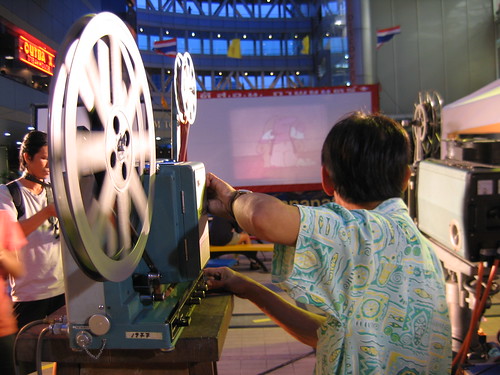
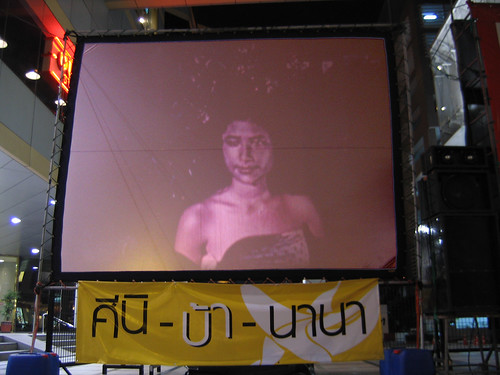
Photo essay: Cine Bananas and Mae Nak Phra Khanong


The past couple of nights have been great for outdoor film screenings in Discovery Plaza at Siam Discovery Center.

For the Cine Bananas show that's part of the Bangkok ... Bananas!! arts festival, the National Film Archive and the Thai Film Foundation have hauled out all their toys, including lots of old movie projectors and short films.


What is it? A small projector is running at the back of this "peep show" box. When the short reel is done, you have to say if you figured out what it was they were showing.


Dubbing artists Suthichai Suthisak, Jirajitr Kanchanapangha and Thongchai Thammasorn performed the soundtrack for Mae Nak Phra Khanong, a 16mm film from 1958. The dubbers perform all the character voices and add such sound effects as gunshots, punches and water splashes.

Suthichai performed all the male roles while Jirajitr performed the female voices, including the titular ghost wife, Mae Nak.


During the reel change Thongchai Thammasorn sold patent medicines. Often, drug companies would tour the Thai countryside and give free outdoor film screenings and give a pitch for their products during the intermission.

The restored van in the background is made up to look like a drug company's movie vehicle.

A drug company showing films was depicted in Pen-ek Ratanaruang's musical comedy Monrak Transistor.


The late Preeya Rungruang starred in Mae Nak Phra Khanong. The story of the ghost wife has often been depicted on film and in Thai television series. Among the most famous films is 1999's Nang Nak by Nonzee Nimibutr. It's even been made into a cartoon.

The ghost's haunting cry of "Mak ... Mak ... Mak ...", tearfully pleading for her husband to not stop loving her, is now an audible memory.

The Cine Bananas film screenings run nightly at Discovery Plaza until May 10. Functions start at around 3.30pm, with peep shows, short animation screenings and displays of old projectors and cameras.

Yongyoot in Udine: Fewer horror films from Thailand

The Udine Far East Film Festival has wrapped up, and on its last day on Saturday, producer-director Yongyoot Thongkongtoon met the press and talked about the three films he was showing there, the horror omnibus 4Bia and Coming Soon and his latest directorial effort, the romantic drama Best of Times (Kwaam Jam San Dtae Rak Chan Yaao).

The Far East Film Festival blog recaps the press meeting, in which Yongyoot talks how about the order of the segments in 4Bia was important. Yongyoot directed the first segment. The others were by younger directors from GTH: Paween Purijitpanya and the Shutter-Alone pair of Banjong Pisanthanakun and Parkpoom Wongpoom.

Yongyoot was among the producers of the horror film, Coming Soon, by the first directorial effort by Alone and Shutter screenwriter Sophon Sakdapisit.

He told the press that there's been a decrease in horror films from Thailand, "due to the fact that both producers and directors are consciously trying to move away from this genre, which, while it has a long tradition, has been overly exploited."

But, I think, as long as it's a well-crafted film -- horror or otherwise -- people will want to watch it.

Yongyoot wasn't the only Thai filmmaker at the Udine fest. Earlier, action-movie directors Panna Rittikrai and Prachya Pinkaew had met the press there.

Nak to make North American premiere in Seattle


The animated feature Nak, with Thailand's most famous ghost refashioned as a magenta-haired kid-friendly heroine, will have its North American premiere at the 35th Seattle International Film Festival, which runs from May 21 to June 14.

(Via Quiet Earth)

Friday, May 1, 2009

Thai teaser poster, synopsis for Pen-ek's Nymph


Pen-ek Ratanaruang has kept his new film Nymph under wraps for as long as possible, playing it close to his chest and letting few details about it leak out to the international press -- maybe a cryptic description of the plot, a few photos to shut people up and a denial/non-denial or two that his movie is a horror film.

But no longer. Nymph (Nang Mai) is premiering at the 62nd Cannes Film Festival, competing in the Un Certain Regard program, which has elevated interest in his film to such a level that nobody can hold back.

So finally there's a teaser poster from Five Star Production promoting the film's July 2 release in Thailand, which I saw on Deknang. And there's an English-language synopsis at the Fortissmo Films website. I only halfway read it and wish I hadn't, so proceed with caution. Some films are better with an air of mystery about them.

A long time ago in an unnamed forest an unfortunate young woman fell prey to two men. Soon after, the lifeless bodies of the two attackers were found floating down the stream nearby. No one knew what happened to the woman, or who or what had saved her life.

May is a city woman who has everything she could ask for. Things are looking stellar: her career is on the rise and her long-time husband, Nop, showers love and attention on her. But fate or desire play tricks on the couple who watches their lives drift by without much thought or reflection, and May starts an affair with Korn, himself a married man.

One day Nop, a professional photographer, is assigned to take a trip into the forest to film its wildlife. He decides to bring his wife along. But the journey slowly reveals how the invisible weight of their urban lifestyle haunts them like a spectre, since May insists on behaving as if she were still in the city. Her sole concerns are her laptop and her phone, and instead of working from the office she now works from the tent in the middle of the jungle.

Nop, meanwhile, treks into the forest to take pictures of wild deer and forgotten cobwebs, and along the way he stumbles into a sad-looking tree, a lonely, mysterious specimen deep in the heart of the jungle. The tree, it seems, is calling out to him, pulling him closer to it, and Nop finds himself spellbound. When her husband fails to return to the tent, May sets out to look for him but only finds his phone, then his sandal.

Only then does she realize how precious their marriage is, and how desperately she needs Nop’s warmth and companionship. Yet when May returns home believing she’s lost her husband, Nop returns. But the forest has changed him into someone else, perhaps forever.

The nymph or nang mai -- a known figure in Thai folklore -- is played by Porntip Papanai. She's appeared in two of Pen-ek's films before -- playing memorably saucy roles in Monrak Transistor and 2007's Ploy. She also had a small role in the recent Fireball. But she's well acquainted with playing a ghost, having portrayed none other than Mae Nak Phra Khanong in De Warrenne Pictures' Ghost of Mae Nak (she's also a regular in De Warrenne films -- watch for her in Soi Cowboy and The Elephant King).

The rest of the cast include "Gybzy" Wanida Temthanaporn from the pop group Girly Berry as May, Nopachai Jayanama (Lord Rachamanu from Naresuan 2) as her husband Nop and NBT anchorman Chamanan Wanwinwet as Korn.

I'm led to understand that Nymph will be dedicated to Pen-ek's late producer Wouter Barendrecht of Fortissimo Films, and in fact the entire official selection of this year's Cannes Film Festival is dedicated to this man who loomed large on the international festival scene.

(Via Deknang)

Watch Apichatpong's Mobile Men and other Stories on Human Rights


Thai indie director Apichatpong Weerasethakul is among the filmmakers and artists who took part in last year's Stories on Human Rights, a 22-segment compilation that was made for the 60th anniversary of the Universal Declaration of Human Rights.

Here's the list of films and their directors:

  • Dangerous Games, Marina Abramovic (Serbia/The Netherlands)
  • A Boy, a Wall and a Donkey, Hany Abu-Assad (Palestine)
  • Lili & Ra, Armagan Ballantyne (New Zeland)
  • The Voice, Sergei Bodrov (Russia)
  • Garish Sun, Charles de Meaux (France)
  • Des films à faire Dominique Gonzalez-Foerster and Ange Leccia
  • Trust, Runa Islam (U.K./ Bangladesh)
  • A Water Tale, Francesco Jodic (Italy)
  • What About Me?, Etgar Keret and Shira Geffen
  • Black Breakfast Jia Zhangke (China)
  • The Crossing, Murali Nair (India)
  • La Mangue, Idrissa Ouedraogo (Burkina Faso)
  • I Drink Your Bathwater, Pipilotti Rist (Switzerland)
  • Voyage, Daniela Thomas (Brazil)
  • The Final Match, Saman Salour (Iran)
  • La Victoire sur les sachets, Sarkis (France)
  • Impasse Bram Schouw (The Netherlands)
  • Glass Ceiling, Teresa Serrano (Mexico)
  • N’Dimagou (Dignity), Abderrahmane Sissako (Mauritania)
  • Sobras, Pablo Trapero (Argentina)
  • Mobile Men, Apichatpong Weerasethakul (Thailand)
  • Participation Jasmila Zbanic (Bosnia)

A book was also compiled as part of the project, containing interviews with the filmmakers, images from the movies and behind-the-scenes photos as well as contributions by 12 authors: Gabriel Garcia Marquez, Khaled Hosseini, Roberto Saviano, Naguib Mafuz, Elfriede Jelinek, Ruth Ozeki, José Saramago, Chimamanda Ngozi Adichie, Assia Djebar, Nuruddin Farah, Toni Morrison and Mo Yan.

The films are divided into six themes, reflecting the six themes of the Declaration: Culture, Development, Dignity and Justice, Environment, Gender and Participation. Apichatpong's short, Mobile Men, is one of the Culture shorts. The 4:08-minute video has two young men riding in the back of a pickup truck as it rolls down the highway.

An initiative of the United Nations High Commissioner for Human Rights, the project was funded by the European Union and curated by Adeline von Furstenburg of ART for the World.

Stories on Human Rights premiered last November in Sao Paulo and has since been shown at many film festivals and special events and broadcast on television worldwide. The shorts are also on YouTube, including Mobile Men, which is embedded below.

But if you're in Bangkok and can wait until Monday, May 4, you can watch all 22 films without having to deal with your computer. It'll be showing at the Foreign Correspondents Club of Thailand. The showtime is 8pm. The screening, the first in Thailand, has been arranged by the European Union, and David Lipman, EU ambassador to Thailand, will serve complimentary wine and snacks.

Apichatpong is expected to be on hand afterward for a Q&A session.